- FCAS could bring about co-development and co-production of military equipment.
- For India, France would represent an alternative to its excessive reliance on Russia or the United States. It would fit New Delhi’s strategy of strategic autonomy.
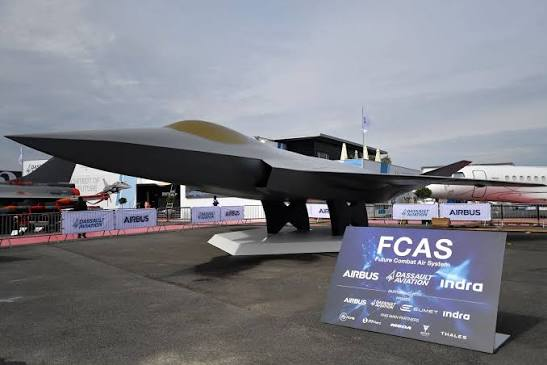
- FCAS represents a system of systems including a sixth-generation manned fighter, remote carriers, drones, sensors, and a combat cloud. Therefore, its importance exceeds that of a single aircraft.
- The initiative by India for an FCAS can be seen as moving from defence procurement to defence collaboration.
India’s efforts to start negotiations for participation in France’s Future Combat Air System (FCAS) reflect a change in India’s defence strategy. This step is taken at a very crucial time for the Indian armed forces, as the country needs additional fighter squadrons right now but also looks towards the future where stealth, artificial intelligence, unmanned technology and networking will be the norm for aerial warfare. In addition to receiving another aircraft, India may gain an opportunity to become a participant in the creation of new-generation combat technologies through joining FCAS.
The Ministry of Defence has reported to Parliament that efforts have been made to “co-join” India with the sixth-generation fighter programme led by the French. But this is still an exploratory step. As for now, no official information has been provided regarding financial, industrial, technological and intellectual property agreements for India to join FCAS.
The most significant feature of the initiative lies in the ability to shift the character of the relationship between India and France in terms of defence cooperation. Traditionally, India has been one of the largest importers of French weaponry, such as the Mirage 2000 and Rafale fighter jets and Scorpène submarines. FCAS could bring about co-development and co-production of military equipment.
This idea can be explained by means of the theory of complex interdependence in international relations, which states that states more and more often create the security relationships not through military alliances but through connected networks of economics, technologies and industries. FCAS cooperation would combine the strengths of French aerospace industry and the Indian manufacturing industry, engineering and potential markets.
For France, India would represent the source of investments, production capacity and one of the key partners in the Indo-Pacific region. For India, France would represent an alternative to its excessive reliance on Russia or the United States. It would fit New Delhi’s strategy of strategic autonomy.
Realism and the China factor
Furthermore, the decision adheres to the principles of structural realism. States eventually desire capabilities which allow them to secure their survival and status in an international order defined by rivalry and uncertainty.
Today, India’s fleet of fighters lacks its full complement of fighters. Simultaneously, China is developing more and more sophisticated aircraft, drones and air defence systems. As such, India needs to think not only about its present need for more fighters but also about the future character of warfare in the 2040s.
FCAS represents a system of systems including a sixth-generation manned fighter, remote carriers, drones, sensors, and a combat cloud. Therefore, its importance exceeds that of a single aircraft. The aim is to develop a networked capability which can communicate, coordinate strikes and operate in a highly contested electromagnetic environment.
According to realist theory, by joining this program, India would enhance its deterrence towards China, making sure that India’s air force will not be several generations technologically behind its main rival.
Strategic Autonomy vs. Dependence
The case of India with regard to FCAS also demonstrates the ongoing dilemma between strategic autonomy and dependence on defence cooperation with one another. The Indian requirement for technology access without being dependent on any external party makes the French approach even more interesting.
In particular, the fact that France traditionally enjoys an autonomous defence industrial policy and has cooperated with India without requiring alliances that are typical of some American projects makes it politically significant.
The partnership allows India to develop its relations with France while at the same time retaining ties with Russia, the United States, Israel and other defence partners.
Nevertheless, strategic autonomy will largely depend on the conditions of the future deal since in the event of Indian companies getting only the right for assembly and component manufacturing and France retaining control over the technology, India might remain a technologically advanced customer rather than a development partner.
The lessons from previous programs
It is important for India not to repeat the mistakes of its previous Indo-Russian program for the Fifth Generation Fighter Aircraft. Issues of workshare, cost, and access to technology were among the reasons why India left that program. These problems may arise in FCAS as well.
In fact, the failure of the previous French-German deal itself shows the difficulties associated with such multinational fighter programs. The disagreements between Dassault Aviation and Airbus regarding leadership, intellectual property, and workshare finally led to the collapse of their fighter program.
Thus, liberalism provides an important response to realism. While institutions and cooperation can generate benefits, this can be done only under a clear set of rules and expectations.
FCAS and India’s AMCA conundrum
India is currently engaged in the development of the Advanced Medium Combat Aircraft (AMCA), its own fifth-generation fighter. On the face of it, involvement in the FCAS programme would seem to conflict with the national programme. In actuality, both programmes could complement each other.
AMCA would give India experience in designing and manufacturing stealth fighters, while FCAS would introduce India to technologies beyond fifth-generation aerospace technology, including manned-unmanned teaming, artificial intelligence, electronic warfare and combat cloud.
But this approach entails the danger of overstretch. India has few monetary, engineering and testing capabilities. Engaging in AMCA, FCAS, and other fighter acquisitions at once may put strains on the defence budget and technical manpower.
Indo-Pacific perspective
FCAS may also come to have geopolitical significance for France. France regards itself as a power in the Indo-Pacific region, while India seeks partnerships in response to changes in the geopolitical balance of the region.
Thus, a partnership between France and India in the sixth generation could come to mean much more than an aerospace partnership. In particular, it would help improve the technological underpinnings of the strategic partnership between France and India.
Ultimately, the initiative by India for an FCAS can be seen as moving from defence procurement to defence collaboration. It can be said that its success would not only depend on whether India gets the sixth-generation fighter jet but whether it gains any technological sovereignty.
There are other things which could address the current problem of a shortage of fighter jets. FCAS is likely to take until the 2040s to provide the operational planes. Strategically, however, the initiative is meant to prepare for the next phase of war.

Anjali Singh is a postgraduate student of Political Science and International Relations, a Social Media Analyst, and a former Research Intern at the Indian Council of World Affairs. Views expressed are the author’s own.
 Aayush Pal
  Piyush Anand