
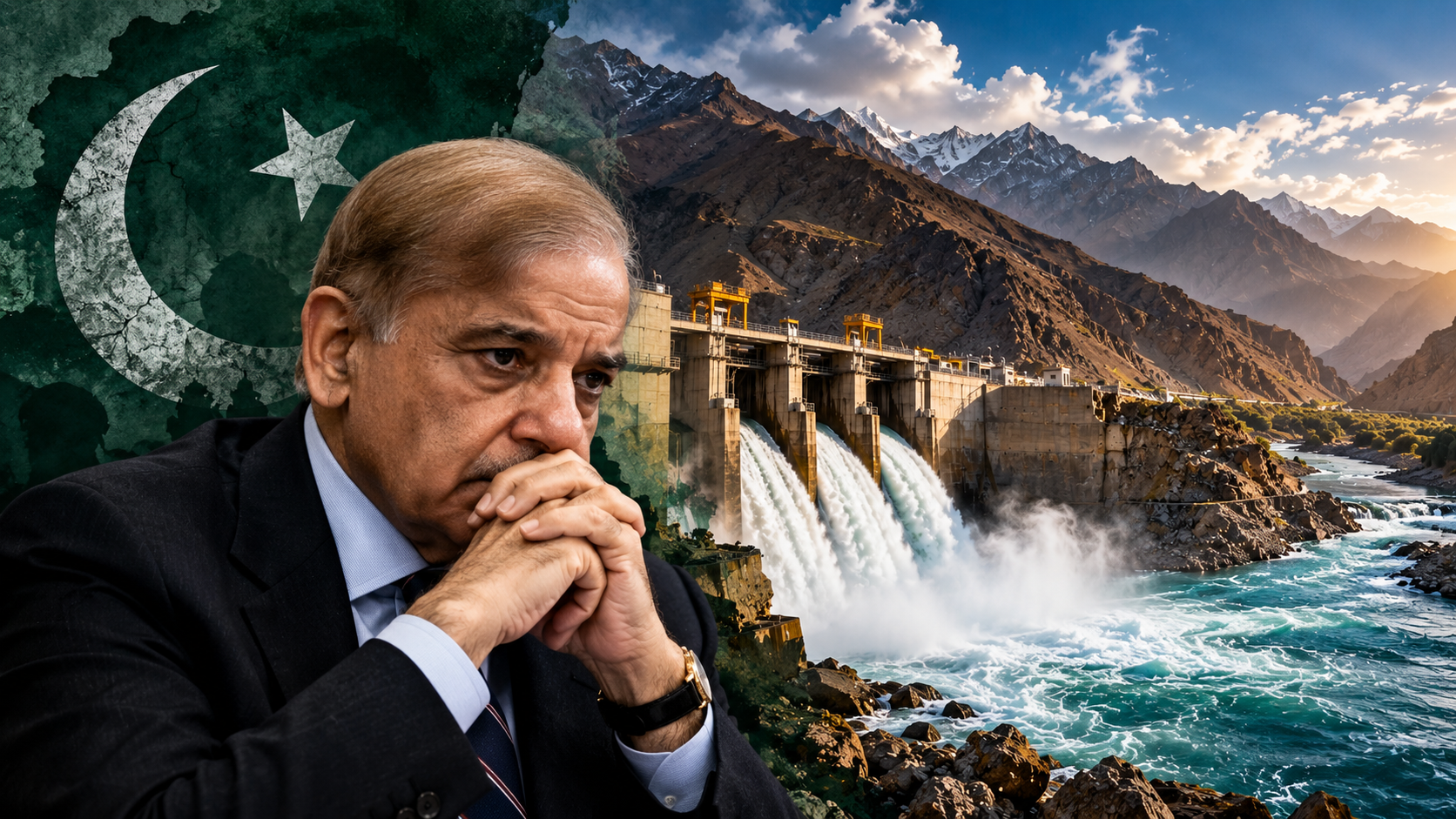
- Pakistan’s leadership has always promoted the notion of Pakistan as a victim of India’s transgression from the country’s inception.
- Pakistan began to portray India as a hydro-hegemon capable of exploiting its upper riparian position to limit Pakistan’s share of water.
- The treaty’s primary goal was to strengthen bilateral cooperation and stability.
- The problem of water-sharing in the Indus River system has also been used to represent India as utilising its upper riparian position to prevent Pakistan from receiving its fair share of water.
- Pakistan benefits from the discourse that portrays it as a victim of India’s hydro-hegemonic position on three levels.
A court of arbitration in The Hague recently ruled that India lacks the authority to unilaterally suspend the Indus Waters Treaty, rejecting New Delhi’s argument for keeping the six-decade-old treaty of water-sharing of the Indus River system in abeyance since April 2025. Following the horrific terror attack in Pahalgam carried out by Pakistan-based terror groups, New Delhi decided to suspend the treaty. The court ruled unanimously that the pact is still in full force and that India is required to comply with it. India contested the judgment, arguing that this court lacks jurisdiction to rule on the Indus Water Treaty. Pakistan hailed the decision as a legal, diplomatic, and moral victory over New Delhi.
This piece does not examine the technical and legal aspects of the Indus Water Treaty or probe the court’s present decision. The article explores the current Indus Water problem by examining Pakistan’s self-imposed victimhood, which aims to blame India, obscure Pakistan’s domestic mismanagement, and attract global attention to its grievances regarding India-Pakistan bilateral disputes. At home and abroad, Pakistan never missed an occasion to portray itself as a victim of New Delhi’s aggressiveness. The problem of water-sharing in the Indus River system has also been used to represent India as utilising its upper riparian position to prevent Pakistan from receiving its fair share of water. It is portrayed as an attempt to destabilise Pakistan by inciting a water and food crisis.
Indus Water Treaty, 1960: A Stabilising Agreement
The division plan for Punjab in 1947 halted the free flow of water in the Indus system, which had previously flowed freely throughout the region. by Punjab’s division plan in 1947. The Indus and its tributaries were now required to obey the India-Pakistan border. The split of the subcontinent disrupted the hydrological system of the Indus River System. Both parts of Punjab rely significantly on the Indus and its tributaries to meet their water and agricultural requirements. In this scenario, both India and Pakistan needed to identify a mutually viable solution.
In this situation, the World Bank volunteered to facilitate the negotiations between the two governments. This mediation proved successful, as India and Pakistan signed the Indus Water Treaty in 1960. The pact granted Pakistan unrestricted access to three western-flowing rivers (the Indus, Jhelum, and Chenab). India was obligated to let the water from these three western rivers flow freely. India was also permitted to use the water from the three eastern rivers (Ravi, Beas, and Sutlej). Uttam Kumar Sinha (2025) suggested that the rivers were separated similarly to how the land was divided in 1947. The separation was viewed as completing the unfinished process of partitioning.
The pact did not preclude India from using water from the west-flowing rivers of the Indus River system, including for hydrological projects. However, these projects must meet the standards of the Indus Water Treaty. Pakistan obtained funding from India and the international community to successfully divert its dependency on hydrological or canal projects from the eastern to the western rivers. The pact also established the ‘Indus Basin Development Fund,’ or ‘Indus Fund.’ The Permanent Indus Commission, a bilateral body comprised of commissioners from India and Pakistan, was also established to strengthen collaboration between the two countries on water sharing. The treaty’s primary goal was to strengthen bilateral cooperation and stability.
The concept of Pakistan’s victimhood politics and its relationship with the Indus Water Treaty (IWT)
Pakistan’s leadership has always promoted the notion of Pakistan as a victim of India’s transgression from the country’s inception. From the Punjab division scheme to the Kashmir crisis, Pakistan’s leadership demonstrated that India and its leaders had put Pakistan down. Even the country’s founder, M.A. Jinnah, stated that India did not accept partition and was determined to dismantle the country. It has been stated that India is pursuing a ‘two-faced foreign policy’: one for the world community, characterised by moral force and accommodation, and the other for Pakistan, characterised by military power and a refusal to compromise. Pakistan’s national discourse is deeply rooted in this worldview, perceiving India as an existential threat.
This thinking also became applicable to the Indus River system dilemma. Pakistan viewed partition’s hydrological legacy as an existential challenge. India controlled the upper portions of the river, while Pakistan heavily depended on the Indus River system. The Indus River system provides 80 percent of the country’s agricultural water needs. Pakistan was concerned that India may obstruct Pakistan’s share of water. In 1948, India blocked the flow of water from the Ferozepur headworks into Pakistan’s canals on technical grounds, heightening Pakistan’s perception of vulnerability. Pakistan began to portray India as a hydro-hegemon capable of exploiting its upper riparian position to limit Pakistan’s share of water.
India’s first prime minister. Nehru believed that the Indus Water Treaty would be a stabilising force for regional peace. However, in Pakistan, the pact is viewed as an ‘unequal arrangement,’ signed under geopolitical pressure. Pakistan was portrayed as an unhappy downstream state, still vulnerable to India’s hydro-hegemony. And India’s present decision to suspend the accord is just another move toward creating a water crisis in order to destabilise or dismantle Pakistan. At the SCO meeting in Bishkek, Pakistan’s Prime Minister Shehbaz Sharif stated that the Indus River is the region’s lifeline. He also stated that Indus water is the red line for Pakistan.
Conclusion
Pakistan benefits from the discourse that portrays it as a victim of India’s hydro-hegemonic position on three levels. First, it assists Pakistan in delegitimising India’s hydrological projects on western rivers; second, it attracts international sympathy and secures international intervention in the Indus River dispute, which India despises; and finally, it allows the Pakistani government to avoid accountability for its mismanagement of Indus River water. It is vital to highlight that violating the treaty does not pose an existential threat to Pakistan. The western rivers are protected by geography, not just by treaty. India could only block Pakistan’s share of water by flooding itself.
True, India has threatened to suspend water supplies or requested a renegotiation, but there is context and legality to the situation. India invoked the treaty’s Article XII (3), which empowers both parties to request a renegotiation. India also requests a renegotiation on three grounds: changing demographics, which has resulted in increased agricultural and residential water needs, accelerated hydropower development as a renewable energy source, and escalating cross-border terrorism in Kashmir. India’s rejection or non-participation in the PCA cannot be interpreted as a veto of the PCA judgment. India must devise a more effective strategy that is not only legally and technically sound but also capable of countering Pakistani propaganda in the world community.

Dr Mohammad Rizwan holds a PhD in political science from Jamia Millia Islamia. His doctoral research focuses on Pakistan’s relations with major global powers. Views expressed are the author’s own.
 Parag Gilada
  Archita Gaur
  Kumar Satish