- As India relentlessly expands its geopolitical footprint, its sporting trajectory from the historic, multi-discipline performance at the Hangzhou Asian Games to securing the 2030 Commonwealth Games, and strategically preparing a bid for the 2036 Olympics, demonstrates a calibrated integration of sport into modern statecraft.
- By breaking into the upper echelons of continental athletic dominance, India projects a compelling narrative of a rising power capable of matching established hegemony.
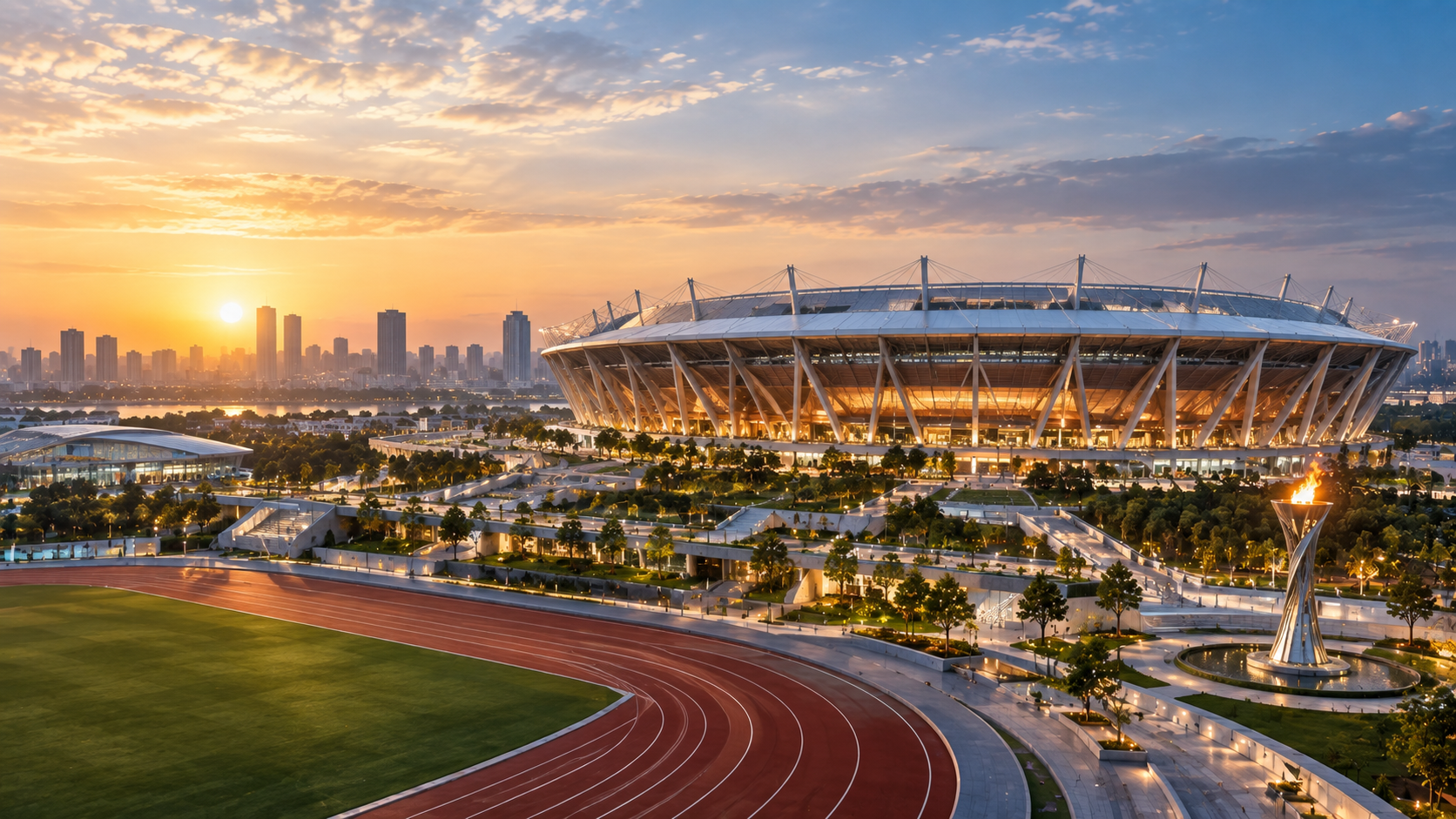
- Hosting the 2030 Games allows India to stress-test its billion-dollar infrastructural investments, most notably the Sardar Vallabhbhai Patel Sports Enclave, under the glare of international scrutiny.
- Securing the Olympic Games is rarely just about sport; it is a formal, irreversible announcement of a nation’s arrival at the very centre of the global order, akin to the reputational transformations achieved by Tokyo in 1964 or Beijing in 2008.
It is a pervasive fallacy to divorce sporting mega-events from the rigorous calculus of high politics. In the realist framework of international relations, sport operates fundamentally as the messenger of politics. As India relentlessly expands its geopolitical footprint, its sporting trajectory from the historic, multi-discipline performance at the Hangzhou Asian Games to securing the 2030 Commonwealth Games, and strategically preparing a bid for the 2036 Olympics, demonstrates a calibrated integration of sport into modern statecraft. The international system relies on continuous, high-visibility signalling. Within this paradigm, the hosting of, and dominating in, mega-events remains the ultimate projection of a state’s soft power currency, economic vitality, and internal cohesion. This is not mere athletic pursuit; it is the calculated projection of national resolve on the global stage.
The Marker of Institutional Maturity
The undeniable link between state capacity and sporting success was rendered visible in India’s unprecedented century of medals at the Hangzhou Asian Games. This milestone was not merely an athletic triumph; it was a highly public demonstration of institutional maturity and bureaucratic course correction.
For decades, India’s sporting narrative relied heavily on isolated, individual brilliance that somehow succeeded despite systemic inertia. However, recent outcomes reflect a deliberate, structural shift in state behaviour. By deploying targeted funding initiatives, importing elite technical expertise, and enforcing the gradual professionalisation of national sporting federations, the state has begun to align athletic performance with its broader national ambition. When athletes ascend the podium in foreign capitals, they act as direct instruments of national power. This newly established on-field credibility provides the essential diplomatic leverage required to transition India from a mere participant in the global order to a formidable, norm-setting host.
Strategic Signalling to the Global South
Beyond domestic cohesion, this athletic resurgence serves a distinct foreign policy objective: signalling leadership to the Global South. Historically, the capacity to consistently harvest medals and host multi-discipline spectacles has been an asymmetry dominated by the West and, more recently, an economically ascendant East Asia.
By breaking into the upper echelons of continental athletic dominance, India projects a compelling narrative of a rising power capable of matching established hegemony. Sport, in this context, acts as an accessible, universally understood metric of comprehensive national power. It communicates state efficiency, demographic dividends, and economic surplus to developing nations far more effectively than traditional diplomatic communiques or policy white papers. It reinforces the image of a nation that can both build domestic prosperity and compete flawlessly in the international arena.
The Rehearsal and the Economic Engine: Amdavad 2030
To secure the ultimate prizes in global sports, a nation must first demonstrate irreproachable organisational competence. The centenary 2030 Commonwealth Games in Ahmedabad serves this precise strategic function. It is not an endpoint, but a rigorous, high-stakes rehearsal.
Mega-events demand the seamless mobilisation of vast state resources, impeccable urban planning, and robust, multi-tiered security apparatuses. Hosting the 2030 Games allows India to stress-test its billion-dollar infrastructural investments, most notably the Sardar Vallabhbhai Patel Sports Enclave, under the glare of international scrutiny. Furthermore, the event acts as a catalyst for a rapidly expanding domestic sports economy. The transition from a state-subsidised athletic model to a commercially viable sports ecosystem requires the very infrastructure, broadcast rights management, and corporate sponsorship frameworks that mega-events compel a host to develop.
Crucially, executing these Games flawlessly provides a mechanism to decisively overwrite the enduring organisational missteps associated with the 2010 Delhi Games. In the theatre of public diplomacy, Amdavad 2030 is engineered to signal to the International Olympic Committee (IOC) that India possesses both the administrative discipline and the financial architecture required for modern event management.
The Diplomatic Prize: The 2036 Olympic Bid
If the Asian Games proved athletic rise and the 2030 event is designed to test organisational capacity, the 2036 Summer Olympics remains the ultimate geopolitical prize. Bidding for the Olympics is, at its core, an exercise in intense diplomatic lobbying, requiring the mobilisation of deep bilateral alliances and transnational economic partnerships. It is a fierce contest for the terrain of the mind.
Securing the Olympic Games is rarely just about sport; it is a formal, irreversible announcement of a nation’s arrival at the very centre of the global order, akin to the reputational transformations achieved by Tokyo in 1964 or Beijing in 2008. By positioning the Ahmedabad-Gandhinagar twin-city model as the anchor for this bid, the state seamlessly merges its domestic urban developmental objectives with its broader foreign policy imperatives.
An Olympic bid forces the acceleration of mass transit, hospitality infrastructure, and technological integration, transforming the host city into a global showcase of Indian state-directed development. It serves as tangible proof to foreign direct investors and sovereign wealth funds that the nation can execute multi-decade, mega-scale urban visions.
Ultimately, while athletes and purists frequently assert that sport and politics do not, or should not, mix, the arena is invariably a theatre for national assertion. The deliberate progression from regional athletic dominance to global hosting represents an incremental, highly calculated expansion of India’s diplomatic footprint.
As New Delhi navigates the complexities of an increasingly multi-polar world order, it has recognised that sport permeates the wider international citizenry in ways traditional statecraft simply cannot. By institutionalising this grand strategy, India is not merely preparing to participate in the global arena; it is actively constructing the physical and diplomatic architecture to host the world. In doing so, it cements its status not just as an emerging market, but as an indispensable power in the twenty-first century.
References
- Nye, J. S. (2004). Soft Power: The Means to Success in World Politics. PublicAffairs.
- Grix, J., & Houlihan, B. (2014). “Sports Mega-Events as Part of a Nation’s Soft Power Strategy.” The British Journal of Politics and International Relations, 16(4), 572–596.
- Grix, J., & Brannagan, P. M. (2024). “Sports Mega-Events as Foreign Policy: Sport Diplomacy, ‘Soft Power,’ and ‘Sportswashing’.” American Behavioral Scientist.
- Collins, S. (2011). “East Asian Olympic Desires: Identity on the Global Stage in the 1964 Tokyo, 1988 Seoul and 2008 Beijing Games.” The International Journal of the History of Sport, 28(16), 2240–2260.
- Ministry of Youth Affairs & Sports, Government of India. (2023). Year End Review of the Department of Sports.
- Ministry of Youth Affairs & Sports, Government of India. (2024). Annual Report 2023–24.
- Government of India. (2025). National Sports Policy 2025.
- Commonwealth Sport. (2025). Amdavad, India Confirmed as Host of the 2030 Centenary Games.
- Press Information Bureau, Government of India. (2021). Sardar Vallabhbhai Patel Sports Enclave, Ahmedabad.
- Ministry of Youth Affairs & Sports, Government of India. (2025). India’s Bid to Host 2036 Olympic Games.
- International Olympic Committee. Olympic Charter / Future Host Commission Framework.
- Comptroller and Auditor General of India. (2011). Report No. 6 of 2011: Performance Audit of XIXth Commonwealth Games.

Parag Gilada is a Master’s student at IISM Mumbai in Sports Management, with a bachelor’s from OP Jindal Global University in Global Affairs, with an interest in Sports Diplomacy and Governance. Views expressed are the author’s own.
 Archita Gaur
  Hridbina Chatterjee
  Divyanka Tandon