
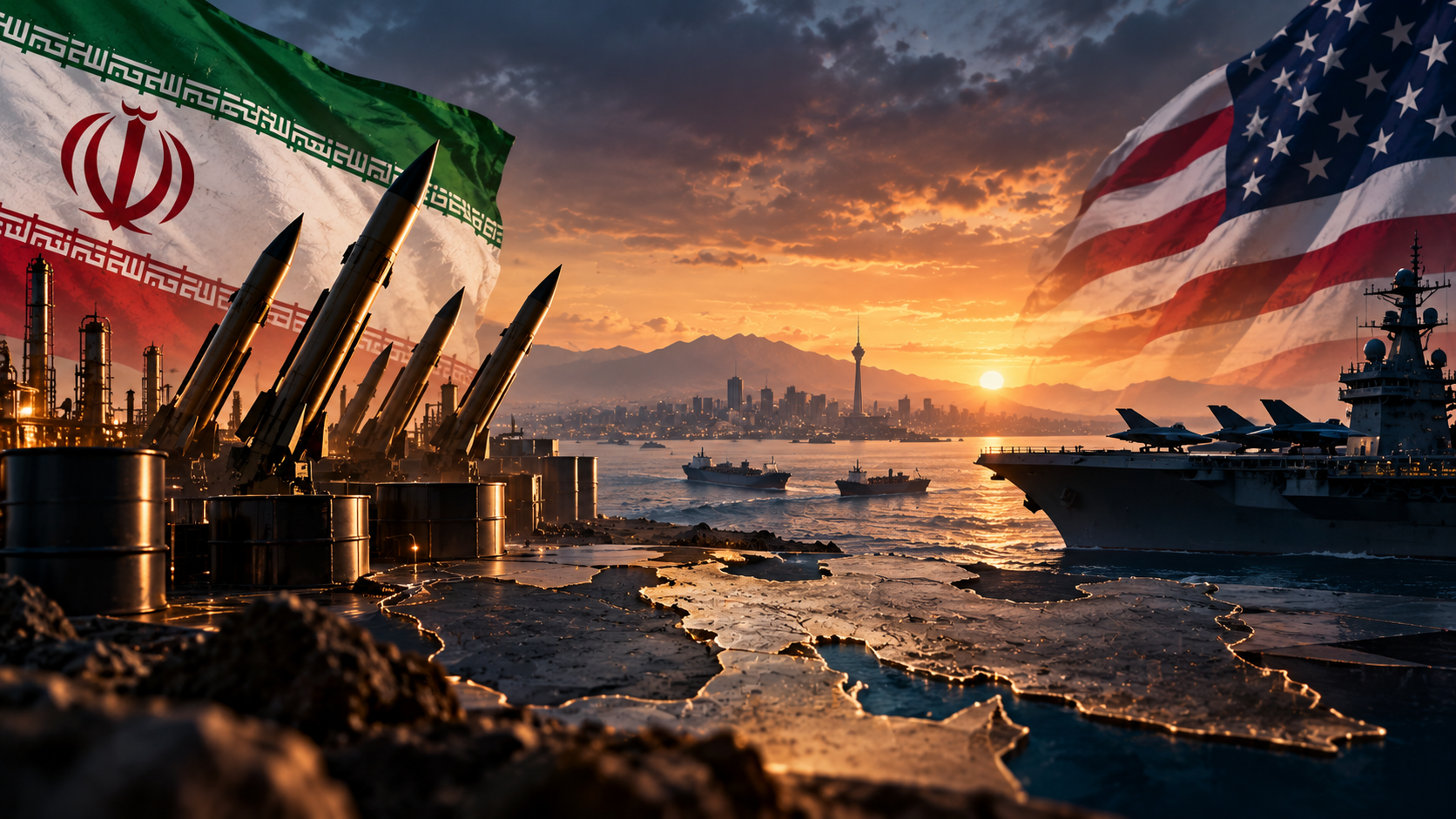
- Iran currently pursues a policy of rivalry with the United States and its regional allies.
- Iran’s national consciousness was filled with paranoia that the outside powers would not tolerate a normal-functioning autonomous Iran.
- The eight-year conflict helped the Islamic world solidify its authority over Iran through a variety of results.
- Iran is leveraging its rivalry with the United States and its allies to achieve its national and foreign policy goals.
At the 81st session of the UN General Assembly, US President Donald Trump stated that he is considering annihilating Iran. The comment by the US president is yet another reference to war to force Tehran to do what Washington and its allies want from Iran. It is vital to highlight that Iran, unlike other normal countries, does not see war as a barrier to nation-building. Instead, Tehran views war or conflict with foes as a tool for state growth. According to Charles Tilly, an American political scientist, ‘war made the state, and the state made the war.’ This means that conflict can assist a state in establishing its legitimacy and monopoly on using coercive force.
The world continues to view Iran and its policies through the lens of religion and the Islamic Revolution. Religion and revolution are no longer the main intellectual means for explaining Iran’s global agenda. Iran continues to use Islam as a tool at both the domestic and global levels, but its goals are secular in nature. Iran currently pursues a policy of rivalry with the United States and its regional allies. Iran’s Vision 2025 claims that the primary goal is to become the region’s leading economic, scientific, and technological force. Tehran sees Washington as the most significant impediment to achieving this objective. Iran sees itself as an inspiration or part of a global movement of opposition to the United States and its policies through the resurgence of anti-colonial values. Iran has formed an “Axis of Resistance” of like-minded militias to oppose the United States and its allies in West Asia. Iran finds security not in religious symbols but in rejecting the United States and destroying its regional partner, Israel.
Iran’s Exceptionalism: Language and Religion.
In his book ‘Iran and Its Loneliness,’ Nodoushan contended that the feeling of exceptionalism is deeply ingrained in Iranian national consciousness. He emphasised that Tehran’s sense of exceptionality is rooted in its language and religion. Iran is the only Shia Muslim country that speaks Persian in a region dominated by Sunni and Arabic speakers. This strategic singularity began with the foundation of the Iranian state by the Safavid monarchy, which ruled the country from 1501 to 1722. The Safavids were responsible for carving out Iranian territory from the ashes of the Abbasid Empire, against the backdrop of the emergence of the Ottoman Empire in the west and the Mughal Empire in the east.
During the early days of the Safavid reign in Iran, Shiism was not the majority religion. To establish a religious separation from the Ottoman kingdom, Safavid monarch Esma’il I pushed and imposed Shiism as the national faith on his subjects. This prompted Iran to embrace Shiism and form an alliance between the king and Shia clergy to preserve Iran as a bastion of pure faith. The monarch was envisioned as the protector of “the Shia domain of Islam” from the Wahhabi aggression that had occurred in the past. This provided legitimacy to the monarchy. The Qajar monarchy also recognised Iran as Shiism’s protected homeland. The clergy took over this responsibility from the monarch during the 1979 revolution.
The Humiliation and Colonisation of Iran
Iran’s sense of exceptionalism is in alignment with its profound anxieties regarding its past. In the beginning of the 19th century, facing expansionist Russian and British empires in India, the Qajar monarchy of Iran ceded more territories and rights to the colonial powers. Following two devastating victories by Russia between 1804 and 1828, Iran lost 10% of its territory to
Russia through the ‘Golestan’ and ‘Turkmanchay’ treaties. These two accords were interpreted as symbols of national humiliation. Similarly, in 1907, an ‘Anglo-Russian Agreement’ was signed, drawing a line across Iran with Russia to the north and Great Britain to the south. The agreement threw the country into further instability and starvation. Iran saw a military coup in 1921, led by Reza Khan, a little-known Iranian military officer. He abolished the Qajar Monarchy and declared himself the new ruler. He formed the national army and expelled Soviet forces from Iran.
This reprieve under Reza Shah came to an end in August 1941 when Soviet and British forces attacked Iran. They deposed Reza Shah and succeeded him with his son, Muhammad Reza Shah. The British seized Iran’s oil provinces of Khuzestan, while the Soviet Union occupied Azerbaijan and Kurdistan. Iran’s humiliation at the hands of colonial powers continued in the 1950s, when Mosaddegh’s popular government decided to nationalise the country’s oil resources. The military coup in 1953 deposed this popular government.
Iran’s national consciousness was filled with paranoia that the outside powers would not tolerate a normal-functioning autonomous Iran. They must safeguard Iran’s sovereignty and territorial integrity by a three-pronged strategy: build a strong centralised state in Iran, grow the country’s economy, and reduce external countries’ influence in the region to a minimum.
Iran-Iraq War (1980-1988): The State Was Shaped by War
The war between Iran and Iraq saw the most trench fighting since World War I, the most tank engagements since World War II, and the most widespread use of chemical weapons in warfare since the Geneva Convention. The conflict had a substantial cost for Iran, with between 200,000 and 2,500 Iranians dead. Iran spent US$160 billion to prosecute this fight, and the cost is expected to be higher. The significant immediate consequence of this battle was that the new regime was forced into survival mode, pursuing three interconnected goals: the survival of the Iranian state and people, the survival of the Islamic Republic, and the survival of the Islamic Revolution.
Beyond that, this battle acted as a means of consolidating Iran’s new regime. Iraq’s unilateral military intervention against Iran strengthened the new regime in the same way that Austria and Prussia’s attack on France solidified the Jacobins in the country. The eight-year conflict helped the Islamic world solidify its authority over Iran through a variety of results. First, the IRGC transitioned from a guerrilla force to an organised fighting force. It emerged as a praetorian guard for the clergy, helping to control security threats from distant lands. Second, the war gave rise to a political elite made up of war veterans who believed they had the right to define Iran’s national and security interests. This class is responsible for anchoring the nation’s security in a wartime mindset that continues to favour those in uniform and loyal to the clergy. Third, this war aided in mobilising popular support for the governing class and establishing a coalition among hardline elements in society. Fourth, the conflict delegitimised or eliminated other factions from society’s mainstream discourse, including communists, socialists, and liberals. This strengthened the influence of Islamic doctrine in Iranian society.
Conclusion: War with the US and its allies
Iran’s animosity toward the United States stems from the 1953 military coup, in which Tehran identified Washington as the primary perpetrator. The US intended a puppet administration in Tehran. This anti-American feeling grew stronger after the Islamic Revolution and the
following Hostage Crisis in 1979. Iran believes that reducing US influence and defeating its regional allies is critical to national security. In his ‘Perpetual Peace,’ German philosopher Immanuel Kant maintained that war would end when the protagonist had exhausted itself through conflict and saw greater value in peace. Iran likewise pursues a security plan in which it exhausts the US and forces it to depart Western Asia. Iran has formed an “Axis of Resistance” against the United States and its regional allies. It supports Islamic movements (both Shia and Sunni) aimed at overthrowing the region’s pro-American dictatorship.
As a result, the battle with the United States will not be a problem for Tehran but rather part of its overall security plan. Iran is leveraging its rivalry with the United States and its allies to achieve its national and foreign policy goals. Iran also portrays its internal problems as a foreign plot to destabilise Iran, and its present battle with the United States has helped the regime cement control over the country. Conflict is not a feasible approach against Iran; instead, it has benefited Tehran.

Dr Mohammad Rizwan holds a PhD in political science from Jamia Millia Islamia. His doctoral research focuses on Pakistan’s relations with major global powers. Views expressed are the author’s own.
 Archita Gaur
  Parag Gilada