
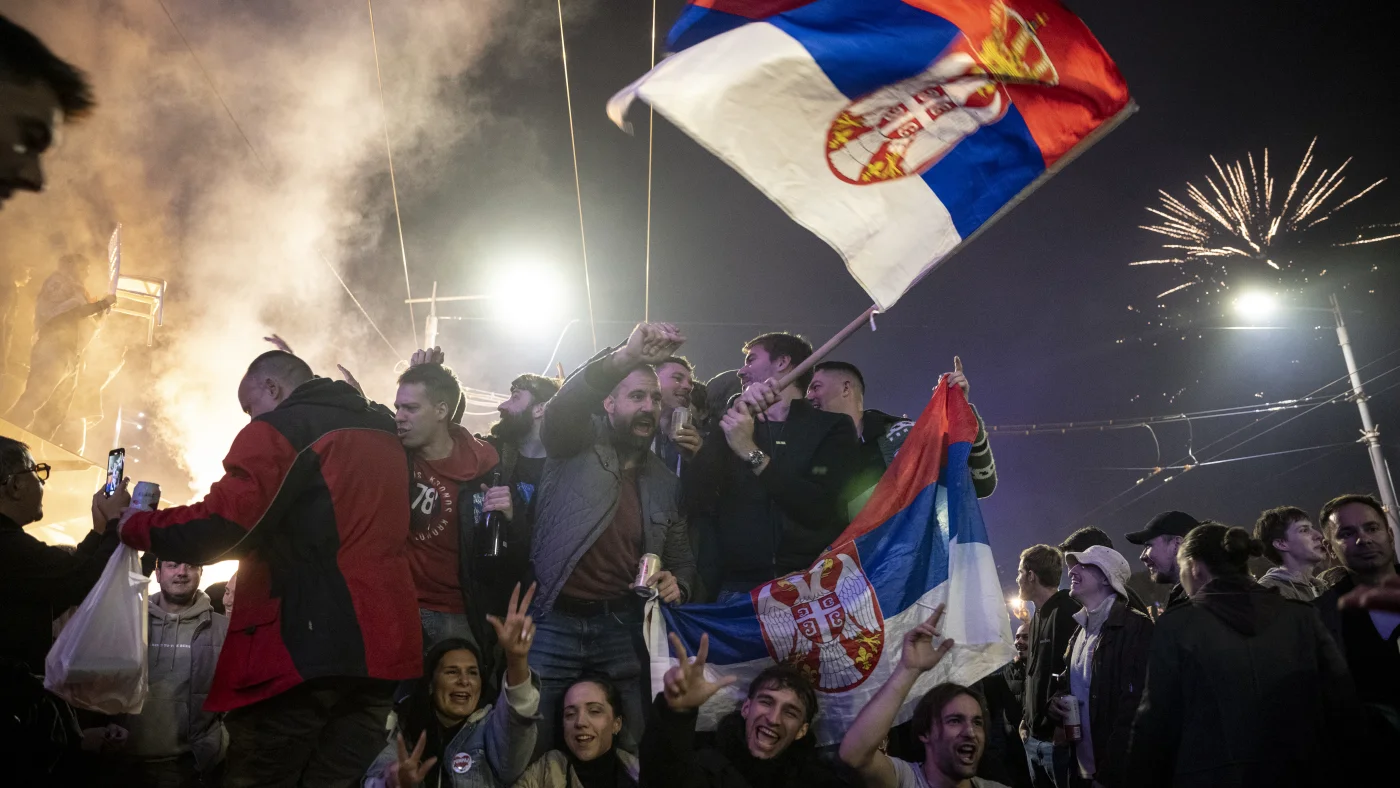
- The student-led movement, organised under the Student List, has emerged as a major political force, signalling a new phase in Serbian politics in which traditional political players face growing challenges from a movement rooted in public protests.
- The snap election, called amid months of student-led demonstrations, saw the Student List secure 138 seats in the 250-member parliament, according to preliminary projections, placing it ahead of the Serbian Progressive Party.
- Serbia has maintained close political and energy ties with Moscow and has resisted joining Western sanctions against Russia following its invasion of Ukraine.
- The defeat of the established political camp marks an important turning point, but the country’s future will depend on whether the new leadership can deliver on its promises while balancing Serbia’s sovereignty, European aspirations and strategic relationships with Russia and China.
In a dramatic political turnaround, Serbia has witnessed a major shift in its political landscape as Aleksandar Vučić, a figure synonymous with Serbian politics for more than a decade, has officially conceded defeat in the parliamentary elections. The result marks a significant setback for the Serbian Progressive Party (SNS), which has dominated the country’s political establishment since 2012. The student-led movement, organised under the Student List, has emerged as a major political force, signalling a new phase in Serbian politics in which traditional political players face growing challenges from a movement rooted in public protests.
The snap election, called amid months of student-led demonstrations, saw the Student List secure 138 seats in the 250-member parliament, according to preliminary projections, placing it ahead of the Serbian Progressive Party. The result has significant implications for Serbia’s political future, raising questions about the durability of the country’s established political order and the ability of a protest movement to translate public support into effective governance.
The origins of the student-led movement can be traced to 1 November 2024, when a concrete canopy collapsed at a railway station in Novi Sad, killing 16 people. The tragedy triggered widespread public anger and student protests, with demonstrators questioning alleged corruption, negligence and failures of governance. What began as demands for accountability gradually developed into a broader movement challenging the incumbent political establishment. Over the following months, demonstrations spread across Serbia, helping the Student List emerge as a prominent voice among citizens demanding greater transparency and institutional accountability.
The Kosovo Question and Serbia’s European Ambitions
For Aleksandar Vučić, the electoral setback comes amid multiple domestic and international challenges. Beyond economic concerns and demands for better governance, Serbia has long faced the challenge of balancing its European ambitions with its relationships with Russia and China. Although the country has pursued European Union membership for years, accession negotiations have remained complicated by concerns over democratic standards, the rule of law and the unresolved status of Kosovo.
Kosovo remains one of the most sensitive issues in Serbian politics. Belgrade continues to regard the territory as part of Serbia, while Kosovo declared independence in 2008 and has gained recognition from numerous countries, including the United States and most EU member states. Brussels has pressed Serbia to normalise relations with Kosovo as part of its European integration process. The issue remains politically contentious within Serbia, where questions of territorial integrity and national sovereignty carry considerable weight. Following the electoral setback, Vučić warned that the incoming political leadership could adopt a more accommodating position towards Kosovo. Whether the Student List will alter Serbia’s existing approach remains to be seen.
Moscow, Beijing and the Geopolitical Balancing Act
Relations with Russia present another significant challenge. Serbia has maintained close political and energy ties with Moscow and has resisted joining Western sanctions against Russia following its invasion of Ukraine. At the same time, Belgrade has faced sustained pressure from the European Union to align more closely with its foreign policy. A change in government could therefore raise questions about whether Serbia will continue its pragmatic approach towards Russian energy imports and diplomatic relations or move towards greater alignment with Brussels.
China’s growing presence in Serbia adds another dimension to this geopolitical balancing act. Chinese investment has expanded across infrastructure, manufacturing and mining, giving Beijing a substantial economic footprint in the country. However, China’s growing influence in the Balkans has also attracted scrutiny from European and American policymakers, particularly amid wider tensions over trade, strategic infrastructure and economic dependence. The incoming leadership will need to determine how to preserve the benefits of foreign investment while strengthening transparency, protecting national interests and maintaining Serbia’s European ambitions.
The Challenge of Turning Protest into Power
Serbia’s political transition therefore carries implications beyond the country’s domestic institutions. The rise of the Student List reflects the ability of a protest movement to challenge an established political order, but electoral success alone will not guarantee lasting reform. The new political leadership will face pressure to address corruption, strengthen accountability and respond to public expectations while navigating difficult economic and geopolitical choices.
Ultimately, the challenge for Serbia’s incoming leadership will be to translate the momentum of the student-led movement into effective governance. The defeat of the established political camp marks an important turning point, but the country’s future will depend on whether the new leadership can deliver on its promises while balancing Serbia’s sovereignty, European aspirations and strategic relationships with Russia and China.

Aayush Pal is a freelance writer on contemporary geopolitical developments. The views expressed in his work are entirely his own.
 Archita Gaur
 Kumar Satish
 Anjali Singh