
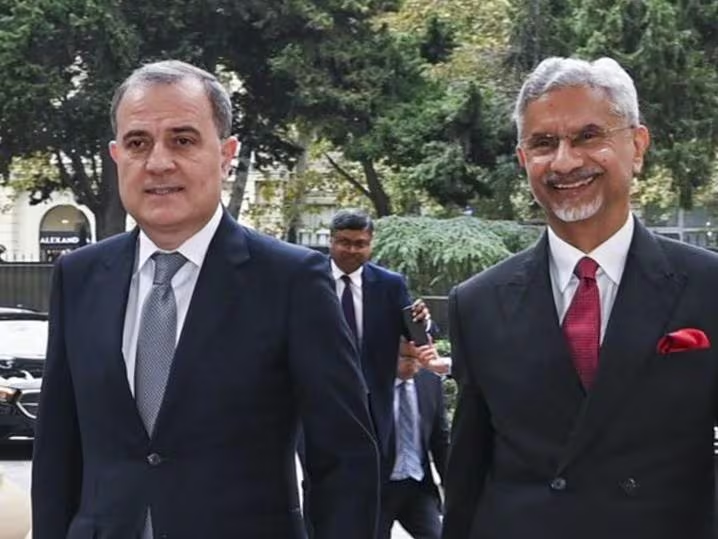
- The visit by Jaishankar to Azerbaijan is thus an important occasion not only from a diplomatic point of view but also as an occasion to enhance economic relations and reconcile political differences through dialogue.
- For India, energy cooperation with Azerbaijan is one of the means of diversifying its energy partners.
- Instead of letting one alliance determine other alliances, India tries to maintain some space for independent decision-making based on the nation’s interests.
- The future success of the relationship would be determined by how both states convert their energy and cultural linkages into more diversified links.
It was on October 23, 2026, that the External Affairs Minister of India, S. Jaishankar, undertook a visit to Azerbaijan. This was during a period when New Delhi was endeavouring to enhance its economic partnerships despite having divergent geopolitical interests in the South Caucasus region. It was the first individual visit by an Indian foreign minister since Sushma Swaraj visited Azerbaijan in 2018.
This followed an informal interaction between Indian Prime Minister Narendra Modi and Azerbaijani President Ilham Aliyev on the periphery of the Shanghai Cooperation Organisation summit held in Bishkek in September. Despite energy being at the heart of their relationship, there were opportunities and challenges in the overall strategic environment.
Energy security and economic interdependence
One of the key aspects of India-Azerbaijan relations is energy cooperation, whereby India’s ONGC Videsh Ltd invested over US$ 1.2 billion in the exploitation of Azeri-Chirag-Gunashli oil and gas deposits and the BTC pipeline. The trade turnover between the two countries was US$ 401 million in 2025, including US$ 226 million in Indian exports and US$ 175 million in imports, mostly oil.
Under the complex interdependence approach, economic connections are ways of pursuing joint interests besides traditional diplomatic relations. Energy cooperation, trade, transport links and tourism offer reasons for both states to keep the relations functional notwithstanding political discrepancies.
For India, energy cooperation with Azerbaijan is one of the means of diversifying its energy partners. For Baku, India can serve as an additional source of investment and a huge consumer market. Nevertheless, India-Azerbaijan economic ties are rather focused on hydrocarbons. Expansion of cooperation in the pharmaceutical industry, machine building, electronics, technologies and other spheres would help establish balance in economic relations.
Strategic autonomy and Armenia-Pakistan factor
India’s relationship with Azerbaijan is intrinsically linked with the geopolitical dynamics of the South Caucasus. India has defence-related connections with Armenia, and Azerbaijan enjoys close ties with Pakistan. The two different alliances have been a cause of concern in India-Azerbaijan relations at certain points in time.
The scenario highlights the concept of strategic autonomy, which is very important in India’s foreign policy. Instead of letting one alliance determine other alliances, India tries to maintain some space for independent decision-making based on the nation’s interests.
According to realism, states strive for security, power and economic gains in a competitive international environment. Consequently, the India-Armenia connection and India’s engagement with Azerbaijan can coexist despite being two separate issues. However, in order to maintain both alliances, diplomatic skills are essential, especially where regional conflicts clash with the interests of partners.
The visit by Jaishankar provides an excellent chance to keep up the conversation without letting any differences overshadow the areas of potential cooperation. The key task for New Delhi is to continue engagement with Baku and maintain other alliances in the region.
Connectivity and Soft Power
Apart from energy, increasing connectivity between the two nations is another aspect that adds dimensions to the bilateral relations. In 2025, India was Azerbaijan’s fourth-largest source of tourists, contributing 166,944 tourists to the nation. The direct flights between Delhi, Mumbai and Baku facilitate tourism, business relations and cultural interactions.
Historical connections can serve as a basis for strengthening ties between the two countries. The Ateshgah Fire Temple located in Baku has inscriptions in Indian scripts. Further, literary works of Nizami Ganjavi and other cultural interactions connected with Indian cinema indicate historical interaction between the two countries.
Using the soft power theory, cultural affinity and people-to-people contacts can help in establishing good relations and enhancing diplomatic ties. Educational cooperation involving training through India’s Indian Technical and Economic Cooperation Programme helps in this respect.
Cultural affinity is not the key to solving strategic differences between the two countries. It helps only in expanding the area of cooperation for policymakers.
Conclusion: Managing Competition through Pragmatic Diplomacy
The Indian foreign policy approach towards Azerbaijan is representative of the larger issue involved in carrying out foreign policy in a region where energy, security, and historic linkages come together. It shows the relevance of realism in terms of strategic considerations, and that of complex interdependence in terms of economic, investment, and social linkages.
The visit by Jaishankar to Azerbaijan is thus an important occasion not only from a diplomatic point of view but also as an occasion to enhance economic relations and reconcile political differences through dialogue. The aim of India would be to increase its presence in the region without compromising on its strategic autonomy. The future success of the relationship would be determined by how both states convert their energy and cultural linkages into more diversified links.

Anjali Singh is a postgraduate student of Political Science and International Relations, a Social Media Analyst, and a former Research Intern at the Indian Council of World Affairs. Views expressed are the author’s own.
 Kumar Satish
 Aayush Pal