
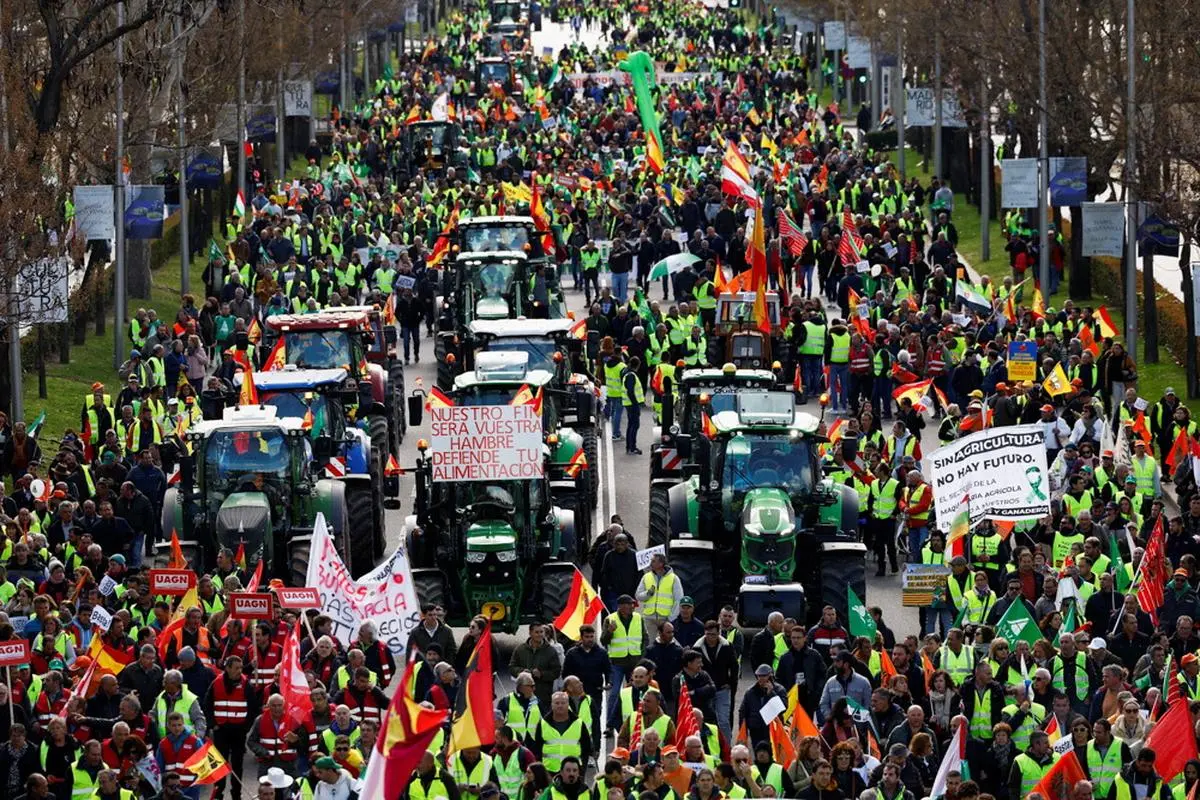
- European farmers’ protests have exposed a fundamental contradiction at the heart of the European Union’s economic strategy: its ambition to expand global trade while protecting the livelihoods of its own agricultural producers.
- They argue that European producers must comply with costly regulations while competing against imports produced under different economic and regulatory conditions.
- This tension highlights a wider geoeconomic challenge: regulation has become more than a domestic policy instrument; it can also influence international competitiveness.
- Ultimately, Europe’s agricultural dilemma illustrates a wider lesson in geoeconomics: strategic autonomy cannot be built solely through external partnerships; it also depends on maintaining the domestic economic resilience necessary to sustain them.
European farmers’ protests have exposed a fundamental contradiction at the heart of the European Union’s economic strategy: its ambition to expand global trade while protecting the livelihoods of its own agricultural producers. From concerns over cheaper imports and rising production costs to opposition against environmental regulations, farmers’ grievances reflect a broader struggle over who bears the costs of Europe’s economic transformation. The debate has acquired renewed significance as the EU pursues trade partnerships, including its proposed agreement with the Mercosur bloc of South American countries, while seeking to strengthen its economic resilience and strategic autonomy. At stake is more than agricultural income. It is the tension between free trade and domestic protection, global competitiveness and rural livelihoods, and the geopolitical ambition to diversify economic partnerships without deepening vulnerabilities at home. Europe’s farmers are therefore not merely protesting agricultural policy; they are bringing a larger geoeconomic dilemma into focus: how can the EU remain an advocate of open markets while ensuring that its own producers are not left carrying a disproportionate share of the costs?
The Economic Pressures Behind the Protests
Combined with these challenges, some of the most common problems facing European farmers include rising input costs, pressure on farm incomes, regulatory requirements and concerns about foreign competition. The costs of fuel, fertilisers, machinery and labour can squeeze profit margins, particularly for smaller farms with limited bargaining power. At the same time, farmers must comply with environmental and food-production standards, which may require additional investment.
A central grievance underlying the farmers’ protests is not necessarily opposition to trade itself, but the perception that European producers face an uneven playing field. They argue that domestic producers must comply with costly regulations while competing against imports produced under different economic and regulatory conditions. This raises a broader question: how should the costs of maintaining high production standards be distributed among producers, consumers and the state?
The EU–Mercosur Agreement: Free Trade Meets Agricultural Protection
These tensions have come into sharper focus with the EU–Mercosur trade agreement. Following more than two decades of negotiations, the agreement was signed on 17 January 2026 between the European Union and the South American Mercosur bloc, comprising Brazil, Argentina, Paraguay and Uruguay. It seeks to expand trade across a combined market of approximately 700 million people. Proponents argue that reducing tariffs could open new markets for European manufacturers while improving access to European consumers for South American agricultural exporters. The agreement also reflects Brussels’ efforts to diversify its trade partnerships amid intensifying economic competition with the United States and China.
However, the agreement that promises new trade opportunities has also generated considerable concern among European farmers. They fear that increased imports of agricultural products from Mercosur countries, including beef, poultry and sugar, could put downward pressure on prices and weaken their competitiveness. These concerns are compounded by differences in production costs, environmental obligations and regulatory requirements across markets. Farmers argue that European producers should not have to bear the costs of stringent domestic requirements while competing against imports that may be cheaper to produce.
The European Commission, however, points to safeguards for sensitive agricultural sectors and maintains that imported food must comply with EU food-safety requirements. The debate therefore extends beyond trade volumes to the question of whether existing safeguards can adequately protect European producers while allowing the EU to pursue the economic benefits of closer trade relations with Mercosur.
The Double Standards Debate: Who Bears the Cost of Regulation?
At the heart of the conflict lies the question of how the regulatory playing field is shaped. European farmers must comply with a range of environmental, animal-welfare and food-safety requirements, as well as regulations governing pesticide use and agricultural practices. These requirements can increase production costs, particularly for smaller farms that have limited resources to invest in new technologies and sustainable practices. Farmers fear that trade liberalisation could put them at a disadvantage if imported products are produced more cheaply or under less stringent production requirements in their countries of origin.
However, food-safety standards differ from production standards, an important distinction in this debate. Agricultural products imported into the European Union must comply with applicable EU food-safety regulations, including limits on pesticide residues. This does not mean that overseas producers must follow every environmental or animal-welfare rule imposed on European farms. Therefore, the central question is not merely whether imports are safe, but whether differences in production requirements place domestic producers at a competitive disadvantage.
For the EU, the challenge is further complicated by its commitment to balancing sustainability with open trade. Introducing additional conditions on imports could help address farmers’ concerns about differences in regulatory requirements. However, such measures could also increase trade costs, complicate negotiations with partner countries and trigger disputes over market access. Conversely, relying on existing food-safety requirements may not address farmers’ concerns about disparities in production costs and regulatory obligations.
This tension highlights a wider geoeconomic challenge: regulation has become more than a domestic policy instrument; it can also influence international competitiveness. The EU must therefore determine how to uphold its environmental ambitions without transferring disproportionate adjustment costs onto its agricultural producers. The credibility of its trade policy will depend partly on whether it can reconcile these objectives through transparent standards, effective enforcement and safeguards that respond to demonstrable economic harm.
Strategic Autonomy and Europe’s Food Security
Behind the headline debate over trade and regulation lies a broader question: what should European economic security look like? Should the EU rely on international markets to secure its food supplies, or should it strive for greater self-sufficiency? Agriculture is more than an economic sector; it supports rural employment, sustains domestic production capacity and strengthens food supply chains. The European Commission has also acknowledged the bloc’s exposure to global market fluctuations and geopolitical disruptions through its dependence on imported agricultural inputs, including fertilisers, animal feed and energy.
This creates a dilemma for European policymakers. Trade agreements can diversify supply sources, strengthen economic partnerships and provide consumers with access to a wider range of products. However, increased import competition can place additional pressure on domestic producers, particularly when their production costs are already high. The challenge for the EU is therefore to pursue greater integration into global markets without undermining the domestic agricultural capacity essential to its long-term food security.
These competing priorities are evident in the EU–Mercosur agreement. While Brussels expects the deal to expand European exports and strengthen commercial ties with South America, it has also introduced safeguards for sensitive agricultural sectors to address the risk of market disruption. Additionally, the EU has proposed a €6.3 billion safety net for farmers under its next long-term budget. These measures reflect an attempt to balance the economic benefits of trade liberalisation with the need to protect vulnerable domestic producers.
Conclusion: Reconciling Free Trade with Agricultural Resilience
Europe’s farmers’ protests reveal that the costs of economic integration cannot be separated from the question of who bears them. The EU’s pursuit of new trade partnerships, stronger global competitiveness and strategic autonomy is understandable in an increasingly uncertain geopolitical environment. However, these ambitions risk losing domestic legitimacy if agricultural producers perceive themselves as disadvantaged by the very policies designed to strengthen Europe’s economic position.
The answer does not lie in abandoning free trade or attempting complete agricultural self-sufficiency. Rather, the EU must strike a balance between maintaining access to international markets and preserving viable domestic production. This requires transparent import standards, effective safeguards against market disruption, targeted support for vulnerable farmers and investment in agricultural productivity. Trade agreements must also be assessed not only by the market access they create, but by how their benefits and adjustment costs are distributed across the economy.
Ultimately, Europe’s agricultural dilemma illustrates a wider lesson in geoeconomics: strategic autonomy cannot be built solely through external partnerships; it also depends on maintaining the domestic economic resilience necessary to sustain them. If the EU cannot reconcile its ambitions for global competitiveness with the livelihoods of its farmers, the resulting tensions will continue to challenge both its trade policy and its broader economic strategy.

Archita Gaur is a postgraduate student at the School of International Studies, JNU. She specialises in the World Economy and has a strong interest in public policy, economic research, and governance. The views expressed are the author’s own.
 Aayush Pal
 Kumar Satish
 Anjali Singh