
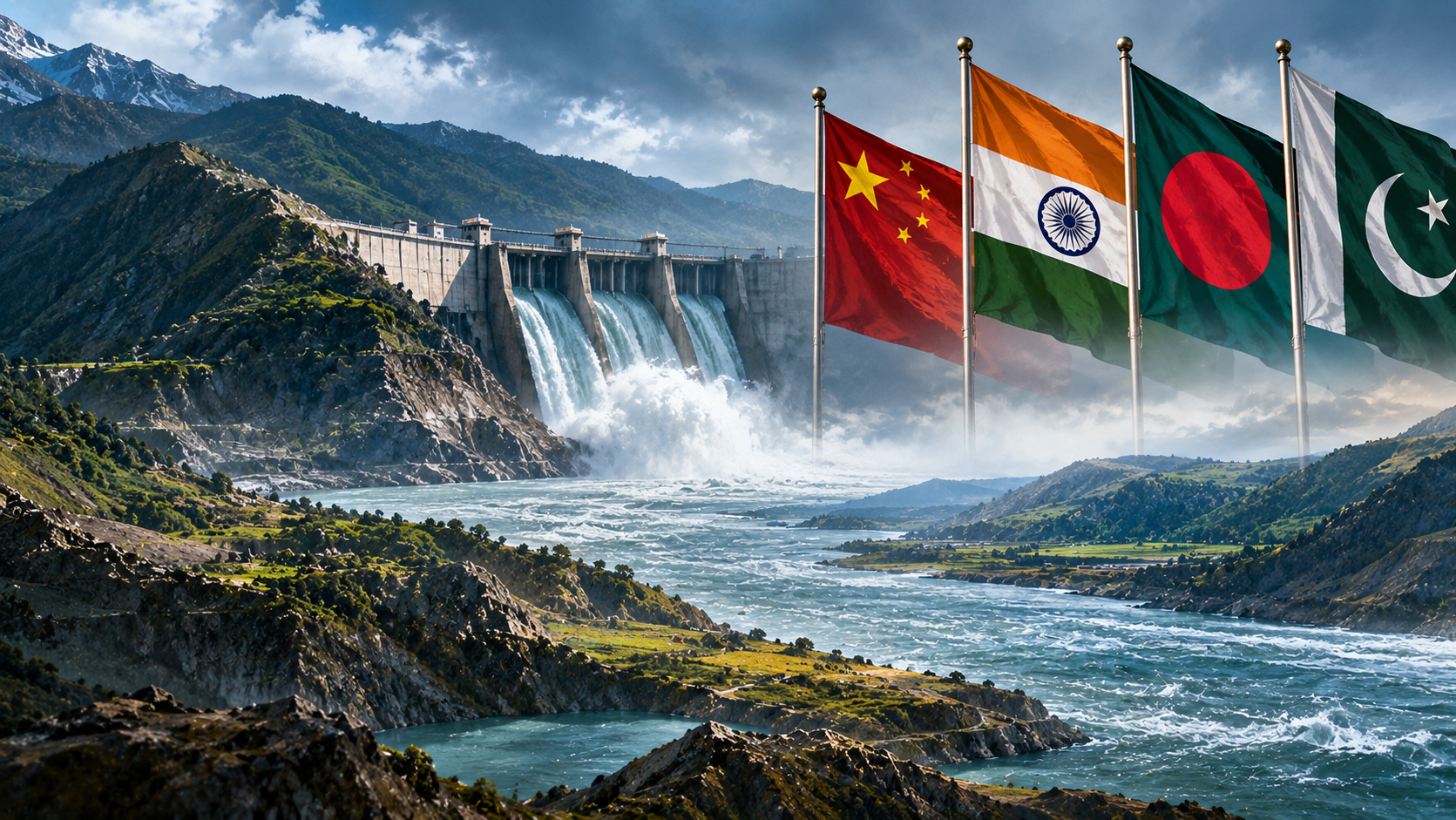
- The challenge is no longer limited to how much water countries receive, but increasingly concerns who controls the infrastructure, information and institutional mechanisms governing its flow.
- The concern is not necessarily that China will permanently divert the river, but that large-scale infrastructure development, coupled with limited transparency, could leave downstream countries vulnerable to decisions over which they have little influence.
- Following the Pahalgam terrorist attack in April 2025, India announced that the treaty would be held in abeyance. This marked a significant departure from an arrangement that had historically maintained a framework for water cooperation despite wider bilateral tensions.
- The future of South Asian water diplomacy will depend not on which country commands the greatest geographical advantage, but on whether regional institutions can turn that interdependence into a basis for cooperation rather than confrontation.
Rivers rarely respect political boundaries, but the politics surrounding them increasingly do. Flowing across national borders, shared river systems connect countries through an intricate web of ecological interdependence, economic necessity and strategic vulnerability. For much of the twentieth century, transboundary rivers were primarily approached as questions of resource allocation, agricultural development and bilateral cooperation. Today, however, their significance extends well beyond these conventional concerns. As climate change intensifies hydrological uncertainty, populations grow, and states expand their hydraulic infrastructure, the management of shared rivers is becoming an increasingly consequential dimension of geopolitical competition.
South Asia offers a particularly revealing illustration of this shift. The region’s major river systems sustain hundreds of millions of people, underpin agricultural economies and shape the developmental priorities of multiple countries. Yet the geographical distribution of these resources creates inherent asymmetries: upstream states possess greater control over the flow of rivers, while downstream countries remain exposed to decisions taken beyond their territorial boundaries. China’s position along the upper reaches of the Brahmaputra, India’s role in the Ganges and Indus river systems, and the complex water-sharing arrangements between India, Bangladesh and Pakistan demonstrate how hydrological interdependence can simultaneously encourage cooperation and generate strategic mistrust.
The challenge is no longer limited to how much water countries receive, but increasingly concerns who controls the infrastructure, information and institutional mechanisms governing its flow. Dams, diversion projects, hydrological data-sharing and treaty arrangements have acquired implications that extend into national security and regional diplomacy. As a result, water is emerging not merely as a shared natural resource, but as a potential instrument of geopolitical leverage. The central question for South Asia is whether existing diplomatic frameworks can accommodate these changing realities, or whether growing asymmetries in control over shared water resources will further complicate an already fragile regional order.
The Geography of Power: Upstream Advantage and Downstream Vulnerability
The geopolitics of transboundary rivers begins with a fundamental geographical asymmetry: upstream countries possess greater influence over the storage, regulation and timing of river flows, while downstream countries remain dependent on decisions taken beyond their territorial boundaries. This creates an imbalance in bargaining power, particularly where rivers sustain agricultural economies, energy generation and large populations. However, geographical advantage does not automatically translate into political control. Its strategic significance depends on infrastructure, institutional arrangements and the ability of states to negotiate mutually acceptable outcomes.
International water law recognises principles such as equitable and reasonable utilisation and the obligation not to cause significant transboundary harm. However, translating these principles into practice can be difficult when national developmental priorities conflict. In South Asia, this tension is particularly visible across the Brahmaputra, Ganges and Indus river systems.
China and the Brahmaputra: The Strategic Implications of Being an Upstream Power
The Brahmaputra illustrates how upstream infrastructure can generate strategic concerns beyond national borders. Originating in Tibet as the Yarlung Tsangpo, the river enters India before flowing into Bangladesh. China’s mega hydropower project near the Great Bend of the Yarlung Tsangpo, construction of which commenced in July 2025, has intensified concerns among downstream countries.
For Beijing, the project represents a significant investment in renewable energy and regional development. For India, however, its scale and location raise questions about downstream water security, ecological disruption and the lack of adequate information-sharing mechanisms. The concern is not necessarily that China will permanently divert the river, but that large-scale infrastructure development, coupled with limited transparency, could leave downstream countries vulnerable to decisions over which they have little influence.
India and China do not have a comprehensive water-sharing treaty governing the Brahmaputra. Their cooperation has instead relied on memoranda of understanding and hydrological data-sharing arrangements. This institutional weakness becomes particularly consequential during periods of extreme rainfall, when timely information is essential for flood preparedness. The Brahmaputra therefore demonstrates that upstream power extends beyond the control of water flows to include access to information and the conditions under which downstream countries prepare for uncertainty.
India and Bangladesh: The Domestic Politics of Shared Rivers
India’s relationship with Bangladesh presents a different dimension of transboundary water politics. Unlike the Brahmaputra dispute with China, where strategic asymmetry is central, water-sharing between India and Bangladesh is complicated by domestic political considerations on both sides.
The 1996 Ganges Water Sharing Treaty established a framework for distributing Ganges waters at Farakka during the dry season. However, the long-standing dispute over the Teesta remains unresolved. Despite repeated negotiations, an agreement has not materialised, partly because water allocation involves competing interests between India’s central government and the state of West Bengal. This illustrates how federal arrangements can constrain foreign policy negotiations, even when bilateral political leadership expresses an interest in cooperation.
For Bangladesh, the issue extends beyond water availability to agricultural livelihoods, river ecology and regional economic security. For India, the challenge is to balance domestic political considerations with the importance of maintaining stable relations with a neighbouring country. The Ganges and Teesta disputes demonstrate that water diplomacy cannot be separated from domestic governance. Bilateral agreements require not only political consensus between national governments but also coordination among the institutions and communities directly affected by them.
The Indus: When Water Meets Strategic Rivalry
The Indus Waters Treaty of 1960 is among the most significant examples of institutional cooperation between adversarial states. Brokered by the World Bank, it established a framework for allocating the waters of the Indus river system between India and Pakistan. Despite wars, diplomatic breakdowns and prolonged political hostility, the treaty largely endured for more than six decades.
However, the relationship between water-sharing and national security has become increasingly contentious. Following the Pahalgam terrorist attack in April 2025, India announced that the treaty would be held in abeyance. This marked a significant departure from an arrangement that had historically maintained a framework for water cooperation despite wider bilateral tensions.
These developments raise a difficult question: to what extent can international agreements survive when political trust collapses? For Pakistan, which is heavily dependent on the Indus basin for agriculture and water security, uncertainty surrounding the treaty carries serious implications. For India, the issue is increasingly framed through the lens of national security, raising questions about the limits of continued cooperation amid persistent cross-border tensions.
The Indus case demonstrates how fragile international institutions can become when water is entangled with wider geopolitical conflicts. It also highlights the risks of treating shared natural resources primarily as instruments of bilateral bargaining.
Climate Change and the Future of Water Diplomacy
These disputes are unfolding against a changing environmental backdrop. Rising temperatures, glacier retreat, increasingly unpredictable rainfall and extreme weather events are altering the hydrological conditions on which existing water-sharing agreements were built. In river systems dependent on Himalayan glaciers and seasonal monsoons, these changes introduce additional uncertainty into water availability and flood patterns.
However, many existing agreements were negotiated around historical river-flow patterns and conventional resource-allocation practices. Their ability to accommodate long-term climatic changes remains limited. This creates a need to move beyond the narrow question of how much water each country receives towards broader cooperation on climate data, flood forecasting, ecological protection and disaster management.
Regional cooperation need not begin with comprehensive new treaties. Even practical arrangements for sharing hydrological information, coordinating emergency responses and consulting affected parties on major infrastructure projects could help reduce mistrust. Such mechanisms are particularly important in South Asia, where political disagreements frequently undermine opportunities for technical cooperation.
Conclusion: From Water Sharing to Water Security
The geopolitics of South Asia’s rivers reflects a broader transformation in how natural resources intersect with national power. The Brahmaputra, Ganges and Indus illustrate different dimensions of this relationship, from upstream strategic advantage and domestic political constraints to the vulnerability of long-standing international agreements.
However, treating water primarily as an instrument of geopolitical leverage risks overlooking the shared vulnerabilities of riparian states. No country can independently manage the ecological, economic and climatic consequences of a river system that crosses multiple national boundaries. As water stress intensifies, the ability to sustain cooperation may become as important as the ability to control infrastructure. Ultimately, the future of South Asian water diplomacy will depend not on which country commands the greatest geographical advantage, but on whether regional institutions can turn that interdependence into a basis for cooperation rather than confrontation.

Archita Gaur is a postgraduate student at the School of International Studies, JNU. She specialises in the World Economy and has a strong interest in public policy, economic research, and governance. The views expressed are the author’s own.
 Aayush Pal
 Anusreeta Dutta