
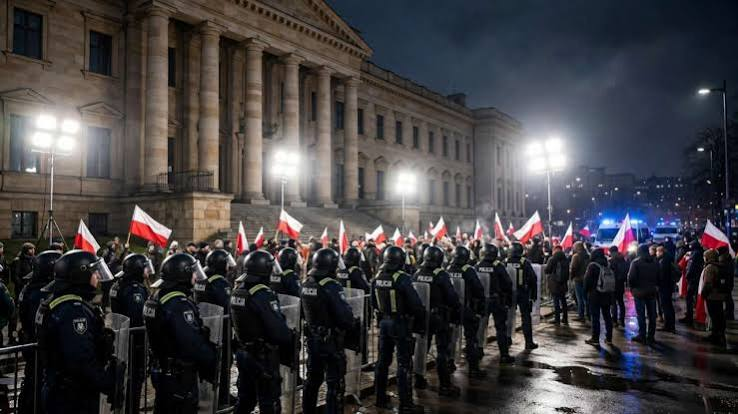
- Poland is witnessing a deepening political crisis as Prime Minister Donald Tusk faces accusations of attempting a coup following the suspension of Constitutional Tribunal President Bogdan Święczkowski.
- The president’s resistance, backed by the opposition, has created a significant judicial deadlock, further deepening political uncertainty and widening the ideological divide within Poland.
- Poland’s political crisis is not simply a domestic struggle over judicial independence, but also a contest over whether the country’s future government will continue to serve as a reliable partner for the European Union’s geopolitical ambitions.
Poland is witnessing a deepening political crisis as Prime Minister Donald Tusk faces accusations of attempting a coup following the suspension of Constitutional Tribunal President Bogdan Święczkowski. In a dramatic development, the controversial political move has triggered a major rift between the government and the principal opposition, with widespread backlash and protests across the country. People have taken to the streets, gathering outside the Constitutional Tribunal in a show of support for its president and demanding that the prime minister withdraw his controversial order.
The official justification provided by Prime Minister Tusk is that the move is intended to establish judicial independence and strengthen the rule of law in the country. However, the principal opposition, the conservative Law and Justice (PiS) party, has vehemently rejected the move, demanding that the prime minister not only withdraw his controversial decision but also step down from his position.
The latest confrontation has created greater political uncertainty in a country already standing at a critical geopolitical juncture. Although the recent development is significant, the underlying divide between the prime minister and the president has been evident for some time. The latest escalation has further intensified Poland’s political crisis.
The Tusk–Nawrocki Confrontation and Judicial Deadlock
Prime Minister Donald Tusk leads the Civic Coalition, a centre-right political alliance, while President Karol Nawrocki, an independent candidate backed by the conservative Law and Justice party, represents a competing political vision. The ideological divide between the two has increasingly translated into institutional confrontation.
President Nawrocki has been blocking new judicial appointments proposed by the prime minister. Tusk’s government, meanwhile, seeks to reverse judicial appointments made during the previous PiS administration, arguing that the reforms introduced by the former government undermined judicial independence.
The president’s resistance, backed by the opposition, has created a significant judicial deadlock, further deepening political uncertainty and widening the ideological divide within Poland.
Poland’s European Identity and the Debate Over Sovereignty
The ideological differences between the two political camps have also shaped their competing visions of Poland’s relationship with the European Union. Prime Minister Tusk is strongly pro-European and seeks to align Poland more closely with European values and the broader aspirations of the European continent. His government has advocated closer integration with the European Union and greater alignment with its institutional and policy frameworks.
This approach has been strongly resisted by the conservative Law and Justice party, which argues that Poland, despite being one of the largest countries in the European Union geographically, must retain its independence in determining domestic and foreign policy.
The opposition has particularly emphasised the need for an independent approach to immigration, border controls, and relations with the European Union. This ideological divide over Poland’s European identity has become a major subject of domestic political debate.
Poland’s Strategic Importance and the Wider Geopolitical Implications
The political unrest comes at a critical moment for Poland’s strategic position in Europe. The country has emerged as one of NATO’s most important members, owing to its geographical location on the eastern flank of the European continent. Since the outbreak of the Russia–Ukraine war, Poland has served as a major logistical gateway for military assistance to Ukraine. A substantial portion of the military assistance transferred from across the Euro-Atlantic region has passed through Polish territory. The country also hosts a significant NATO military presence and remains central to the alliance’s eastern-flank security architecture.
Poland’s strategic importance has also made the direction of its domestic politics a matter of considerable interest to the European Union. From a critical perspective, the EU has a strong strategic interest in ensuring that a pro-European government remains in power in Warsaw, given Poland’s role as a major transit route for military assistance to Ukraine and as a potential first responder in the event of a wider security crisis. Major European powers, including France and Germany, have been among the principal contributors to Ukraine’s war effort, and Poland’s geographical position provides them with critical logistical access and strategic visibility along Europe’s eastern frontier. This raises questions about whether Brussels and its leading member states increasingly view Poland’s political alignment as essential to sustaining their broader Ukraine policy. Critics of deeper European integration argue that an EU-aligned government in Warsaw may be more inclined to approve major European policy initiatives, including continued military and financial support for Ukraine, while limiting resistance to the bloc’s wider strategic priorities. In this interpretation, Poland’s political crisis is not simply a domestic struggle over judicial independence, but also a contest over whether the country’s future government will continue to serve as a reliable partner for the European Union’s geopolitical ambitions.
Given its proximity to Russia and its position along Europe’s eastern frontier, political stability in Poland is not merely a domestic concern but a matter of strategic importance for the European Union and NATO as a whole. The opposition has also accused the prime minister of deliberately creating a constitutional crisis to facilitate Poland’s further integration with the European Union, including the eventual adoption of the euro and the relaxation of border controls, which it argues could intensify migration-related challenges. These competing political narratives have further deepened ideological divisions within Poland, raising questions about the country’s future political and strategic direction.
Judicial Independence and the Crisis of Democratic Institutions
The latest political confrontation has raised fundamental questions about judicial independence and the separation of powers in Poland. Although Poland is a democratic country with constitutional provisions for the separation of powers, the integrity and independence of its judicial, legislative, and executive institutions remain central to its democratic framework.
The ongoing confrontation has intensified concerns over attempts by successive governments to influence judicial appointments and reshape the judiciary in ways that could favour their political interests. The controversy surrounding judicial appointments and executive intervention has not only challenged established democratic principles but has also raised serious questions about the independence of the judiciary.
The crisis in Poland reflects a broader international concern, as governments and legislatures across the world have increasingly sought to influence or constrain judicial authority through political and executive decisions. Ultimately, Poland’s current political crisis raises a fundamental question about the future of its democratic institutions: whether the struggle to restore the rule of law can be pursued without further undermining the independence and legitimacy of the very institutions it seeks to protect.

Aayush Pal is a freelance writer on contemporary geopolitical developments. The views expressed in his work are entirely his own.
 Archita Gaur