
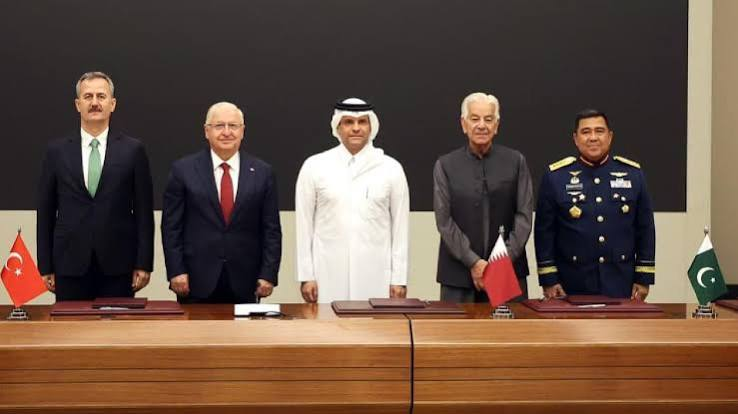
- The memorandum seeks to expand cooperation in technical training, research and development, military production, and the broader defence-industrial sector.
- The Badr Memorandum represents a continuation of Pakistan’s expanding multilateral defence-industrial partnerships since 2026.
- The failure of the Mecca agreement to provide a credible deterrent against Houthi attacks on Saudi Arabia raises fundamental questions about the practical effectiveness of such partnerships.
- The success of the Badr Memorandum will depend not merely on the ambitions of its participating countries, but on their ability to translate political commitments into tangible military-industrial capabilities and credible strategic cooperation.
In a major geopolitical development, Qatar, Indonesia, Türkiye, and Pakistan have signed the Badr Memorandum of Understanding, marking a significant step towards strengthening defence cooperation and fostering a deeper strategic partnership among the participating countries. The memorandum seeks to expand cooperation in technical training, research and development, military production, and the broader defence-industrial sector. One of the most significant aspects of the memorandum is its emphasis on joint production and technology transfer among the participating countries. This represents an important development that could reshape the geopolitical balance of power in the region.
Historically, these four countries have pursued their geopolitical ambitions and strategic aspirations through various partnerships. One of the major common links between them has been their participation in the Organisation of Islamic Cooperation (OIC). As Muslim-majority countries with overlapping interests in regional and international affairs, they have increasingly sought to strengthen their strategic coordination. Considering the changing balance of power in the region, these countries have now elevated their strategic partnership to a new level. The Badr Memorandum represents a continuation of Pakistan’s expanding multilateral defence-industrial partnerships since 2026. Initially, Pakistan signed the Mecca Pact alongside Saudi Arabia and Türkiye, and its subsequent agreement with the participating countries suggests that Islamabad is becoming increasingly involved in regional affairs. More importantly, a noticeable trend has emerged in Pakistan’s growing defence coordination with these countries following Operation Sindoor, during which it suffered significant military and strategic losses in India’s justified response to cross-border aggression. Pakistan’s subsequent efforts to seek strategic support and strengthen defence partnerships with other countries raise questions about the effectiveness of its military capabilities and the strategic consequences of India’s strikes.
Türkiye’s Growing Defence-Industrial Ambitions
The recent agreement presents a significant opportunity for Türkiye, which has witnessed growing international interest in its defence-industrial complex. Ankara has invested heavily in developing its domestic defence industry and has emerged as a major producer and exporter of unmanned aerial vehicles (UAVs), supplying them to several countries, particularly across the Islamic world. Türkiye’s geopolitical ambitions extend beyond becoming a major defence-industrial hub. It also seeks to strengthen its position as a significant strategic player in West Asia. Its growing involvement in regional affairs reflects its broader geopolitical aspirations and its desire to expand its influence. Since the Badr Memorandum explicitly emphasises joint production and technology transfer, Türkiye could use the agreement as an opportunity to expand its defence exports, strengthen industrial partnerships, and develop new markets for its military equipment. Pakistan’s participation could be particularly significant in this regard. Despite its domestic defence-industrial ambitions, Pakistan continues to rely heavily on imported military equipment, particularly from China. During Operation Sindoor, Pakistan was also found using Turkish-origin unmanned aerial vehicles. Under the latest agreement, Pakistan could seek to further expand its UAV arsenal and strengthen its military capabilities. This would create additional market opportunities for Türkiye’s defence manufacturers, allowing Ankara to expand its exports while strengthening its strategic relationship with Islamabad.
Qatar: The Potential Financial Backbone of the Partnership
Qatar’s participation is particularly significant given its financial resources and growing interest in defence-industrial diversification. Doha could potentially emerge as a major financier of joint defence-industrial initiatives among the participating countries. Qatar could invest in the defence-industrial capabilities of these countries, support joint production programmes, and facilitate the development of shared military technologies. For Qatar, the agreement presents an opportunity to diversify its defence-industrial partnerships, strengthen its domestic capabilities, and expand its presence in international defence markets. The country’s growing security concerns and the changing geopolitical environment in West Asia could further encourage Doha to pursue such partnerships. By investing in a broader defence-industrial network, Qatar could seek to strengthen its strategic autonomy and reduce its dependence on a limited number of external suppliers.
Indonesia’s Expanding Defence-Industrial Ambitions
Indonesia’s participation in the agreement is particularly interesting given its geographical position and strategic role in Southeast Asia. Indonesia has historically maintained extensive relationships with both Islamic and non-Islamic countries. Its participation in the Badr Memorandum, however, suggests a growing interest in strengthening its engagement with the wider Islamic world and diversifying its strategic partnerships beyond Southeast Asia. In recent years, Indonesia has increasingly focused on strengthening its military capabilities and developing its domestic defence-industrial sector. The country has witnessed considerable economic progress and is seeking to translate its economic growth into greater military and strategic autonomy. One of Indonesia’s major objectives has been to reduce its dependence on foreign military imports by strengthening domestic manufacturing, research and development, and technology transfer. The Badr Memorandum could provide Indonesia with an opportunity to expand its defence-industrial cooperation, acquire technological expertise, and participate in joint military production programmes. Such cooperation could help Jakarta strengthen its domestic capabilities while diversifying its international defence partnerships.
The Changing Security Environment in West Asia
The Badr Memorandum comes at a particularly critical moment, as the geopolitical dynamics of West Asia have undergone significant changes following the recent war between the United States and Iran. Iran has sought to reshape the regional balance of power through its military capabilities and its network of regional partners. The activities of Iran-aligned groups, particularly the Houthis in Yemen, have created significant security challenges for countries across the region. Qatar has also faced attacks on military installations and critical infrastructure, further highlighting the vulnerabilities of regional states amid escalating tensions. The Houthis’ continued attacks on regional targets have raised serious questions about the effectiveness of existing security arrangements and the ability of individual countries to deter threats. This is where multilateral strategic partnerships become particularly significant. The underlying objective of such arrangements is to involve multiple countries in strengthening defence capabilities, sharing technological expertise, and developing industrial capacities that could provide support during periods of regional instability. However, the effectiveness of these partnerships depends on whether the participating countries are willing and capable of translating their commitments into tangible military and strategic support.
The Effectiveness of the Pact: Questions Over Pakistan’s Strategic Commitments
Despite the ambitious objectives of the Badr Memorandum, several serious questions remain regarding the effectiveness of such defence-industrial partnerships. The Mecca agreement, signed between Saudi Arabia, Türkiye, and Pakistan, has already raised questions about the credibility of collective defence commitments. Following the agreement, Houthi attacks on Saudi Arabia have continued and have targeted major military and critical infrastructure facilities. The agreement was expected to provide a framework for a coordinated response to security threats. However, Türkiye and Pakistan have so far failed to provide credible support that could effectively deter or prevent these attacks. Although Pakistan and Türkiye have deployed military personnel and supplied certain military equipment to Saudi Arabia, these measures have failed to restrict Houthi attacks or eliminate the security vulnerabilities facing the Kingdom. Pakistan’s reluctance to become directly involved in the ongoing conflict has further raised questions about the intentions and practical effectiveness of the agreement. Islamabad’s position that it would not participate in a wider war has highlighted the limitations of its strategic commitments. Similar concerns could emerge regarding the Badr Memorandum, particularly given Pakistan’s already stretched defence capabilities and its growing regional commitments.
Pakistan is currently facing severe domestic security challenges. The activities of the Balochistan Liberation Army (BLA), the Tehreek-e-Taliban Pakistan (TTP), and other militant organisations have created significant security challenges within the country. The Pakistani government has struggled to deliver on its domestic security commitments, while the deteriorating internal security environment continues to place additional pressure on its military and political establishment. Against this backdrop, Pakistan’s growing involvement in West Asian affairs could further complicate its strategic calculations. Its participation in multiple defence-industrial and security partnerships raises questions about whether it possesses the military, economic, and political capacity to fulfil its expanding commitments.
Conclusion: Strategic Ambitions Versus Military Capabilities
The Badr Memorandum reflects the growing ambitions of Pakistan, Türkiye, Qatar, and Indonesia to strengthen their defence-industrial capabilities and establish a more interconnected strategic partnership. For Türkiye, the agreement offers an opportunity to expand its defence exports and strengthen its position as a major military-industrial power. Qatar could emerge as a significant financier of joint defence initiatives, while Indonesia could use the partnership to diversify its military-industrial capabilities and reduce dependence on foreign imports. For Pakistan, however, the agreement presents a more complicated strategic calculation. Islamabad’s expanding involvement in West Asian affairs could provide geopolitical leverage and strengthen its regional influence. Yet its growing commitments come at a time when the country is already facing severe domestic security challenges and significant military and economic constraints. The failure of the Mecca agreement to provide a credible deterrent against Houthi attacks on Saudi Arabia raises fundamental questions about the practical effectiveness of such partnerships. Pakistan’s expanding regional commitments could therefore prove to be a double-edged sword. While they may offer opportunities for greater geopolitical influence, they could also expose the country to additional strategic and security challenges. Ultimately, the success of the Badr Memorandum will depend not merely on the ambitions of its participating countries, but on their ability to translate political commitments into tangible military-industrial capabilities and credible strategic cooperation.

Aayush Pal is a freelance writer on contemporary geopolitical developments. The views expressed in his work are entirely his own.
 Archita Gaur