
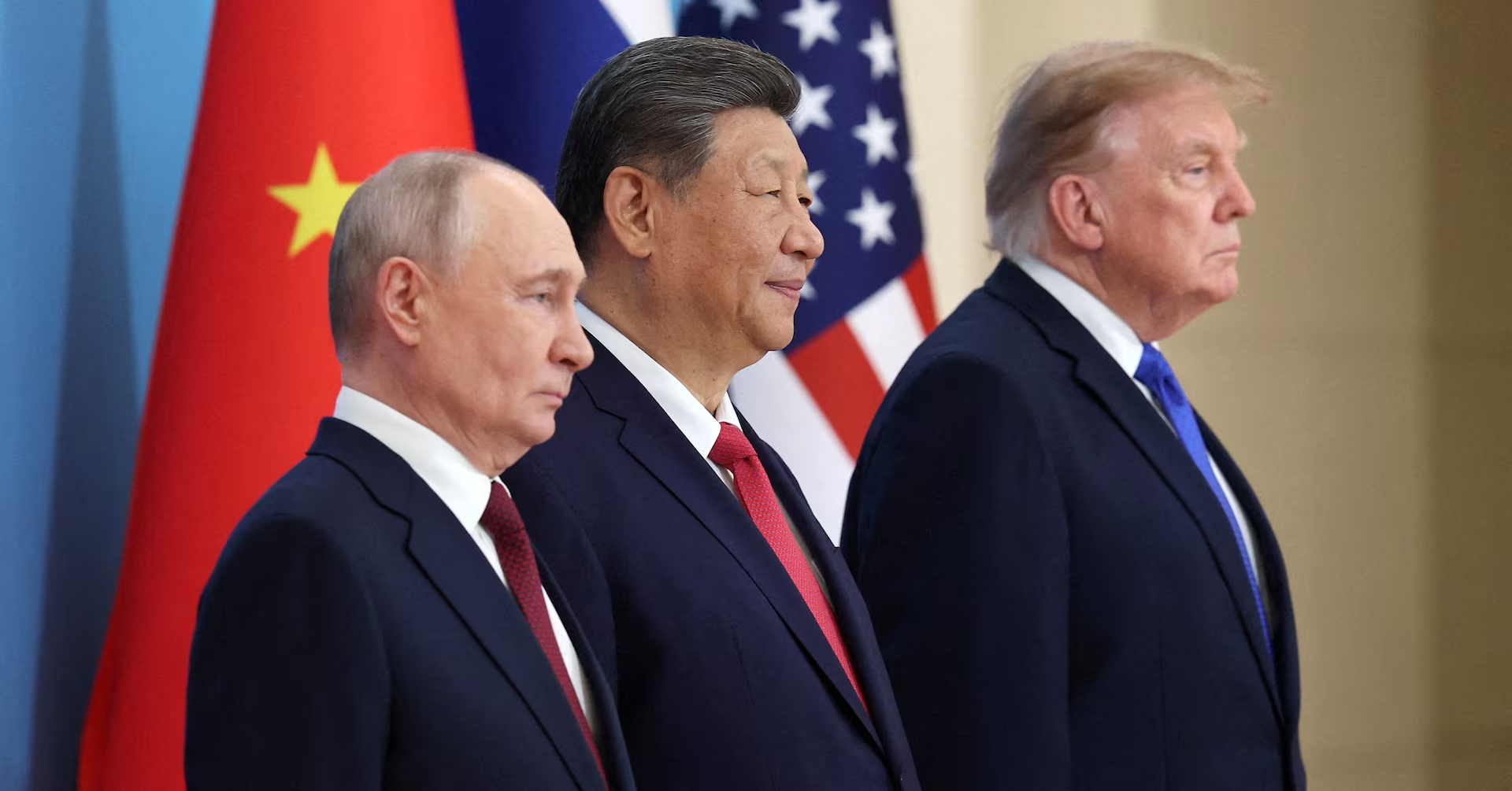
- The first-ever trilateral meeting between the three major powers of the world, the United States, China and Russia, brought together US President Donald Trump, Chinese President Xi Jinping and Russian President Vladimir Putin.
- -Although the trilateral commitment does not establish a new arms-control framework, the willingness of Washington, Moscow and Beijing to discuss nuclear risks together represents an important diplomatic development.
- -The larger question, however, is whether these commitments will translate into meaningful structural changes within the organisation.
- For China, the potential benefits extend beyond the immediate outcomes of the summit. Its larger objective is to maintain its position within the international system while strengthening its economic, technological and geopolitical influence.
In a historic moment, the first-ever trilateral meeting between the three major powers of the world — the United States, China and Russia — brought together US President Donald Trump, Chinese President Xi Jinping and Russian President Vladimir Putin. The meeting took place on the sidelines of the 33rd Asia-Pacific Economic Cooperation (APEC) Economic Leaders’ Meeting in Shenzhen, China, and lasted approximately 90 minutes. The summit attracted considerable global attention, bringing together three leaders whose countries occupy central positions in contemporary geopolitics. More importantly, the meeting took place at a particularly consequential moment, when the international order is increasingly polarised, strategic competition is intensifying, and the contest for global influence is becoming more pronounced. Several important declarations emerged from the summit, covering nuclear security, the reform of the United Nations, global energy security and the jurisdiction of international institutions. Beyond these declarations, discussions surrounding Ukraine and Iran also assumed considerable significance.
Nuclear Risk Reduction: A Shared Commitment Amid Growing Strategic Competition
The first major declaration concerned nuclear risk reduction. The three countries reiterated that a nuclear war cannot be won and must never be fought. They emphasised the importance of preventing nuclear proliferation and reducing the risks associated with nuclear confrontation. This declaration assumes particular significance in the aftermath of the expiration of the New START treaty between Russia and the United States in February 2026. The treaty had provided an important framework for limiting the strategic nuclear arsenals of the two countries. Its expiration has raised concerns about the future of bilateral arms control and the possibility of an unconstrained nuclear competition. The declaration also comes at a time when President Trump, since returning to office, has repeatedly emphasised the need to prevent an escalation of the global nuclear arms race. Although the trilateral commitment does not establish a new arms-control framework, the willingness of Washington, Moscow and Beijing to discuss nuclear risks together represents an important diplomatic development.
Reforming the United Nations: A Bigger Question for the Global South
The second major declaration concerned the reform of the United Nations. This is particularly significant because both Russia and China have consistently argued that the existing international institutional framework does not adequately represent the interests and aspirations of the Global South. Both countries have criticised the perceived Western dominance of international institutions and called for a more representative global governance structure. The United Nations, despite being the principal multilateral organisation, has frequently faced criticism over its inability to respond effectively to contemporary conflicts and the concerns of developing countries. In this context, the trilateral declaration on UN reform carries implications beyond the immediate interests of Russia and China. It raises a broader question about the representation of developing nations and the future of multilateral governance. However, the United States’ participation in this commitment makes the development particularly interesting. Washington has historically been one of the principal architects and supporters of the post-Second World War international institutional order. Yet, under President Trump, the United States has adopted an increasingly critical approach towards several multilateral institutions, including the United Nations. Against the backdrop of growing differences between the Trump administration and the UN, Washington’s willingness to endorse a declaration on institutional reform represents an important diplomatic development. The larger question, however, is whether these commitments will translate into meaningful structural changes within the organisation.
Global Energy Security: A Shared Strategic Interest
The third major declaration concerned global energy security, particularly the production and supply of refined petroleum products and the broader stability of international energy markets. This assumes considerable significance amid contemporary geopolitical conflicts, particularly the confrontation involving Iran and the disruptions to energy transportation through the Strait of Hormuz. The security of critical maritime routes has become an increasingly important concern for countries dependent on uninterrupted energy supplies. For the United States, energy security has both economic and political implications. Disruptions in global energy markets can translate into higher domestic fuel prices, placing additional pressure on consumers and the broader economy. Rising gasoline prices have also remained a politically sensitive issue for the Trump administration and the Republican Party. For China, the stakes are equally significant, although its strategic concerns are somewhat different. As one of the world’s largest energy consumers, China remains heavily dependent on stable international energy supplies. Any prolonged disruption in the Middle East, particularly involving Iran, could have implications for its energy requirements and industrial production. Russia, meanwhile, faces a different set of challenges. The ongoing Ukraine war has seen repeated Ukrainian attacks on Russian energy infrastructure, particularly petroleum refineries. These attacks have affected Russia’s energy production and raised concerns about the security of its domestic energy infrastructure. President Trump has repeatedly urged both Moscow and Kyiv to avoid targeting energy infrastructure. Washington has also explored energy-related arrangements with Moscow, reflecting the importance of maintaining stable energy supplies. Consequently, the declaration on energy security represents an area of overlapping interests for all three countries. While their individual motivations differ, maintaining stable energy production, refining capacity and international supplies remains a shared strategic priority.
International Criminal Court: Sovereignty Versus International Jurisdiction\
Another important outcome of the summit concerned the International Criminal Court (ICC) and the jurisdiction of international judicial institutions. The three countries expressed their opposition to what they described as the excessive exercise of jurisdiction by the ICC and emphasised the importance of state sovereignty and immunity for government officials. This is particularly interesting in the context of the United States, which has repeatedly criticised the ICC and questioned its jurisdiction over American officials. President Trump has also taken a critical position towards the institution.
Ukraine: Can Washington and Moscow Find Common Ground?
Beyond the formal declarations, one of the most consequential subjects discussed during the summit was the ongoing Russia-Ukraine war. Both President Trump and President Putin acknowledged that Ukraine featured in their discussions. This assumes considerable importance given that the conflict has remained one of the most significant sources of confrontation between Russia and the Western world. Moscow has repeatedly emphasised that any settlement must address its stated security concerns. Russia has sought assurances against Ukraine joining NATO and has demanded restrictions on Ukraine’s military capabilities, alongside other territorial and political conditions. For Washington, engagement with Moscow remains particularly important. The United States has been one of Ukraine’s principal sources of military, financial and intelligence assistance throughout the conflict. Consequently, any meaningful diplomatic effort to end the war requires considerable engagement between Washington and Moscow. Russia, for its part, appears interested in reaching an understanding with the United States that could improve bilateral relations and address its broader security concerns. Moscow’s approach also involves presenting areas of potential cooperation to Washington while seeking a settlement on terms favourable to its strategic interests. China’s involvement adds another dimension to these discussions. Beijing and Moscow have developed increasingly close strategic and economic relations, and developments affecting Russia’s security environment also have implications for China’s broader geopolitical interests. A potential improvement in US-Russia relations could therefore have consequences extending beyond Europe. It could reshape the strategic environment in which China operates and influence the broader balance of power between Washington, Moscow and Beijing. For the United States, the challenge lies in pursuing diplomatic engagement without compromising its existing strategic commitments and security interests in Europe and the Indo-Pacific. However, despite the discussions, the summit did not produce a concrete ceasefire agreement or a new framework for resolving the Ukraine war. The question of whether these discussions can translate into a sustainable settlement remains open.
Iran: The Other Major Geopolitical Question
Another important subject in the broader discussions was the conflict involving Iran, which has remained a major point of contention for the United States. The issue carries considerable strategic importance for all three countries, although their interests differ substantially. For China, Iran represents an important energy partner. Maintaining access to Iranian energy supplies and ensuring stability across the wider Middle East remain important considerations for Beijing. Russia, meanwhile, shares significant strategic interests with Tehran. Both countries have developed close political and security relations, and instability involving Iran could have wider implications for Moscow’s regional interests. For Washington, the situation is considerably different. The Trump administration has maintained a firm position against Iran acquiring nuclear weapons and has sought to limit Tehran’s regional influence. This creates an interesting diplomatic contradiction. While Washington seeks to constrain Iran’s nuclear ambitions and regional activities, both Moscow and Beijing maintain important relationships with Tehran. President Trump indicated that both Xi Jinping and Putin shared the view that Iran should not acquire nuclear weapons. However, agreement on preventing nuclear proliferation does not necessarily translate into agreement on how Iran should be approached. The central challenge for the three countries, therefore, is to identify common ground on Iran’s nuclear ambitions while navigating their competing regional interests. Any broader understanding between Washington, Moscow and Beijing could have considerable implications for the future of the Middle East.
China: The Potential Beneficiary of the Trilateral Engagement?
An important question emerging from the summit is which of the three countries stands to gain the most from this diplomatic engagement. China arguably has considerable strategic interests at stake. First, any improvement in relations between Washington and Beijing could benefit China’s long-term economic and technological ambitions. Beijing is attempting to strengthen its position in critical industries, particularly semiconductors and artificial intelligence, where access to technology, international markets and strategic cooperation remains important. Second, China has established itself as a central manufacturing hub in the global economy. Stable economic relations with the United States are therefore important for its industrial ambitions and international trade. Third, by bringing Washington and Moscow together, Beijing has an opportunity to strengthen its diplomatic positioning. Acting as a host and facilitator of dialogue between the two countries allows China to demonstrate its ability to engage with competing global powers. This diplomatic positioning could help Beijing maintain its strategic relationships with Moscow while pursuing a more stable relationship with Washington. For China, therefore, the potential benefits extend beyond the immediate outcomes of the summit. Its larger objective is to maintain its position within the international system while strengthening its economic, technological and geopolitical influence. Nevertheless, the summit does not necessarily indicate that the three countries have overcome their underlying strategic differences. Their competing interests, particularly in the Indo-Pacific, Europe and the global economic system, remain substantial.
The Yalta Comparison: Is the World Witnessing Another Moment of Great-Power Diplomacy?
Several observers may be tempted to compare this historic trilateral meeting with the 1945 Yalta Conference, where Soviet leader Joseph Stalin, US President Franklin D. Roosevelt and British Prime Minister Winston Churchill met to discuss the post-Second World War settlement. The Yalta Conference played an important role in shaping the post-war international order, including discussions surrounding the future of Europe and the establishment of the United Nations. The Shenzhen meeting, similarly, brought together three major powers whose decisions have considerable implications for global security, economic stability and international governance.

Aayush Pal is a freelance writer on contemporary geopolitical developments. The views expressed in his work are entirely his own.
 Anjali Singh
 Niranjan Kadam