
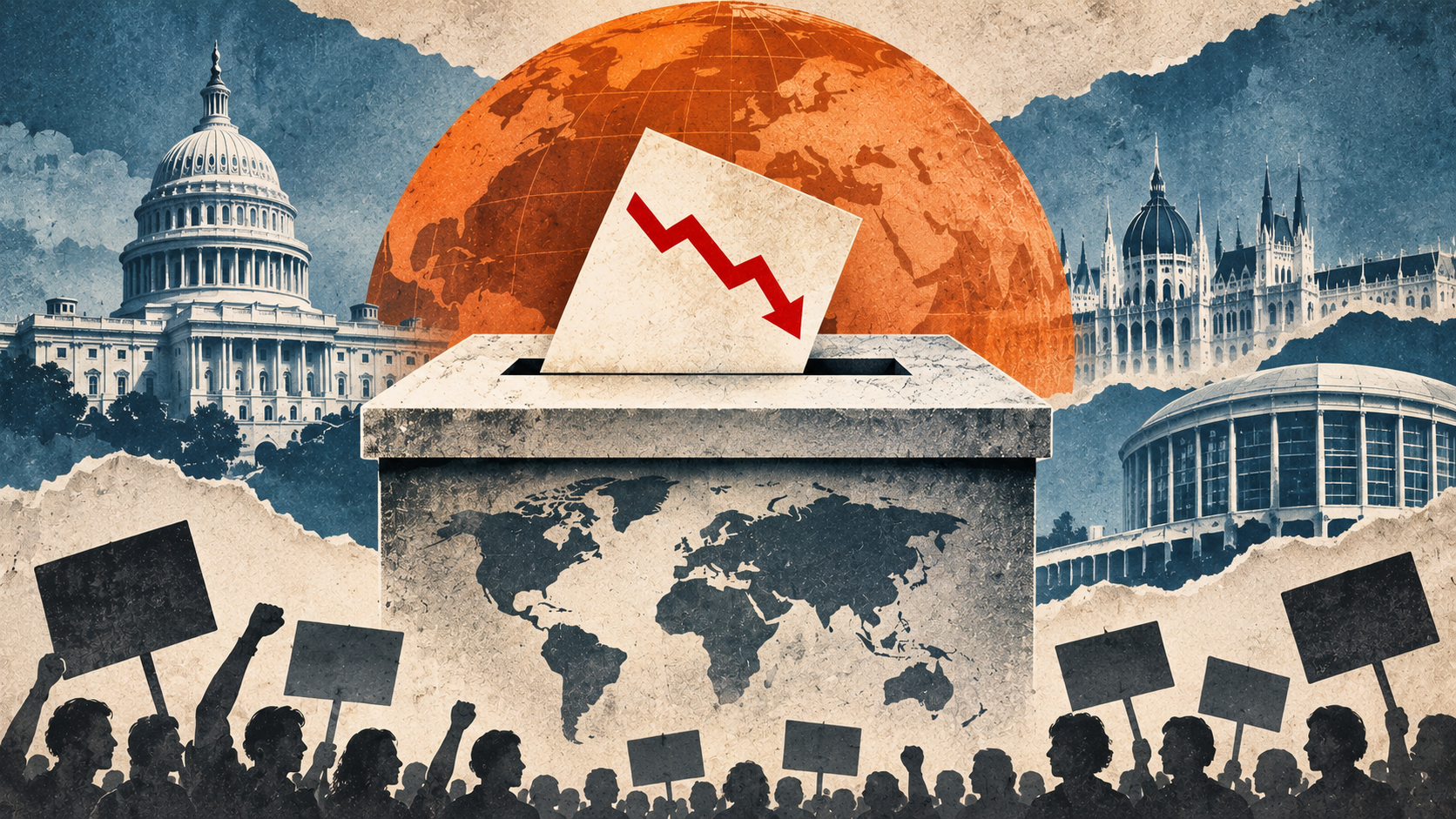
- The electoral appeal and public support enjoyed by several far-right movements appear to be weakening, with a series of electoral setbacks raising questions about their future.
- The fundamental problem with this political approach is that movements which initially gain public support by challenging established institutions can gradually become increasingly dependent on the concentration of power themselves.
- Another major reason behind the declining electoral fortunes of right-wing populist movements is their inability to translate ambitious electoral promises into tangible outcomes.
- What is increasingly evident, however, is that the public mandate enjoyed by these movements is no longer beyond question.
Across the world, the far right has increasingly moved towards the centre of global politics, characterised by charismatic personalities, revolutionary promises and sweeping electoral victories. For over a decade, right-wing populism has been gaining ground, whether through the rise of Donald Trump in the United States in 2016 or Viktor Orbán’s prolonged dominance in Hungary. However, something interesting has been unfolding lately. The electoral appeal and public support enjoyed by several far-right movements appear to be weakening, with a series of electoral setbacks raising questions about their future.
This trend was evident in the defeat of Hungarian Prime Minister Viktor Orbán, who was strongly endorsed by President Trump and widely regarded as one of his closest ideological allies in Europe, often described as the ‘European Trump’. Similar setbacks have emerged for right-wing political forces in Serbia and Brazil, alongside the Republican Party’s losses in the US midterm elections. These developments raise a fundamental question: Has the far right started losing its grip on global politics?
The Anti-Establishment Promise and the Paradox of Power
To understand this changing political landscape, it is important to examine the factors behind the rise of far-right politics over the last decade. Several political observers have argued that the systematic rise of right-wing populism was largely driven by its anti-establishment appeal. This was particularly visible during the 2016 US presidential election, when Donald Trump positioned himself as an outsider challenging the traditional political establishment. He promised sweeping reforms and portrayed himself as an alternative to a leadership that he described as globalist, liberal and interventionist.
However, the interesting contradiction is that once these leaders assumed power, they increasingly became the establishment they had initially promised to challenge. This was evident during Trump’s presidency, when his administration not only struggled to fulfil several of its electoral promises but also increasingly came into confrontation with independent institutions and voices questioning its decisions. His repeated clashes with the Supreme Court, opposition leadership, media organisations and other independent institutions became a defining feature of his administration. Critics of his political approach were frequently portrayed as adversaries of the country rather than legitimate voices within a democratic system.
A similar pattern could be observed in Hungary under Viktor Orbán. Having promised to protect Hungarian sovereignty against the influence of the European Union, restrict immigration and defend traditional cultural values, Orbán gradually presided over a system characterised by the concentration of political power and growing concerns about institutional independence. Brazil witnessed similar tensions during Jair Bolsonaro’s presidency, particularly through his confrontations with the Supreme Court and his questioning of public-health institutions and COVID-19 vaccination policies.
The fundamental problem with this political approach is that movements which initially gain public support by challenging established institutions can gradually become increasingly dependent on the concentration of power themselves. When leaders begin treating democratic institutions, opposition parties and independent voices as obstacles to their authority, they risk alienating voters who initially supported them in the expectation of political reform.
The Failure to Deliver on Revolutionary Promises
Another major reason behind the declining electoral fortunes of right-wing populist movements is their inability to translate ambitious electoral promises into tangible outcomes. These leaders often come to power promising revolutionary economic reforms, stronger governance, lower living costs and a decisive transformation of the existing political system. However, once in government, the gap between their promises and actual performance becomes increasingly visible.
Serbia provides an important example. President Aleksandar Vučić built his political appeal around economic development, infrastructure expansion, anti-corruption commitments and improving living standards. However, allegations surrounding corruption and state-linked infrastructure projects became an important source of public dissatisfaction. The collapse of the railway station canopy in Novi Sad in November 2024, which killed 16 people, triggered widespread protests and student-led mobilisation against alleged corruption and government negligence. This movement became a significant challenge to Vučić’s political establishment.
Hungary offers another example. Under Orbán, the country faced persistent economic difficulties, elevated inflation and concerns about the deterioration of public services and infrastructure. The inability to translate years of political dominance into satisfactory economic and administrative outcomes became an important factor in the growing public dissatisfaction with his government.
The United States presents a particularly significant example of this contradiction. During his 2024 presidential campaign, Trump promised an America First agenda, an end to foreign wars and a renewed focus on domestic priorities. However, during his second administration, the United States became involved in a war with Iran, while concerns over the domestic economic situation, inflation and the cost of living continued to affect public confidence. This illustrates how the gap between electoral rhetoric and governing realities can become a significant political liability.
Economic Nationalism, Protectionism and the Question of Accountability
Another major challenge confronting far-right politics has been its reliance on protectionist economic policies. Several right-wing populist movements have promoted economic nationalism, arguing that restricting foreign competition and prioritising domestic industries would strengthen their national economies. However, the interconnected nature of the global economy makes economic isolation and protectionism considerably more complicated than political rhetoric suggests.
Trump’s tariff policies, Orbán’s economic approach and the protectionist tendencies associated with Bolsonaro’s government illustrate different dimensions of this debate. Modern economies depend on international trade, foreign investment, supply chains and economic cooperation. Consequently, policies that create trade restrictions or uncertainty can generate additional economic pressures, affecting businesses, consumers and domestic industries.
The fundamental contradiction is that while these leaders promise economic independence, their policies can create vulnerabilities in economies that remain deeply connected to international markets. Economic nationalism may offer considerable political appeal, but its long-term sustainability depends on whether it can deliver tangible improvements in productivity, employment and household purchasing power.
Another significant factor contributing to the declining public confidence in these movements is the growing perception of political and financial influence over government institutions. Under Trump’s political leadership, the relationship between wealthy donors, corporate interests and political power has attracted considerable scrutiny. The growing influence of billionaire supporters and wealthy political donors has raised questions about whose interests are ultimately represented by these movements. Similar concerns have emerged around the concentration of wealth and political influence among individuals close to Orbán’s establishment.
When substantial financial contributions and the interests of wealthy individuals become closely associated with political power, questions about transparency, accountability and the influence of money in democratic institutions inevitably emerge. Movements that initially promised to challenge entrenched elites risk facing accusations of creating new political and economic establishments of their own.
The Future of the Global Political Pendulum
As the global political landscape reaches another critical juncture, the electoral setbacks suffered by right-wing populist movements raise an important question: Is there an opportunity for liberal and centre-left politics to regain political ground? More importantly, will these political movements be able to learn from their past mistakes and sustain public confidence?
The growing electoral resistance to right-wing populism does not necessarily indicate the disappearance of its ideological appeal. Rather, it demonstrates that political dominance cannot be sustained indefinitely through charismatic leadership, nationalist rhetoric and ideological mobilisation alone. Governments ultimately have to deliver on their promises, maintain institutional accountability and address the everyday economic concerns of their citizens.
The challenge for liberal and centre-left political movements will be to recognise that their earlier electoral setbacks were also the consequence of their own failures to address public dissatisfaction, economic insecurity and declining institutional trust. Simply opposing the far right may not be sufficient to regain public support. They will have to demonstrate that they can offer credible economic alternatives, effective governance and a political vision that resonates beyond traditional ideological divisions.
For now, the ideological divide in global politics remains deeply entrenched. However, the recent electoral setbacks suffered by right-wing populist movements have raised fundamental questions about the sustainability of their political model. Whether this marks the beginning of a broader political realignment or merely a temporary electoral correction remains to be seen. What is increasingly evident, however, is that the public mandate enjoyed by these movements is no longer beyond question.

Aayush Pal is a freelance writer on contemporary geopolitical developments. The views expressed in his work are entirely his own.
 Niranjan Kadam