

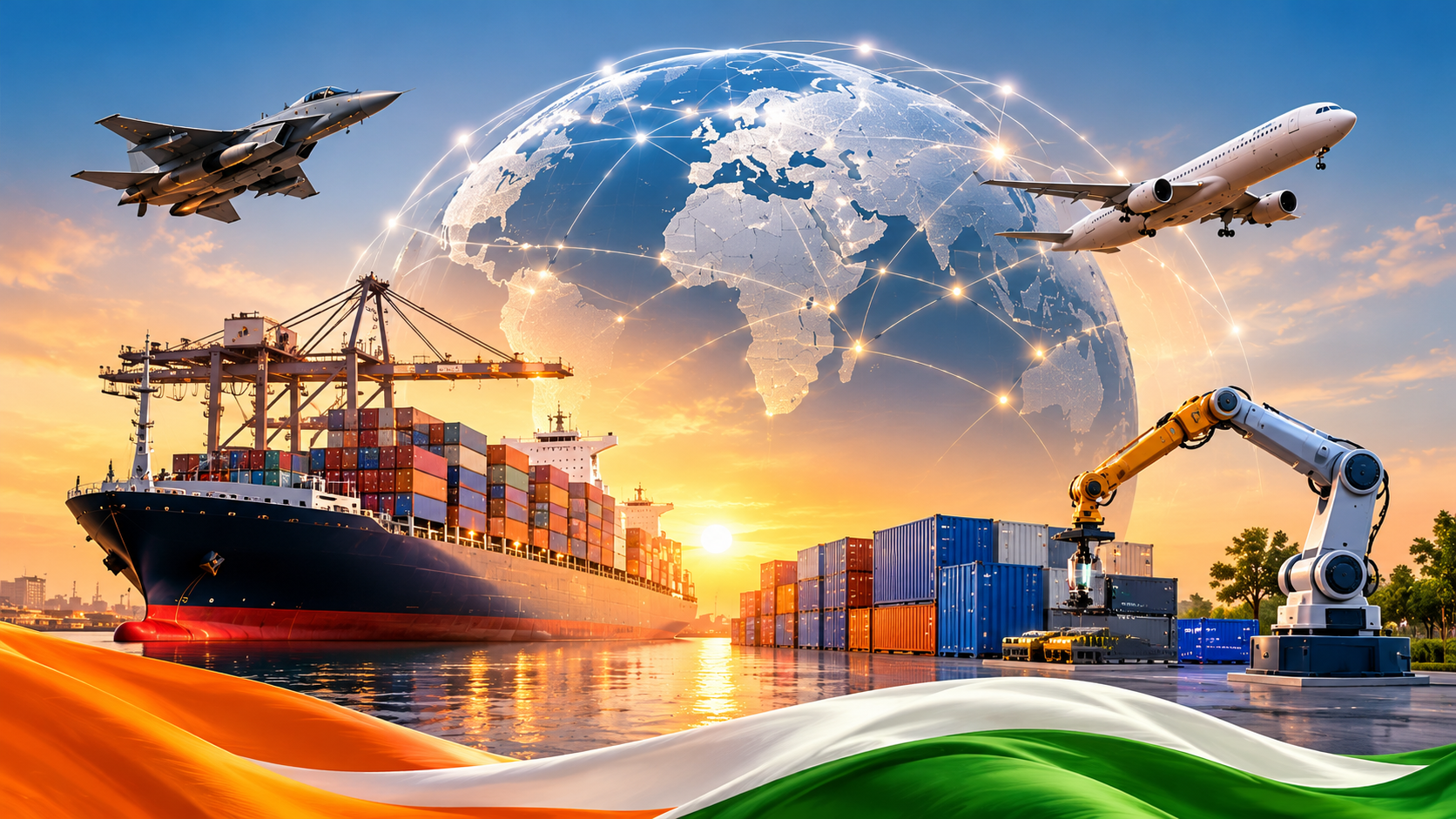
- India’s ambition to achieve $1 trillion in exports this financial year 2026–27 is increasingly looking achievable.
- India’s combined merchandise and services exports reached $568.84 billion during April–October 2026, registering growth of 16.66% compared with the corresponding period last year.
- India’s defence exports reached a record Rs 38,424 crore in FY 2025-26, representing a remarkable 62.66% increase over Rs 23,622 crore in the previous financial year.
- The larger opportunity is not simply to export more, but to establish India as an indispensable part of global supply chains.
India’s ambition to achieve $1 trillion in exports this financial year 2026–27 is increasingly looking achievable. At a time when global trade is facing geopolitical disruptions, protectionist policies and uncertain demand, India’s export performance is demonstrating the growing competitiveness of its manufacturing and services sectors.
The latest figures released by the Ministry of Commerce and Industry indicate that India’s combined merchandise and services exports reached $568.84 billion during April–October 2026, registering growth of 16.66% compared with the corresponding period last year. This is a significant acceleration in India’s external trade performance.
India’s total exports reached a record $863.1 billion in FY 2025-26. The government subsequently set an ambitious target of $1 trillion for FY 2026-27. The April-October performance suggests that India is broadly maintaining the required growth trajectory.
Merchandise exports: Manufacturing gains momentum
A particularly encouraging development is the strong performance of merchandise exports.
India exported goods worth $309.06 billion during Apr–Oct 2026–27, registering a growth of 21.96% over the corresponding period last year. Non-petroleum exports also increased by 18.01% to $259.22 billion, indicating that export expansion is not solely dependent on petroleum shipments.
October witnessed particularly strong growth. Merchandise exports reached $49.47 billion in October 2025, an increase of 45% over the same period last year.
Several manufacturing segments recorded impressive gains:
- Petroleum products: 140.21% growth.
- Electronic goods: 62.70%.
- Gems and Jewellery: 40.06%.
- Organic and inorganic chemicals: 36.20%.
- Engineering goods: 36.01%.
Electronics exports, in particular, deserve attention. Their rapid expansion reflects India’s growing role in global electronics manufacturing, supported by production-linked incentive schemes, investments in mobile-phone manufacturing and the expansion of domestic component ecosystems.
The growth in these sectors suggests that India’s manufacturing ambitions are gradually translating into export competitiveness.
Service exports: India’s invisible economic powerhouse
Services continue to provide India with a substantial competitive advantage. Services exports were estimated at $259.78 billion during Apr-Oct 2026-27, with a 10.93% growth over the previous year.
More importantly, services generated a trade surplus of $124.8 billion, helping offset the merchandise trade deficit.
Defence exports: from import dependence to a growing exporter
The most notable development in India’s export story is the expansion of its defence manufacturing industry. India’s defence exports reached a record Rs 38,424 crore in FY 2025-26, representing a remarkable 62.66% increase over Rs 23,622 crore in the previous financial year.
The private sector contributed 45.16%, while defence public sector undertakings accounted for 54.84%, with Indian defence products now reaching more than 80 countries.
This expansion reflects the impact of indigenous manufacturing initiatives, defence procurement reforms, increased private-sector participation and the growing capabilities of Indian defence companies. Products such as artillery systems, ammunition, armoured vehicles, radars, electronic systems, naval equipment and defence components are contributing to India’s expanding international presence.
The Modi government’s ambition to achieve ₹50,000 crore in defence exports by 2029 indicates that this sector is being positioned as a long-term contributor to India’s manufacturing and export ecosystem.
The strategic significance is equally important. Defence exports strengthen India’s diplomatic relationships, expand its defence partnerships and establish the country as a reliable supplier of military equipment.
What needs attention going forward?
Despite the encouraging numbers, achieving $1 trillion in exports will require addressing several challenges.
First, reducing logistics and manufacturing costs is needed, as Indian exporters continue to face infrastructural bottlenecks and high transportation costs. Second, excessive dependence on a limited number of markets calls for diversifying export destinations. Third, to encourage and strengthen MSME participation, export growth should become broader-based rather than concentrated among a few large companies. Fourth, moving up the value chain is crucial; the objective should be to capture a larger share of global manufacturing value rather than merely expand assembly operations, with a focus on increasing domestic value addition.
An export-driven India is emerging
India’s journey towards $1 trillion in exports represents more than an ambitious numerical target. It reflects a gradual transformation in the country’s economic structure, with manufacturing, technology, services and defence increasingly contributing to its global economic presence.
If India can combine its manufacturing ambitions with competitive logistics, skilled human capital, stable economic policies and deeper global trade integration, the $1 trillion milestone could become a stepping stone towards an even larger export economy.
To conclude, the larger opportunity is not simply to export more, but to establish India as an indispensable part of global supply chains.

Niranjan Kadam G is a columnist and digital creator with a keen interest in India’s foreign policy, political science, and global affairs shaping India’s strategic and economic interests. His work focuses on analysing international developments, geopolitics, and their implications for India’s position in the evolving global order. The views expressed are the author’s own.
 Hridbina Chatterjee
 Aayush Pal
 Anjali Singh