
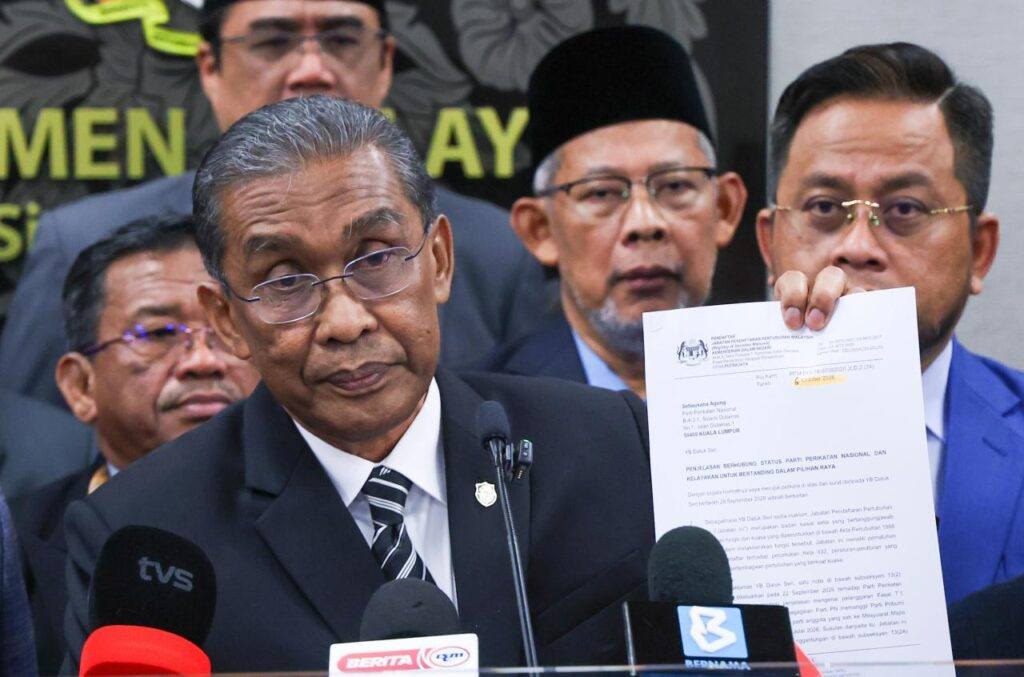
- The cancellation of the registration of Perikatan Nasional (PN), the largest opposition coalition in Malaysia, due to disagreements between PAS, a conservative Islamic party, and the nationalist party Parti Pribumi Bersatu Malaysia (Bersatu), has increased political tensions in the lead-up to the elections on November 14 in the Malaysian state of Melaka.
- Despite the previous alliance during the general election campaign, the increasing rivalry has made it difficult for the parties to cooperate with each other.
- This poses a complicated political environment for Anwar Ibrahim, because the existence of fragmented opposition forces makes it hard for any political party opposing the Anwar administration to consolidate its strength in the Melaka election.
- The case shows that political power is defined not only by the number of political parties in a coalition, but also by their ability to regulate their conflicting interests through certain agreements and collaboration.
The cancellation of the registration of Perikatan Nasional (PN), the largest opposition coalition in Malaysia, due to disagreements between PAS, a conservative Islamic party, and the nationalist party Parti Pribumi Bersatu Malaysia (Bersatu), has increased political tensions in the lead-up to the elections on November 14 in the Malaysian state of Melaka.
On October 20, the Registrar of Societies (RoS) of Malaysia cancelled the registration of PN in light of the unsatisfactory answer provided by the political party to the previous warning. This was the result of a complaint by Bersatu, headed by former Malaysian Prime Minister Muhyiddin Yassin, that it was not included in the PN supreme council conference held in July.
Divisions within undermine the opposition
The disagreement has revealed a battle for power in PN, with PAS being the largest party in terms of seats in the Malaysian Parliament, which has 222 members. At the same time, Bersatu has tried to retain its position in the coalition.
Despite the previous alliance during the general election campaign, the increasing rivalry has made it difficult for the parties to cooperate with each other. Additionally, their individual campaigns in the state elections in Johor and Negeri Sembilan have demonstrated the weakness of their collaboration.
As a result, PN’s registration might be cancelled, and, consequently, their respective parties may have difficulties in running for elections with the united logo and strategy.
Thus, from the political point of view, the disagreement demonstrates how cooperation in politics depends not only on common interests of the parties but also on their internal agreements and rules.
Anwar’s government is working under a complicated political climate
This poses a complicated political environment for Anwar Ibrahim, because the existence of fragmented opposition forces makes it hard for any political party opposing the Anwar administration to consolidate its strength in the Melaka election. The problem is that even though Anwar heads a ruling coalition of parties made up of Pakatan Harapan and Barisan Nasional (BN), they still have some level of competition in various states even though they collaborate at a federal level.
It is important to note that Anwar’s government has not had an easy time in regional elections. Even though talks are being held on how to possibly cooperate between BN and PAS, it is happening at the same time that the government is facing deregistration. In conclusion, this move will not guarantee an electoral victory for Anwar.
Institutions and the rule of law
PN’s case before the Registrar of Societies also brings into question the interrelationship between political competition and regulation through institutional means. While the authorities argue that there were insufficient grounds addressed for the cancellation, the opposition contends that this is a move aimed at weakening the political opposition.
This illustrates the significance of procedural transparency and legality. The planned court case by PN may prove to be an important test as to how disputes concerning political organisations are dealt with under Malaysia’s legal system.
There is no evidence from the available information that the move was politically motivated. On the other hand, the claims made by the opposition party make it all the more important to scrutinize the move.
Conclusion: Coalition Politics from an International Relations Perspective
According to international relations, the political instability in Malaysia highlights the significance of stability within the country for its general political legitimacy and its participation in regional politics. Political coalitions are similar to strategic alliances: while they might boost collective power, disagreements about leadership and shared interests may impede their efficiency.
As a participant in regional politics via the Association of Southeast Asian Nations (ASEAN), Malaysia requires a stable political situation in order to maintain policy consistency and conduct international affairs. While the deregistration of PN alone does not automatically mean any disturbance in Malaysia’s foreign policy, future elections will determine the stability of the political situation in the country.
Finally, the case shows that political power is defined not only by the number of political parties in a coalition, but also by their ability to regulate their conflicting interests through certain agreements and collaboration. The further actions of PN may be either reorganisation of the party, successful protest against this decision or failure to act.

Anjali Singh is a postgraduate student of Political Science and International Relations, a Social Media Analyst, and a former Research Intern at the Indian Council of World Affairs. Views expressed are the author’s own.
 Aayush Pal