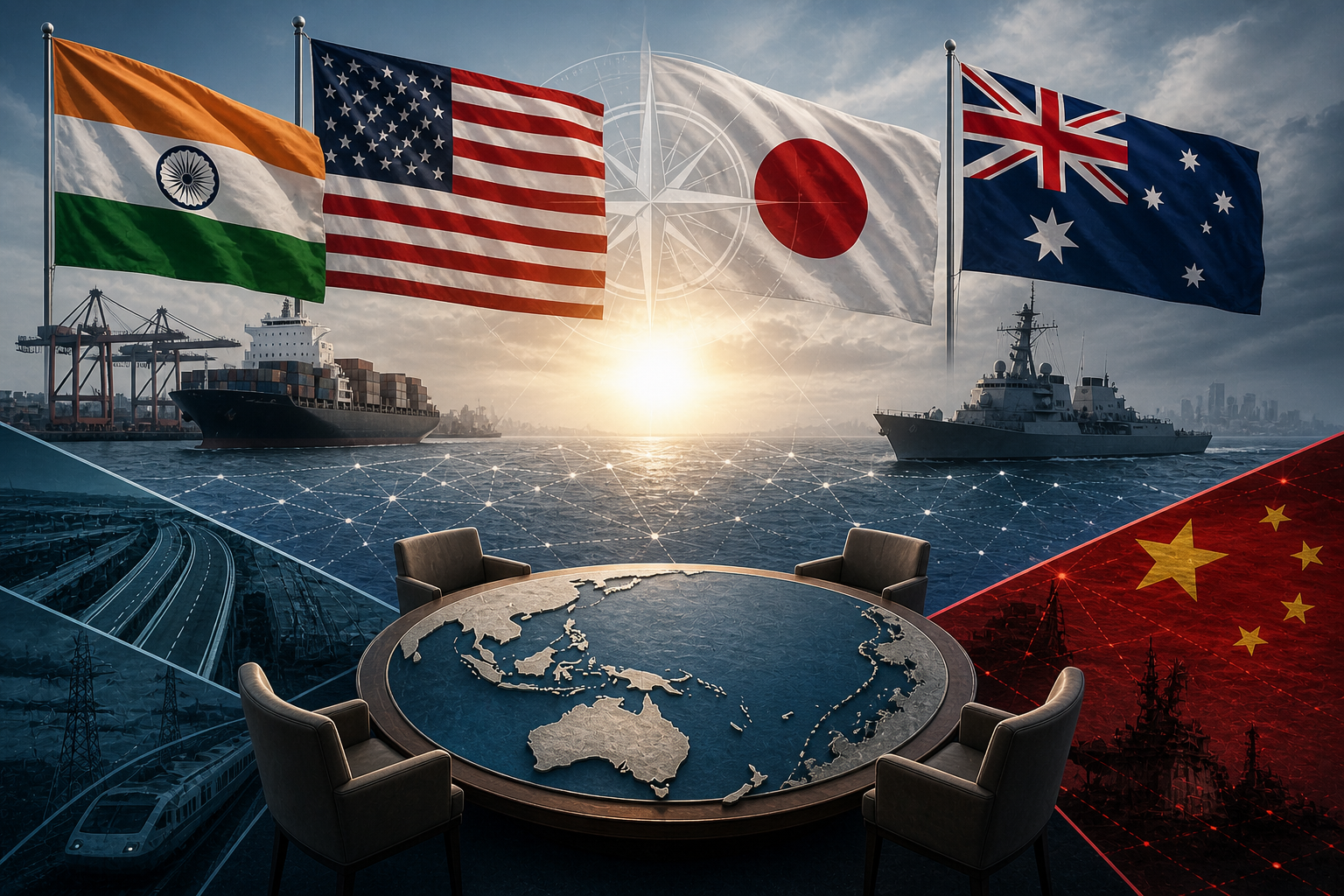
- The Indo-Pacific accounts for nearly two-thirds of global GDP, roughly 60 per cent of global maritime trade, and close to 70 per cent of seaborne energy flows. More than 80 per cent of the world’s goods transported by ships move through Indo-Pacific sea lanes and chokepoints.
- This growing assertiveness was closely observed by India, the United States, Japan, and Australia. Another important factor was the leadership alignment among these countries after 2016.
- However, post-pandemic, significant changes took place within the Quad countries due to leadership transitions. These leadership changes impacted the functioning of the Quad.
- Despite these challenges, the potential of the Quad remains intact. However, the current phase reflects strategic uncertainty and reduced cohesion.
The Quadrilateral Security Dialogue (Quad) is an informal strategic grouping of four Indo-Pacific countries, including India, the United States, Japan, and Australia. The origin of this grouping dates back to the 2004 Indian Ocean tsunami, when these four countries came together for disaster relief in what was called the Tsunami Core Group.
In 2007, former Japanese Prime Minister Shinzo Abe proposed a broader democratic security framework in the Indo-Pacific. Following this, the first meeting took place on the sidelines of the ASEAN Regional Forum in 2007. Since then, the grouping has existed as an informal arrangement in the region.
The Indo-Pacific Imperative
At that time, the Indo-Pacific had begun to emerge as the new global centre of gravity, with major economies increasingly concentrated in the region. The Indo-Pacific accounts for nearly two-thirds of global GDP, roughly 60 percent of global maritime trade, and close to 70 percent of seaborne energy flows. More than 80 per cent of the world’s goods transported by ships move through Indo-Pacific sea lanes and chokepoints. Any conflict in this region has direct global repercussions. Therefore, the safety and security of the Indo-Pacific becomes a key responsibility for these countries.
What brought these four countries together was a shared sense of aspiration and commonality. The most important common factor has been democracy, along with geography, regional alignment, and the geopolitical significance of the Indo-Pacific. Another key factor has been the presence of a common strategic challenge in the form of China.
Strategic Convergence Under Trump’s First Term
During the first administration of Donald Trump, there was a strong push to strengthen ties with India, Japan, and Australia in the Indo-Pacific. This was the period when China was expanding its sphere of influence through its economic initiative, the Belt and Road Initiative. Many countries in South Asia and Southeast Asia became part of this initiative, which challenged the economic interests of the United States, India, and Japan.
At the same time, China was militarising the region by creating artificial structures and asserting de facto control over the South China Sea. It laid claims over territories of countries like the Philippines and Malaysia, while also posing a strategic threat to Taiwan and even Japan. Under President Xi Jinping, China has focused on expanding its influence in the Indo-Pacific. The broader idea has been to secure maritime routes, especially through the Strait of Malacca, as a large portion of China’s trade passes through this region.
This growing assertiveness was closely observed by India, the United States, Japan, and Australia. Another important factor was the leadership alignment among these countries after 2016. Leaders such as Indian Prime Minister Narendra Modi, President Donald Trump, Shinzo Abe, and former Australian Prime Minister Scott Morrison shared a similar understanding of the strategic challenge posed by China. They emphasised the importance of rule of law, transparency, and inclusivity in the Indo-Pacific, and opposed any attempt by China to dominate the region.
During this period, there was also growing discussion about whether the Quad should evolve into a military alliance to provide stronger deterrence against China. China itself reacted strongly and referred to the Quad as an “Asian NATO.”
Post-Pandemic Drift and Leadership Reset
However, post-pandemic, significant changes took place within the Quad countries due to leadership transitions. In the United States, Joe Biden came to power in 2021. In Japan, Shinzo Abe resigned and Fumio Kishida assumed leadership. In Australia, the conservative government of Scott Morrison lost power, and Anthony Albanese led the Labour Party to victory. India remained the only country where leadership continuity was maintained under Prime Minister Narendra Modi.
These leadership changes impacted the functioning of the Quad. Diplomatic engagement became less active, and much of this slowdown can be attributed to domestic priorities and leadership constraints. For instance, the Labour government in Australia aimed to stabilise relations with China, as economic considerations were central to its electoral agenda. China and Australia share strong trade ties, especially in coal exports, and tensions during the Morrison government had severely affected Australia’s economy. After coming to power in May 2022, Albanese reset relations with China, leading to the resumption of coal imports.
In the United States, however, President Biden largely continued the strategic approach of the previous administration towards the Quad, reflecting bipartisan consensus on China as a strategic competitor. This led to the Quad Leaders’ Summit in Tokyo in May 2022, which remains the only major summit-level engagement in recent years, indicating a degree of stagnation since then.
In Japan, Prime Minister Kishida faced domestic political and economic challenges, including stagnation and internal party issues within the Liberal Democratic Party. As a result, Japan’s leadership became more inward-focused.
India’s Strategic Autonomy vs Western Alignment
The most significant development, however, occurred in India’s geopolitical positioning after the Russia-Ukraine War. While the other Quad countries supported Ukraine and imposed sanctions on Russia, India maintained its strategic autonomy and continued its relationship with Russia, particularly in the energy sector. This created differences within the Quad, especially when the other members attempted to bring Ukraine into Indo-Pacific discussions, which India resisted. India maintained that the Quad should remain focused strictly on Indo-Pacific issues.
Trump 2.0 and the Fracturing of Alignment
The situation further evolved with the return of Donald Trump to power. It was initially expected that his second administration would revive the Quad, but his approach turned out to be significantly different. His policies emphasised economic nationalism and transactional diplomacy. He openly criticised allies, including India, and introduced tariff measures, even referring to India as a “tariff king.” He also pressured India to reduce its energy ties with Russia, which is unrealistic given India’s energy requirements.
Additionally, his statements regarding mediation during the India-Pakistan tensions in May 2025 were strongly rejected by India. Repeated claims of mediation and other remarks created friction in bilateral ties. At the same time, the United States showed renewed engagement with Pakistan, driven largely by economic and strategic considerations. This raised concerns in India about the reliability of the partnership.
There were also tensions between the United States and other allies. For instance, Trump criticised Japan on trade issues and blocked major investment moves such as Nippon Steel’s proposed expansion in the US. Similar economic pressures were applied to allies, including Australia.
A Grouping in Pause, A Region in Flux
As a result, countries like India, Japan, and Australia have begun reassessing their strategic positions and diversifying partnerships. This has contributed to a sense of stagnation within the Quad.
Despite these challenges, the potential of the Quad remains intact. However, the current phase reflects strategic uncertainty and reduced cohesion. In this entire situation, the primary beneficiary has been China, which continues to expand its economic and geopolitical influence in the Indo-Pacific while challenging the rules-based order in the region.
Reference
1)https://thediplomat.com/2026/04/the-quad-isnt-dead-its-just-moved-out-of-the-spotlight/
2)https://foreignpolicy.com/2025/11/03/quad-indo-pacific-trade-deal/
3)https://www.theaustralian.com.au/special-reports/indo-pacific/in-memoriam-the-slow-death-of-the-quad/news-story/15918a84925e782236e1513f3cbfe919
4)https://www.lowyinstitute.org/the-interpreter/has-india-defanged-quad

Aayush Pal is a freelance writer on contemporary geopolitical developments. The views expressed in his work are entirely his own.
 Kumar Satish
  Anjali Singh