
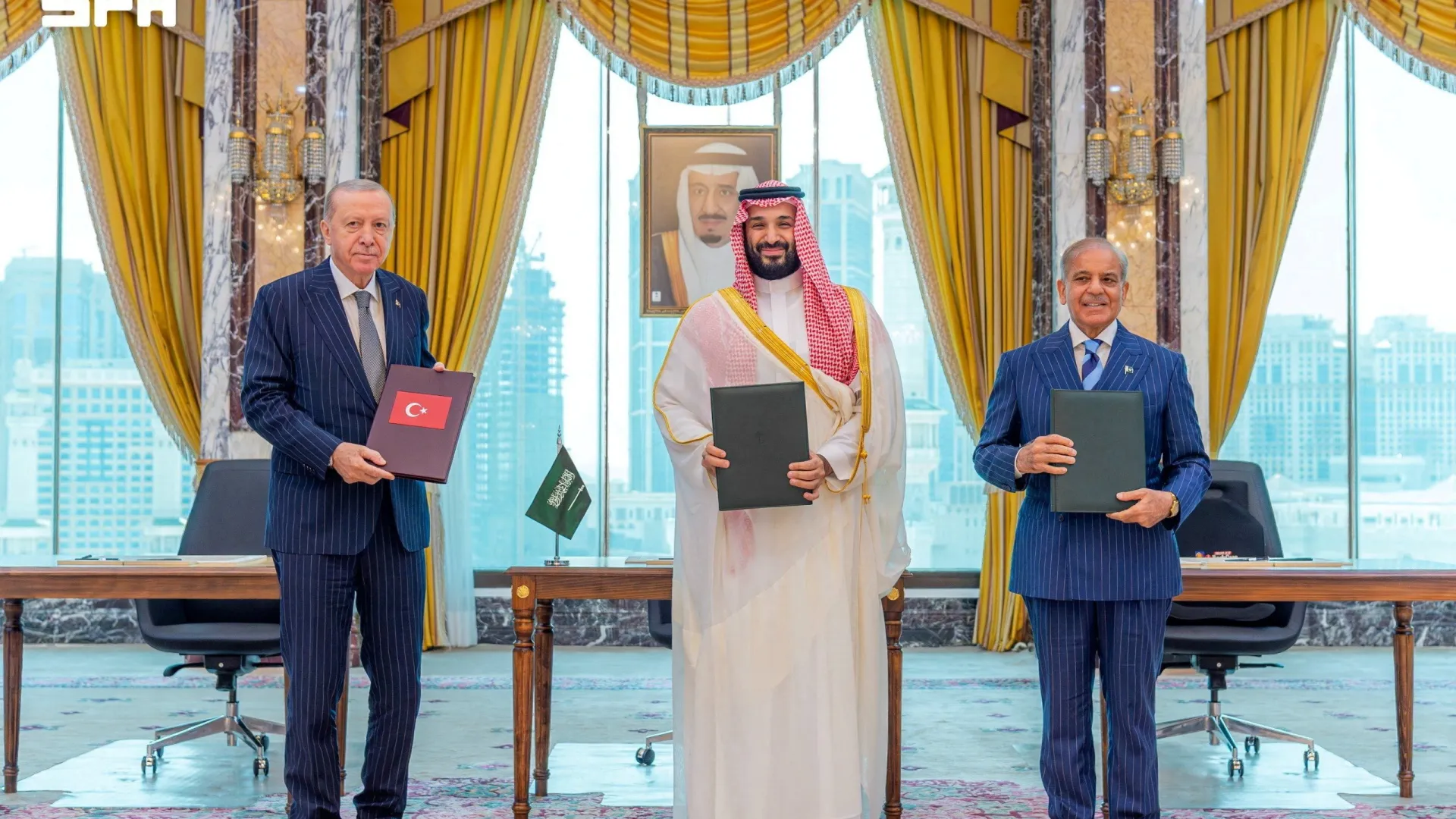
- The agreement, signed by Saudi Crown Prince Mohammed bin Salman, Turkish President Recep Tayyip Erdoğan and Pakistani Prime Minister Shehbaz Sharif, declares a mutual defence pact, which says an attack on one country will be considered an attack on all countries.
- It is not a matter of an isolated diplomatic sphere, but rather Saudi Arabia and Türkiye’s explicit willingness to choose Pakistan’s side, coinciding with a structural realignment on the opposing side, with the United Arab Emirates (UAE) and Israel choosing to form a close alliance with India.
- The loose arrangement is by design, acknowledging the fundamental principle of India’s foreign policy: strategic autonomy. New Delhi doesn’t seek to be bound by any formal military alliance that might limit its policy choices or involve it in foreign commitments.
- The worsening military polarisation along with regional disruptions from the Iran war directly overlap with Eurasian trade dynamics, thus affecting the viability of significant global connectivity projects.
- The two separate clusters are emerging, marking a fundamental shift in the global order, which is being hastened by geopolitical shifts after the Iran war.
Saudi Arabia, Türkiye and Pakistan have signed the Makkah Joint Defence Agreement, commonly known as the “Mecca Pact,” at Al-Safa Palace in Mecca on 7 August 2026, which will have a pivotal role in shaping Eurasian strategic architecture. The agreement, signed by Saudi Crown Prince Mohammed bin Salman, Turkish President Recep Tayyip Erdoğan and Pakistani Prime Minister Shehbaz Sharif, declares a mutual defence pact, which says an attack on one country will be considered an attack on all countries. It states the “attack on one is an attack on all” principle, constituting a tri-axis of Saudi Arabia’s capital and diplomatic power, Türkiye’s defence industrial strength, and Pakistan’s military human resources and nuclear deterrent. It is not a matter of an isolated diplomatic sphere, but rather Saudi Arabia and Türkiye’s explicit willingness to choose Pakistan’s side, coinciding with a structural realignment on the opposing side, with the United Arab Emirates (UAE) and Israel choosing to form a close alliance with India. Both West Asia and South Asia are experiencing the simultaneous crystallisation of two regional counterbalances within a classic realist balance-of-power paradigm.
Strategic Motivations and the Catalyst of the Iran War
The immediate catalyst for the Mecca Pact is the regional security uncertainty after multipolar conflicts at the beginning of 2026 and the changing power pledges from the Asian region. While the traditional security assurance provided by Washington saw its meaning and scope adjusted, regional powers began to coalesce around self-reliant defence force-building. By then, Türkiye and Saudi Arabia had made a conscious strategic decision, with support from Islamabad, in building a Sunni military axis. Saudi Arabia has immediate military force, cooperation in air defence, and Pakistan’s nuclear deterrent, which does not require the approval of Western powers. The alliance benefits President Erdoğan, who wants to make Turkey a military power in the Arabian Sea and the Gulf and to find secure defence manufacturing partners and customers at the state level in Türkiye. The deal not only provides Pakistan with financial support from the Saudi capital but also high-tech military equipment from Ankara, ensuring Islamabad’s position as the indispensable security pillar of this new alliance.
Institutional Distinctions: Formal Defence Treaty vs. Strategic Autonomy
Like a formal, static trilateral military alliance, the Mecca Pact features clear collective security commitments and institutionalised defence coordination mechanisms. The India-UAE-Israel-US grouping, named I2U2, on the other hand, is a flexible and non-binding mini-lateral grouping that is strategically converging. Conversely, the India–UAE–Israel strategic convergence is a strategically converging, non-binding, flexible partnership. The loose arrangement is by design, acknowledging the fundamental principle of India’s foreign policy: strategic autonomy. New Delhi doesn’t seek to be bound by any formal military alliance that might limit its policy choices or involve it in foreign commitments. However, the India–UAE–Israel strategic convergence operates on a case-by-case basis with bilateral and trilateral arrangements, intelligence sharing, co-development of defence technologies, and co-patrolling the seas. This flexible approach enables Abu Dhabi, Tel Aviv and New Delhi to reach the level of deep defence coordination and operational agility needed without violating their foreign policy goals.
| Pakistan-Saudi-Türkiye Axis | India – UAE – Israel Triangle |
| 1. Formal Binding Mutual Defence 2. Codified “Attack on One” Clause 3. Nuclear Deterrence and Manpower 4. Turkish Industrial Technology 5. Integrated Command Framework | Flexible Mini-lateral Partnership Preserves Strategic Autonomy Co-development and Cyber Defence Intelligence Sharing and Tech Issue-Specific Security Alignment |
The Defence Equation and the Shadows of Recent Conflicts
Although institutions can be flexible, the India-UAE-Israel association has quickly brought defence and hard security to the centre of its agenda, on the heels of growing threats in the region and the wider repercussions of the Iran war. This partnership has proven crucial in the ongoing conflict, particularly during Operation Sindoor in May 2025, when the Pakistani military could use Turkish military drones and reportedly received Turkish technical and operational assistance to target Indian soldiers. The Mecca Pact further consolidates the strategic weight of Saudi Arabia, Türkiye and Pakistan, with Türkiye’s defence-industrial capabilities and Pakistan’s military capacity adding depth to the new security arrangement. The Israel–UAE–India partnership is a formidable counterweight in response to this threat. Israel’s battle-tested air defence, radar and precision weaponry proved to be a lifesaver during Operation Sindoor, and coupled with the UAE’s strategic position and the industrial scale of India, they offer an effective multi-layered defence shield to neutralise the tactical superiority of the Pakistan-Saudi-Turkey alliance.
How to enhance Geo-Economic Interplay: The fate of Trade Corridors and IMEC
The worsening military polarisation along with regional disruptions from the Iran war directly overlap with Eurasian trade dynamics, thus affecting the viability of significant global connectivity projects. The Economic Corridor India-Middle-East-Europe (IMEC), which connects Indian ports to the UAE, Saudi Arabia, Jordan, Israel, and Europe, is now beset with complicated geopolitical realignments and security challenges along the way. While the UAE and Israel maintain their support for IMEC as a tool for regional integration, Saudi Arabia’s new defence alliance with Türkiye and Pakistan is escalating political and security concerns at the corridor’s land and sea transit points. Moreover, since Türkiye was not part of the initial transit path of IMEC, the Mecca Pact is used as a bargaining chip to advocate for other trade routes through Iraq and Anatolia. The increased maritime chokepoints being militarised- the Strait of Hormuz, Bab-el-Mandeb and the entire Arabian Sea- lead to higher insurance costs, increased security considerations for commercial shipping and the need to add naval escort services to energy corridors. Thus, trade routes throughout West Asia have ceased to be purely commercial routes and have become competitive, where the resilience of the trade chain is intertwined with the power of the sea.
Broader Consequences for Eurasian Geopolitics and International Order
The two separate clusters are emerging, marking a fundamental shift in the global order, which is being hastened by geopolitical shifts after the Iran war. Middle powers are not merely playing the role of patrons in the relationship of power blocs, but are creating additional security and trade structures in the region. The Mecca Pact is a security pact that integrates military partnerships and formal treaty commitments, while the India–UAE–Israel axis is a very flexible, technology-oriented security and economic pact that is based on strategic autonomy. Both groupings will play a critical role in the stability of Eurasia, the flow of energy, and the nature of their diplomatic relations in the future as they consolidate their positions and work through their own security dilemmas. The status quo is fragile, but the crystallisation of these conflicting triads has made West Asia and South Asia two inseparable strategic realities.
References:
- Pakistan, Saudi Arabia, Turkiye sign joint defence agreement
- Saudi Arabia, Pakistan and Turkey sign Nato-style defence pact amid deadly Houthi strikes in Yemen-
- ‘Attack on one, attack on all’: What’s in Saudi Arabia-Turkey-Pakistan defence deal? What it means-
- Sunni Nato is here: Pakistan, Turkey, Saudi Arabia sign defence pact in Mecca-

Parag Gilada is a Master’s student at IISM Mumbai in Sports Management, with a bachelor’s from OP Jindal Global University in Global Affairs, with an interest in Sports Diplomacy and Governance. Views expressed are the author’s own.
 Hridbina Chatterjee
  Divyanka Tandon
  Kumar Satish