|
Getting your Trinity Audio player ready...
|
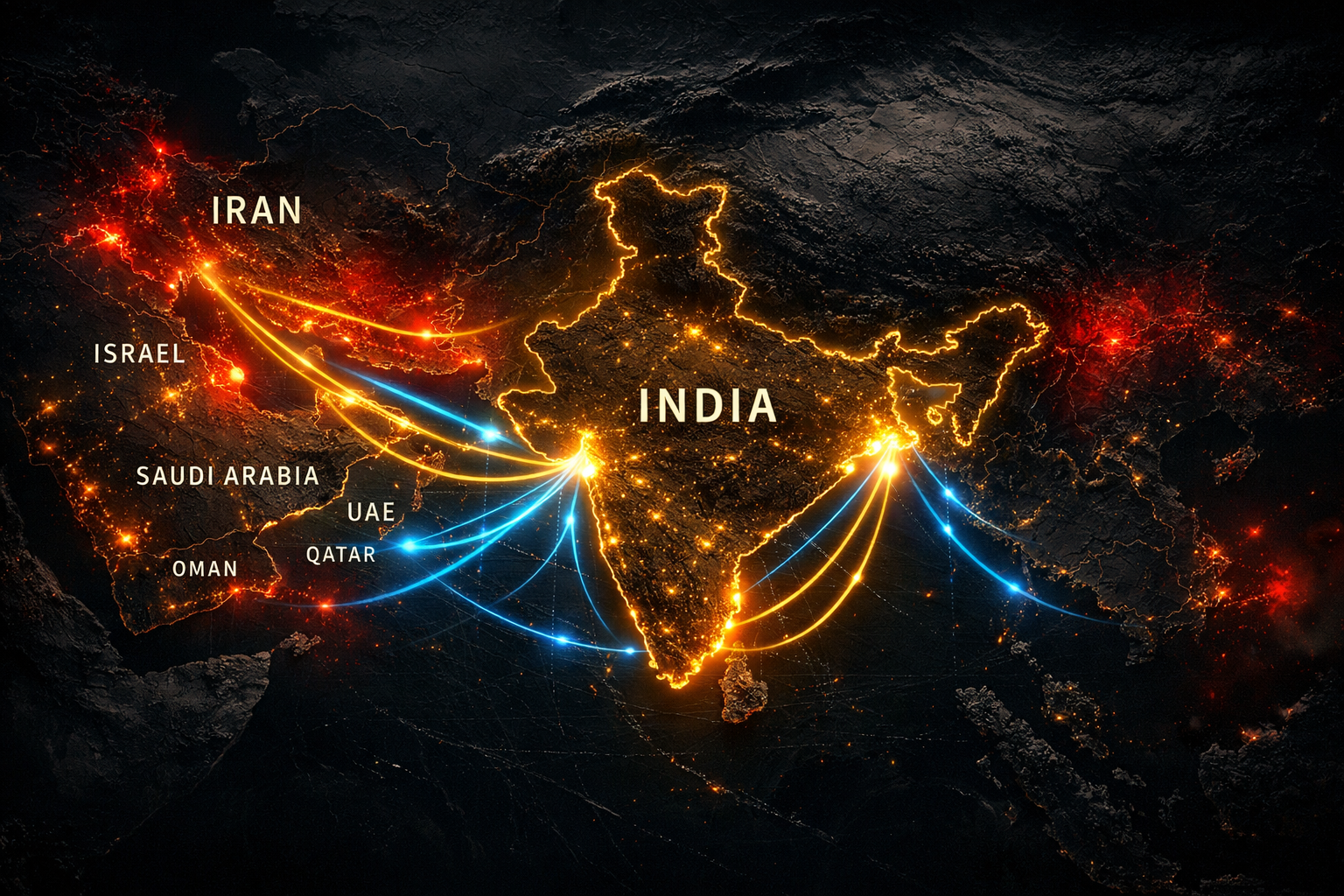
- The conflict not only puts their safety at jeopardy but also hurts the remittance flow that boosts India’s foreign exchange reserves.
- The energy dimension of the crisis is perhaps the most alarming concern, as India is fundamentally import-dependent for its energy security.
- India’s multi-dimensional engagements with all the stakeholders of the region prove that its silence is far from passive bystanding; it is a pulse of a “Vishwa Stabiliser”.
- India had timely shifted from its passive “abstain and chill” posture to a more proactive “All Aligned” policy.
The tremors of the conflict in West Asia, triggered by the late-February strikes on Iran by the USA and Israel under “Operation Epic Fury” and sustained by Iran’s “Operation True Promise 4”, have reached India’s doorsteps. The recent hike in March of Rs. 60 on LPG cylinders, combined with the Government’s slashing of excise duty on petrol and diesel, serves as a sharp reminder that geographical distinctiveness no longer shields a nation from geopolitical volatility (Chakraborty, 2026). While Iran’s response has showcased its capability to bypass traditional defences and strike multiple targets across the Gulf region and send shockwaves globally, a secondary concern is under discussion through New Delhi’s policy circles: Why is India so quiet?
This is certainly not a spectator’s war for India. The US & Israel-Iran confrontations have pushed West Asia into a new era of chaos and instability. It puts New Delhi’s strategic interests at stake. According to the latest figures of the Ministry of External Affairs, more than 10 million Indians reside in this region. This conflict not only puts their safety at jeopardy but also hurts the remittance flow that boosts India’s foreign exchange reserves.
The energy dimension of the crisis is perhaps the most alarming concern, as India is fundamentally import-dependent for its energy security. Thus, constantly increasing oil prices in the global market and significant disruption in the vessel movement across the Strait of Hormuz (the world’s most critical energy artery) deeply hurt India’s fiscal health and overall economic stature.
India also has a huge strategic investment in the region. For instance, India’s multi-Million-dollar investment in the Chabahar port of Iran and the International North-South Transport Corridor (INSTC) signifies its cordial, long-term relations with Iran. On the other hand, the Special Strategic Partnership with Israel, elevated just before the onset of the war, covers various crucial sectors like defence, agriculture, and water management, critical technology, etc., making Israel a crucial partner. When viewed alongside the visionary blueprints of the IMEC (India Middle East Corridor) and Quadrilateral groups like I2U2 (India, Israel, USA and UAE), as well as India’s close relation with other Gulf Nations like UAE, Saudi Arabia, Qatar, etc., it is clear that India is not merely a bystander, rather, it is a stakeholder in the fragile equilibrium that is under turbulence currently in West Asia.
Given these deep-rooted strategic interests in the region, New Delhi must act with urgency, as all other mediation efforts, such as the one led by Islamabad, are structurally incomplete. Even though the Pakistan-led mediation efforts are being seen as an early success, they are, in all likelihood, destined to falter. While Pakistan cannot fundamentally facilitate such high-stakes, international talks, it has stepped into the role primarily driven by its proximity to the current US administration, its own significant stakes in seeing the conflict resolved, and to position itself as an influential power of the region.
However, the reasons for its possible failure are structural. Chief among those is that there exists no means of communication between Pakistan and Israel. Considering Israel’s dominance in the region, it is safe to assume that any durable peace proposal in this theatre is contingent upon Israeli involvement. A true mediation in such a crisis requires the ability to speak and even engage with every belligerent involved. Since Islamabad does not maintain any diplomatic channels with Tel Aviv, its mediation capacity is inherently capped. Additionally, Pakistan’s perceived role as a “messenger” for the United States makes its posture prone to scepticism from Tehran (Basak, 2026).
These limitations had already become evident. The recent ministerial-level conference held in Islamabad, originally scheduled for two days, concluded inconclusively in just one (Castillo and Ahmed, 2026). The effort seems to have failed as it did not yield any concrete outcome.
This is precisely where New Delhi’s “All Aligned Policy”, forged through decades of careful diplomacy of maintaining and strengthening relations with all the stakeholders in the region, emerges as a unique and realistic stabilising force. While Islamabad’s “courier diplomacy” might get the media attention and even secure itself a more visible seat at the table, India is operating in a more substantive domain. Through “Non-Paper diplomacy” fueled by quiet, back-channel exchanges of assurances, India is leveraging the trust it had built across all sides to maintain the region’s fragile equilibrium. New Delhi had historically mastered this form of statecraft, having successfully navigated complex global crises, such as the pivotal 12-point agreement during Nepal’s internal disturbances in 2005, while staying “under the radar” all the time.
Evidence of this machinery being again in high gear is visible in the relentless pace of New Delhi’s current outreach. Prime Minister Narendra Modi had maintained a constant and active line of communication with the Iranian President and the heads of several other Gulf nations (Media Centre, 2026). This has been reinforced by the telephonic conversation between the Prime Minister and the US President Donald Trump. Simultaneously, India has been constantly and effectively connected with Israel through robust diplomatic channels, a link that operates with high precision impacts without bringing all the public attention. Such multi-dimensional engagements with all the stakeholders of the region prove that India’s silence is far from passive bystanding. Rather, it is a pulse of a “Vishwa Stabiliser”. The most tangible evidence of this machinery in the motion, though still in its premature stage, is visible in the high seas, where several Indian flagged vessels carrying critical LPG supplies were allowed safe passage by the Iranian authorities through the Strait of Hormuz. This can be an outcome of New Delhi’s high-level ‘non-paper’ exchanges with Tehran. Such a small yet significant success is proof of India’s unique leverage, which it can utilise to ease the rising tensions in the region.
India had timely shifted from its passive “abstain and chill” posture to a more proactive “All Aligned” policy. By moving beyond simple neutrality to active stabilisation, New Delhi is doing more than just safeguarding its strategic interests in the region; it is cementing its reputation as an indispensable, trusted global player, especially to its partners in the Gulf. Demonstrating such ability to bridge such a dangerous divide will effectively and gradually guarantee India its permanent seat at the high table.
References:
- Basak, S. (2026). Pakistan’s role in the West Asia War appears to be that of a messenger, not a mediator, The Indian Express. Available at: https://indianexpress.com/article/opinion/columns/us-iran-israel-war-pakistan-mediation-trump-munir-sharif-10599092/ (Accessed: 31 March 2026).
- Castillo, E. and Ahmed, M. (2026). Why Pakistan has emerged as a key mediator between us and Iran | The Times of Israel, Why Pakistan has emerged as a key mediator between the U.S. and Iran. Available at: https://www.timesofisrael.com/why-pakistan-has-emerged-as-a-key-mediator-between-us-and-iran/ (Accessed: 31 March 2026).
- Chakraborty, A. (2026). Domestic LPG cylinder prices get a sharp hike of Rs 60 amid West Asia crisis, The Indian Express. Available at: https://indianexpress.com/article/india/domestic-lpg-cylinder-price-hike-rs60-west-asia-crisis-delhi-full-list-10569072/ (Accessed: 31 March 2026).
- Media Centre (2026) Prime Minister Shri Narendra Modi speaks with the President of Iran. Available at: https://www.mea.gov.in/pressreleases.htm?dtl/40886/Prime_Minister_Shri_Narendra_Modi_speaks_with_the_President_of_Iran (Accessed: 31 March 2026).

Atri Patel is a law graduate from Jindal Global Law School and is currently an LL.M. candidate at Gujarat National Law University. He has a keen interest in geopolitics and follows international relations from an Indian perspective. Views expressed are the author’s own.
 Ajith Shetty Heranje
  Anusreeta Dutta
  Aayush Pal