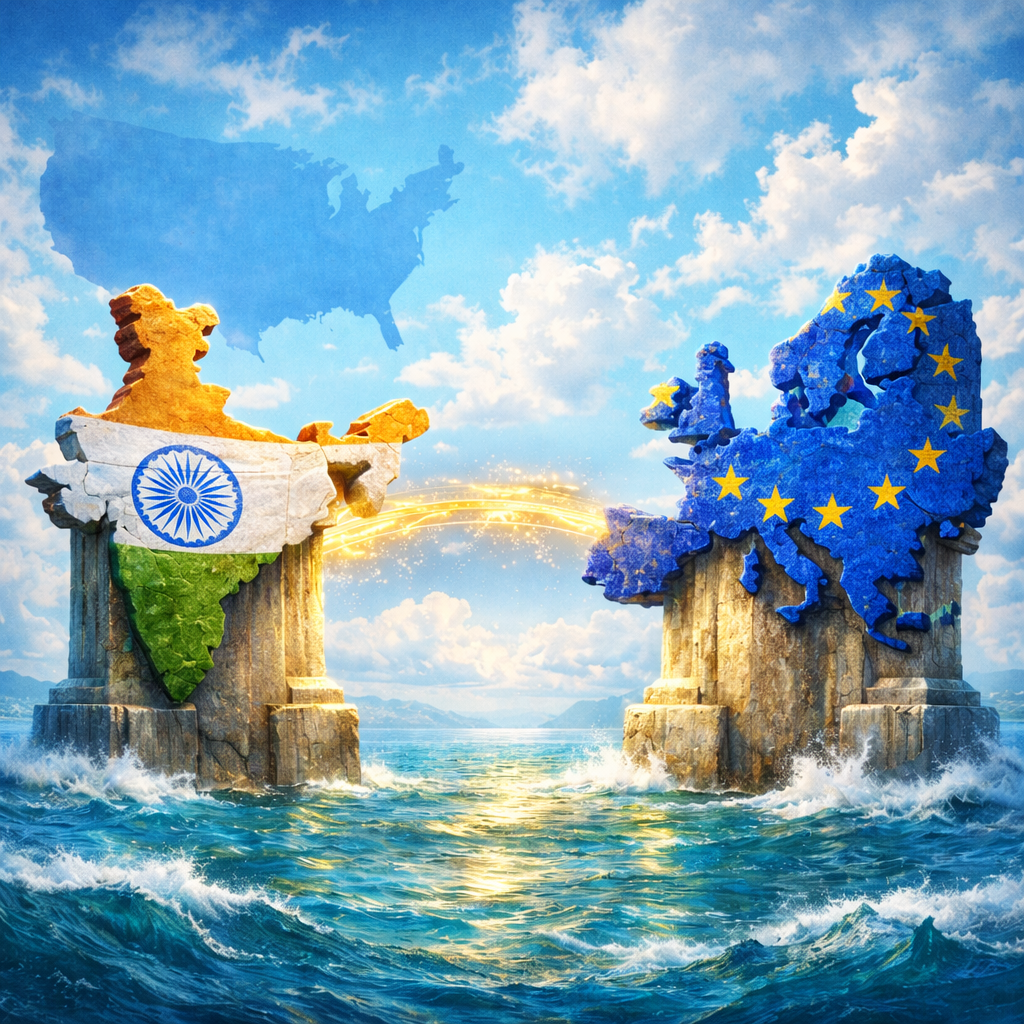
- The EU-India FTA isn’t just a race to reduce tariffs on German cars and Indian textiles anymore, but has transformed itself into a vital geopolitical lighthouse.
- The FTA has exposed an ugly truth – that depending on a single, weakening superpower is strategically untenable, especially as the spectre of a return to such politics in Washington pushes European capitals to accelerate their search for diversity.
- The FTA is a collective derisking exercise, signalling that despite the superpower turn to unilateralism, major powers along the Eurasian rimland seek predictable, rule-based economic interaction.
- In a world of great power whimsy and betrayal of old allies, the EU-India partnership ceases to be merely “potential” and becomes an institutional necessity, with the FTA as the fragile hinge on which that transition rests.
The geopolitical tectonic plates are moving at bewildering speed globally. We have ventured into a time where cooperative, collaborative frameworks have given way to a raw, transactional power dynamic that is the living resurgence of “might makes right.” In this jittery new normal, where long-standing allegiances are rattled by the memory and looming spectre of “America First” unilateralism, the years-in-the-making hunt for a Free Trade Agreement (FTA) between the EU and India has taken on dimensions that stretch far beyond mere economics.
The EU-India FTA isn’t just a race to reduce tariffs on German cars and Indian textiles anymore. It has transformed itself into a vital geopolitical lighthouse. It represents an effort by two of the world’s biggest democratic spaces to calm choppy diplomatic waters and build up the “middle ground” against the corrosive tides of superpower rivalry and caprice.
The Shadow of Unilateralism
To get a sense of why Brussels and New Delhi are suddenly cosying back up, one needs to know something about this disorder. The global liberal international order that emerged after the Cold War, based on rules-based multilateralism, is under threat.
Europe’s sense of security was already deeply scarred by the traumatic experience of the Trump presidency, with its tariffs on allies and questioning of NATO’s value, and an approach to diplomacy in which everything was a deal. It exposed an ugly truth: Depending on a single, ever-weakening superpower is strategically untenable. A Specter of a return towards such politics in Washington makes European capitals shake, pushing them even more into speeding up their search for diversity.
At the same time, China’s ascendance as an assertive power has weaponised economic interdependence, and India, as well as the EU, are being nudged to gnaw into supply chain vulnerabilities. The world is currently and succinctly separating into adversarial technoeconomic blocs. And in a world of “might can have anything it wants,” nations that depend on international law and open markets fare poorly unless they team up.
Strategic Autonomy Meets Multi-Alignment
In this environment,t the EU and India are natural, if sometimes awkward partners. Both are advocates of a multipolar world order, and both fear the weakening of multilateral institutions, such as the WTO.
In its pursuit of ‘Strategic Autonomy’, an FTA with India is a building block of the EU. The EU requires large, friendly markets beyond the strait-jacket of the US-China binary in order to underpin its economic model and project its regulatory power. India, with an enormous demographic dividend and increasingly large economic clout, is the indispensable alternative.
For India, the accord is an essential element of its “multi-alignment” approach. As New Delhi tries to transform itself from a developing into a developed country by 2047, it needs strong access to high-end technology, capital and markets that the EU offers. Moreover, deeper economic integration with Europe also represents crucial leverage, a geopolitical hedge against Chinese coercion and American capriciousness.
So the FTA is a collective derisking exercise. It is a statement that, despite the superpower turn to unilateralism in certain policy areas, major powers in the Eurasian rimland seek to establish zones of predictable, rule-based economic interaction.
A Signal Beyond Commerce
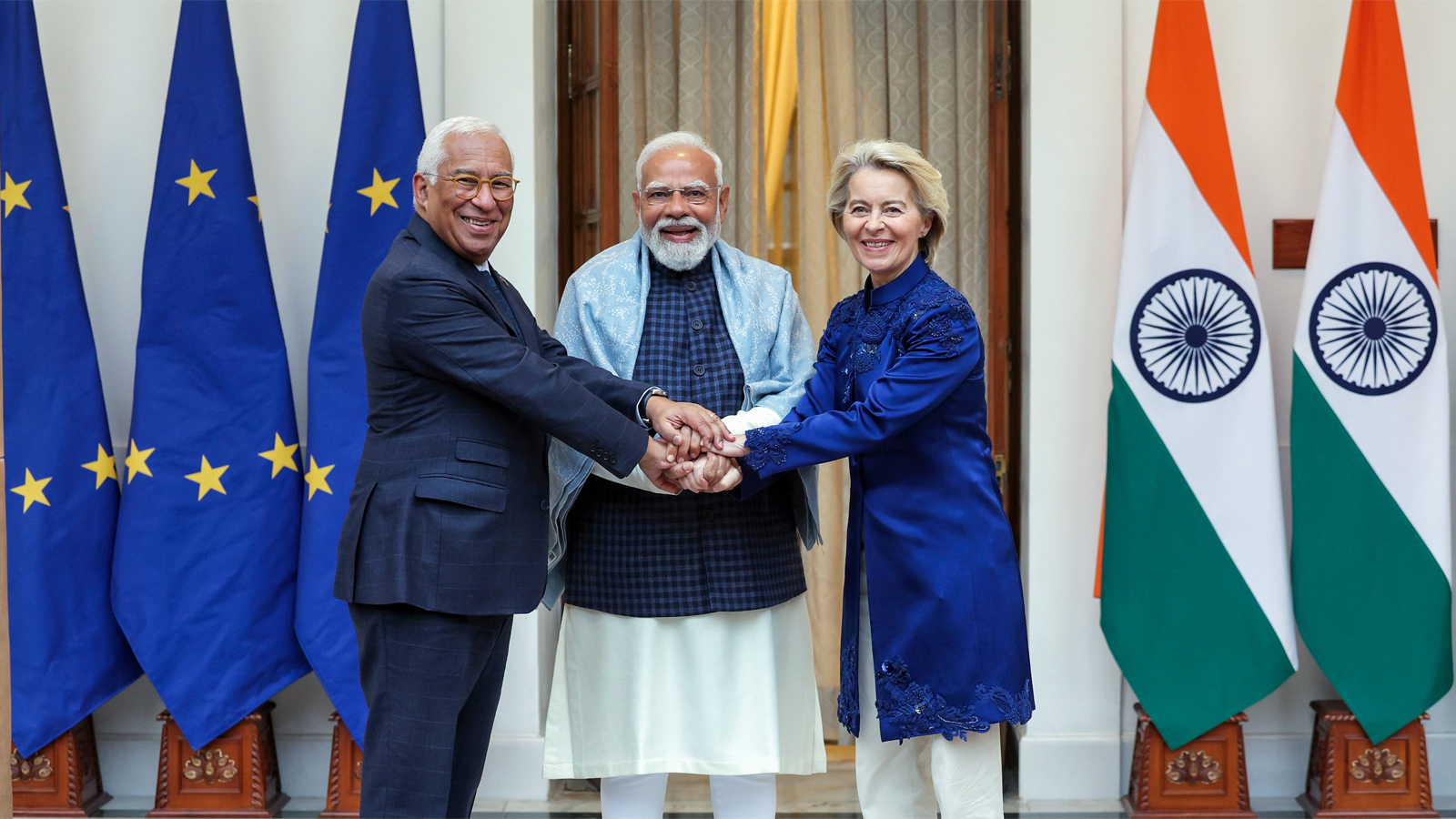
A successful conclusion of an EU-India FTA would be difficult to ignore from a diplomatic perspective. It shows that democracy and open markets are still plausible organising principles for international relations, even after the ascendancy of authoritarian state capitalism.
It undermines the story of a world inevitably sliding into protectionist autarky. In their effort to standardise the standards in two large, diverse economies, India and the E.U. are seeking to demonstrate that complex democracies can still deliver substantial multilateral deals.
What’s more, the agreement is essential for building bulletproof supply chains “friend-shoring”, in vital sectors from pharmaceuticals to green technologies. And this is not just about economic efficiency; it is a national security imperative for both sides to minimise dependencies on geopolitical rivals.
The Realism of the Challenge
But knowing the geopolitical case for an FTA is not the same as ensuring it happens. The path forward is littered with the carcasses of scores of broken-down negotiating rounds that came before.
The EU’s insistence on including strict labour and environmental standards as part of trade deals, a move seen in New Delhi as disguised protectionism or regulatory imperialism, remains a major hurdle. India is just as entrenched in its agriculture and dairy. It is already seeing a piling up of such friction points, and new ones like CBAM (the EU’s Carbon Border Adjustment Mechanism) threaten to arrive before the old ones have started getting resolved.
But the difference today, compared to the failed stabs of the past decade, is that there is compelling pressure from external conditions. We can no longer afford to be clogged with diplomatic inertia.
Conclusion: Stabilising the Centre
In a world of great power whimsy and betrayal of old allies, as we have been witnessing in the recent past, the EU-India partnership ceases to be a “potential” one but an institutional necessity.
It is the FTA which the transition hangs on a thread of. It would mean more than merely a boost to GDP for both blocs. It would be a sign of maturity for the globe’s middle, a signal from 1.8 billion people living in democracies that we will not allow ourselves to be passive observers as power trumps rights, but instead take an active part in designing a stable, rules-based world. At a time when we are in the midst of such geopolitical tempest, that is a signal worth sending.
References:
- “EU and India seek closer relations as Trump upends global order”: Source: Chatham House; Link: Read the Analysis
- “India-EU FTA: How Trump tariffs hastened ‘mother of all trade deals’”: Source: The Financial Express; Link: Read the Article
- “A New EU-India Strategic Agenda in 2025”: Source: Observer Research Foundation (ORF); Link: Read the Brief
- “Brussels resists pressure to dilute CBAM in India trade deal”: Source: Carbon Pulse; Link: Read the Report
- “India, EU Finalise Landmark Trade Deal as Both Hedge Against US Uncertainty”: Source: Modern Diplomacy; Link: Read the Article

Shashank Pandey holds a Master’s degree in Diplomacy, Law, and Business from O.P. Jindal Global University. He currently works as a Policy Research and Strategic Consultant for the Office of the Deputy Chief Minister and Finance Minister of Manipur. Views expressed are the author’s own.
 Divyanka Tandon
  Faareha Usmani
  Archita Gaur