
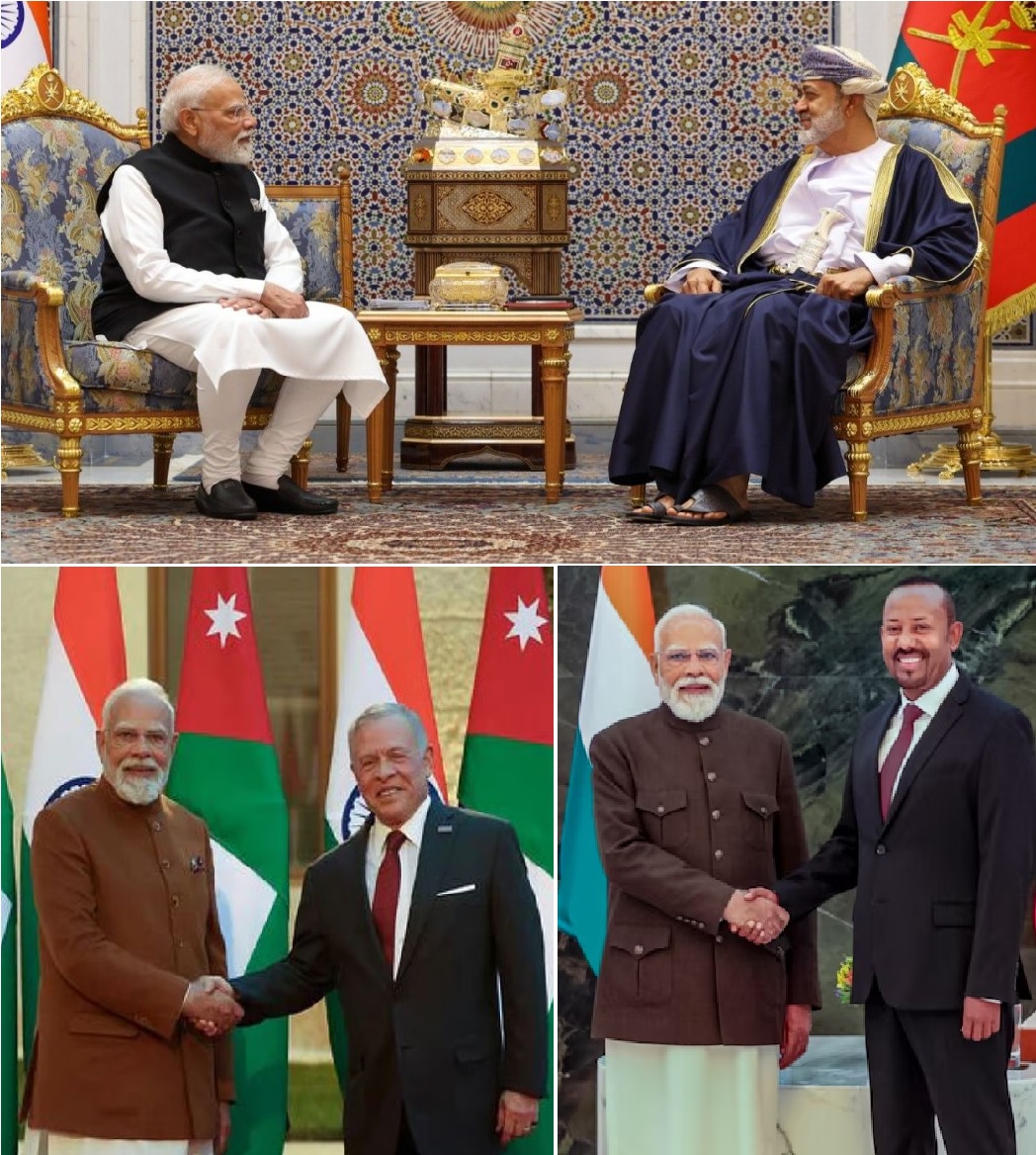
- The 3 visits reflect a deliberate, calibrated push: India is not merely reacting to regional churn but shaping outcomes through diversified, resilient partnerships that extend from the Mediterranean rim to the Horn of Africa and the western Indian Ocean.
- For the first time, India and Ethiopia have elevated their ties to a Strategic Partnership, signalling a shift from development-centric engagement to a broad-based political, economic and security compact.
- Personal rapport does not replace national interest, but it lubricates the machinery of diplomacy.
- These visits transform abstract slogans about ‘multi-alignment’ and ‘Global South leadership’ into concrete projects and partnerships that create jobs, build infrastructure, and enhance security at home.
Prime Minister Narendra Modi’s December 2025 tour of Jordan, Ethiopia and Oman signals a confident, outward-looking India that is simultaneously consolidating old friendships and staking claim to new strategic spaces in West Asia and Africa. It underlines how Indian diplomacy is using personal rapport, economic leverage and geopolitical clarity to create partnerships that directly advance national interests in energy security, connectivity, technology, and regional stability.
Strategic significance of the three visits
Each of the three stops – Amman, Addis Ababa and Muscat- speaks to a distinct strategic vector in India’s foreign policy: West Asian stability and access to the Levant through Jordan, African partnerships and multilateral leadership through Ethiopia, and maritime security and energy through Oman. Jordan sits at the crossroads of West Asia, bordering Israel, Syria, Iraq and Saudi Arabia, giving India a trusted window into one of the world’s most fragile yet consequential regions. Ethiopia is Africa’s second-most populous country and host of the African Union and several UN agencies in Addis Ababa, making it a diplomatic and political nerve centre for the continent. Oman is India’s closest defence partner in the Gulf, a maritime neighbour across the Arabian Sea, and a critical energy and logistics hub at the mouth of the Strait of Hormuz. Taken together, these three visits reflect a deliberate, calibrated push: India is not merely reacting to regional churn but shaping outcomes through diversified, resilient partnerships that extend from the Mediterranean rim to the Horn of Africa and the western Indian Ocean.
Jordan: gateway to a turbulent region
Modi’s Jordan coincided with the commemoration of 75 years of diplomatic relations, but the symbolism was matched by substance. The relationship, traditionally marked by political goodwill, has now been concretely upgraded with new memoranda of understanding in renewable energy, water management, cultural links and digital cooperation. The MoU on technical cooperation in new and renewable energy opens the door for Jordan to leverage Indian experience in solar and wind power, while also aligning with India’s aim of exporting green technology and project expertise. Cooperation in water resources management is strategically vital in a region where water scarcity can quickly morph into a security challenge; India’s experience in river-basin management and low-cost water technologies becomes a diplomatic asset. The twinning of Petra and Ellora, backed by a renewed cultural exchange programme for 2025–2029, elevates soft power and creates new pathways for tourism, heritage conservation and people-to-people links. Critically, Jordan offers India an anchor of moderation in a combustible neighbourhood, and both sides have strongly reiterated their shared opposition to terrorism in all forms and their commitment to regional stability. In the backdrop of continued turbulence in West Asia, a politically stable, security-conscious Jordan that trusts India is a strategic asset; it enables candid exchanges on the Gaza crisis, extremism and broader regional dynamics without the baggage that often colours major power interactions.
Ethiopia: Africa’s Partnership with Strategic Depth
The Addis Ababa visit may, in the long run, prove one of the most consequential African engagements of Modi’s tenure. For the first time, India and Ethiopia have elevated their ties to a Strategic Partnership, signalling a shift from development-centric engagement to a broad-based political, economic and security compact. Eight agreements were signed, including a debt restructuring deal under the G20 Common Framework and an MoU to establish a data centre at Ethiopia’s Ministry of Foreign Affairs. These moves cement India’s image as a responsible creditor willing to support African economies under stress, not merely extract markets and resources. Cooperation frameworks on customs, artificial intelligence training, short-term technical courses under the Indian Technical and Economic Cooperation (ITEC) programme, and expanded scholarships for Ethiopian students reflect a pivot to knowledge, digital and capacity-building partnerships rather than traditional aid. With over 675 Indian companies registered in Ethiopia and cumulative investment estimated at more than USD 6.5 billion, generating upwards of 75,000 local jobs, India has quietly become one of Ethiopia’s most consequential economic partners. Ethiopia’s strategic location in the Horn of Africa, its role in regional peacekeeping, and its centrality to African Union deliberations mean that deeper India–Ethiopia ties naturally spill over into a stronger Indian voice in continental and multilateral forums. In a world where great powers are jostling across the Red Sea and the Indo-Pacific, India’s partnership with Ethiopia underscores a different proposition: development, digital public goods and capacity-building as instruments of strategic influence.
Oman: Maritime Neighbour, Energy Partner
Muscat represents continuity and deepening of one of India’s steadiest Gulf partnerships. Modi’s December 2025 visit delivered a major economic and strategic milestone: the signing of a Comprehensive Economic Partnership Agreement (CEPA) and a joint vision document on maritime cooperation. The CEPA seeks to reduce trade barriers, stabilise rules and unlock investment flows, positioning India as a manufacturing and services hub and Oman as a logistics and energy gateway under its Vision 2040 strategy. On the energy front, both sides have agreed to expand collaboration in exploration and production and to work together in new and renewable sectors such as green hydrogen and green ammonia, directly advancing India’s long-term energy transition and energy security goals. A joint maritime cooperation vision, supported by regular tri-service exercises and enhanced information exchange, elevates Oman’s role as India’s frontline maritime security partner in the western Indian Ocean, crucial for safeguarding trade routes and countering piracy and other non-traditional threats. Just as important is the human bridge: nearly 675,000 Indians live and work in Oman, and their welfare featured in the joint statement, with both sides recognising the diaspora’s contribution to the Sultanate’s development. Strengthening air connectivity, educational linkages, and cultural exchanges ensures that this partnership remains anchored in people, not just policy.
Personal Warmth As Diplomatic Capital
What set this three-nation tour apart was not only the agreements signed but the tenor of the interactions. Modi’s hosts went out of their way to project personal warmth and political trust, converting protocol visits into demonstrations of long-term confidence in India’s role on the global stage. In Ethiopia, Prime Minister Abiy Ahmed Ali and the Ethiopian state conferred on Modi the “Great Honour Nishan of Ethiopia”, the country’s highest honour, a gesture reserved for the closest of partners. That decoration is more than a ceremony; it signals Ethiopia’s willingness to treat India not just as another external actor but as a strategic co-traveller in its developmental and diplomatic journey. In Jordan, King Abdullah II hosted talks in an atmosphere of evident camaraderie, with both leaders speaking of shared values of moderation, inter-faith harmony and the fight against terrorism, as well as a determination to transform political goodwill into economic and technological partnerships. In Oman, the leadership’s emphasis on historical ties, trust and continuity, along with readiness to enter into an ambitious CEPA and a forward-looking maritime partnership, showed a comfort level that only comes with decades of reliable engagement. Personal rapport does not replace national interest, but it lubricates the machinery of diplomacy. Warmth allows faster decisions in crises, greater political space for risk-sharing ventures, and a thicker web of institutional cooperation that can endure domestic political cycles on all sides.
Advancing India’s National Interest
The tangible outcomes of the trip clearly advance India’s core strategic objectives: securing energy, expanding trade, shaping regional orders, and exporting India’s developmental model. Renewable energy cooperation with Jordan and green hydrogen–linked energy collaboration with Oman dovetail with India’s ambition to become a leader in clean energy while diversifying away from overdependence on a narrow set of fossil suppliers. CEPA with Oman, debt restructuring and investment protection with Ethiopia, and trade target-setting with Jordan collectively strengthen India’s economic resilience and export potential in West Asia and Africa. The Ethiopia data centre project, AI training programmes, expanded scholarships, and digital public goods cooperation position India as a provider of affordable, scalable digital solutions for the Global South. In Jordan, cooperation on digital platforms and IT training – including institutions like the Indian–Jordan Centre of Excellence in IT – reinforces India’s brand as a trusted tech and skills partner. Shared counter-terrorism language with Jordan and Oman, maritime security cooperation with Muscat, and peacekeeping and defence training dialogues with Ethiopia contribute to a regional security architecture where India is seen as a stabilising force. Access to ports, bases, and strategic dialogues from the eastern Mediterranean theatre through the Red Sea corridor down to the western Indian Ocean bolsters India’s ability to safeguard sea lanes and respond to contingencies. In essence, these visits transform abstract slogans about “multi-alignment” and “Global South leadership” into concrete projects and partnerships that create jobs, build infrastructure, and enhance security at home.
India’s Diplomatic Moment
The December tour is emblematic of a broader evolution: Indian diplomacy is currently performing with a confidence and agility rarely seen in the post-Independence era. From hosting the G20 and championing the African Union’s inclusion as a permanent member, to advancing South–South cooperation and playing an active role in crisis management, India has chosen to be an agenda-setter rather than a bystander. This three-country itinerary deliberately bridges regions – the Arab world, Africa, and the Gulf – where India’s role is increasingly that of a connector, interlocutor and problem solver. The model on display is distinct: partnerships based on mutual respect, demand-driven development cooperation, and an insistence on strategic autonomy rather than bloc politics. What stands out is the ability to balance hard interests with soft power, and transactional gains with long-term credibility. By tying energy, trade and technology agreements to broader narratives of inclusive growth and stability, Indian diplomacy is building reputational capital that cannot be easily matched by either purely military or purely commercial actors.
Taking Relations Forward Pragmatically
The challenge now is to convert this diplomatic momentum into durable, measurable gains. Warmth and symbolism must be followed by hard-headed, pragmatic implementation. First, focus on delivery and timelines. Project execution- from Jordan’s water and renewable projects to Ethiopia’s data centre and AI training, and Oman’s CEPA-linked investments – must be monitored closely with joint review mechanisms that include government, private sector and local stakeholders. Second, build institutional muscle. Upgrading strategic dialogues, defence consultations and economic commissions with all three countries, and empowering embassies with more resources and specialised expertise, will ensure that personal rapport at the top is backed by sustained bureaucratic engagement. Third, deepen people-centric initiatives. Expanding scholarships, cultural exchanges, skills programmes and mobility pathways – particularly with Ethiopia’s young population, Jordan’s tech-savvy workforce and Oman’s large Indian diaspora – will anchor the relationships in societal goodwill that can outlast political cycles. Finally, align regional and multilateral agendas. Coordinated positions with Jordan and Oman on West Asian stability and energy markets, and with Ethiopia on AU reform, peacekeeping and development finance, will give India greater weight in global negotiations while also delivering benefits back to these partners.
If pursued with this mix of ambition and realism, Modi’s December 2025 tour will be remembered not merely as a set of photogenic bilateral stops, but as a pivotal moment in the maturation of Indian diplomacy- where personal warmth, strategic clarity and pragmatic follow-through came together to quietly redraw India’s map of partnerships from Amman to Addis to Muscat.

Dr. Nanda Kishor M. S. is an Associate Professor at the Department of Politics and International Studies, Pondicherry University, and former Head of Geopolitics and International Relations at Manipal University. His expertise spans India’s foreign policy, conflict resolution, international law, and national security, with several publications and fellowships from institutions including UNHCR, Brookings, and DAAD. The views expressed are the author’s own.
 Anusreeta Dutta
  Anjali Singh
  Amit Dasgupta & Uma Sudhindra