
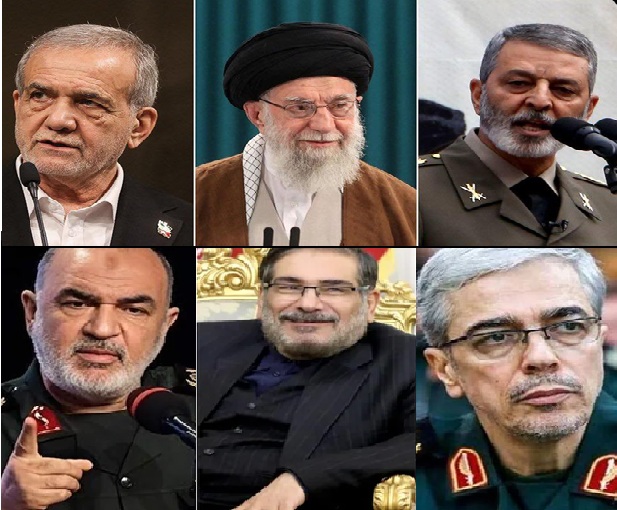
- Since the end of the Second World War, Israel has assassinated more individuals – over 2,700 operations – more than any other democratic country employing tactics from poisoned toothpaste to exploding mobile phones.
- The Jewish Hebrew Bible’s Talmudic Precept ‘If someone comes to kill you, rise and kill him first’, encapsulates Israel’s pre-emptive approach to survival, rooted in its precarious geopolitical reality.
- Israel justifies its strategy of targeted killings as an extension of its right to self-defence under Article 51 of the United Nations Charter, which allows nations to defend themselves against armed attacks.
- The joint Israel–US strikes, culminating in the death of Iran’s Supreme Leader, may unify the Iranian population behind the regime and harden Tehran’s stance against nuclear and missile concessions.
Israel has long institutionalised targeted killings as a tool of pre-emptive self-defence, grounded in its perception of existential vulnerability and justified under Article 51 of the UN Charter.
Operation Roaring Lion in February 2026 marks a decisive escalation from covert shadow war to open, coordinated Israel–US military action against Iran, aimed at degrading Tehran’s nuclear and missile capabilities and restoring deterrence.
However, the killing of Iran’s Supreme Leader risks strategic blowback. Instead of forcing concessions or enabling regime change, it may consolidate domestic support for the Islamic regime and harden Iran’s resolve.
Introduction
Since the end of the Second World War, Israel has assassinated more individuals – over 2,700 operations – more than any other democratic country employing tactics from poisoned toothpaste to exploding mobile phones.
The Jewish Hebrew Bible’s Talmudic Precept “If someone comes to kill you, rise and kill him first “, encapsulates Israel’s pre-emptive approach to survival, rooted in its precarious geopolitical reality. The roots of this doctrine can be traced back to before Israel’s independence, when pre -state Jewish Zionist militias in British mandate Palestine, like Bar Giora (1907 – 1909) and the Haganah, conducted targeted killings against their adversaries. These pre-state Zionist militias evolved into the Israel Defence Forces (IDF ), Mossad (Israel’s foreign intelligence agency), and Shin Bet ( Israel’s domestic security service ) after Israel’s independence in 1948.
Nazi Germany’s extermination of six million Jews in Europe in what became known as the Holocaust during the Second World War cemented Israel’s belief in existential vulnerability, justifying extreme measures to thwart national security threats. From the 1940’s, targeting British colonial officials and Nazi collaborators, to the post – 1948 era, eliminating Palestinian, Hezbollah, and Iranian figures, Israel’s Defence Forces and Intelligence services honed assassination as a substitute for conventional war. Assassination techniques deployed by the Israeli state against its adversaries include drones, remote-controlled bombs, cyber sabotage, special forces raids and Air Strikes.
Israel justifies its strategy of targeted killings as an extension of its right to self-defence under Article 51 of the United Nations Charter, which allows nations to defend themselves against armed attacks. By framing assassinations as pre-emptive strikes against imminent threats, Israel asserts it is acting within its legal rights. Israel often designates targeted individuals as combatants or unlawful combatants, arguing that they are actively engaged in hostilities against the state.
Israel has been criticised by some in the international community, who claim that targeted killings are extrajudicial and therefore violations of international law. This has strained Israel’s diplomatic relations and fuelled anti-Israel sentiment globally. Targeted killing operations often result in collateral damage, leading to the deaths of innocent civilians and exacerbating regional tensions. Collateral damage not only raises humanitarian concerns but can also create a backlash against the state conducting the assassination, potentially fuelling further violence and radicalisation.
Israel’s shift from covert operations to joint overt Israel- US military strikes against Iran
Iran and Israel have been engaged in a covert war for years, which involves support for armed proxy groups and targeted killings. As part of its covert war with Iran, Israel has engaged in the targeted killings of over a dozen nuclear scientists and military commanders within Iran. This includes the 2020 assassination of Iran’s top nuclear scientist Mohsen Fakrizadeh using an AI-assisted, remote -controlled killer robot.
On February 28, 2026, Israel launched Operation Roaring Lion, which to date is Israel’s largest ever overt military campaign against Iran. The United States participated under a separate Pentagon designation – Operation Epic Fury – covering American air, naval and missile components. The strikes followed US and Israeli intelligence assessments that Iran had enriched uranium beyond 90 per cent near weapons-grade level at sites including Fordow and Natanz. As per its Begin Doctrine, Israel has long stated it would not permit Iran to cross what it calls the “nuclear threshold.
Diplomatic negotiations between the United States and Iran had stalled. The US administration framed the operation as an effort to permanently degrade Iran’s ability to produce nuclear weapons and long-range missiles. Strategically, the campaign appears designed to:
- Reduce nuclear enrichment capacity
- Destroy missile production and storage sites
- Disrupt IRGC command and control (C2) nodes
- Restore deterrence through overwhelming force
The joint Israel – US military strikes have resulted in the death of Iran’s Supreme Leader Ayatollah Khamenei. Thus, unlike Israel’s earlier limited strikes Operation Roaring Lion seems to be structured as a sustained degradation campaign whose long term goal sems to be to facilitate the overthrow of Iran’s Islamic regime by sections of Iran’s population who are dissatisfied with Iran’s economic problems due to Western economic sanctions as well as those sections of Iranian society who are opposed to the Islamic regime’s restrictions on political freedoms and women’s rights. That such dissatisfaction against the regime exists is evident, given the regime’s harsh crackdown on recent public protests over the country’s worsening economic conditions.
Within hours, Iran retaliated in an operation codenamed Operation True Promise 4, launching a massive missile and drone barrage targeting Israel and US military facilities across Kuwait, UAE, Bahrain, Turkey and Saudi Arabia. This confrontation marks a decisive shift from covert shadow conflict to open, coordinated state-on-state warfare.
Conclusion
Thus, while regime change in Iran seems to be the long-term goal behind Israel and the US’s decision to resort to military strikes, the short-term goal seems to be to put pressure on Iran’s Islamic regime to make diplomatic concessions regarding Iran’s nuclear program. However, instead, the joint military strikes by Israel and the US, which have resulted in the death of Iran’s Supreme Leader, could instead result in uniting Iran’s population behind the Islamic regime and bolstering its domestic legitimacy in the face of an external military attack and make it more unwilling to make diplomatic concessions regarding Iran’s nuclear and missile programs.
References
- Alexander, K (2024). A Double-Edged Sword: Political and Tactical Implications of Israel’s Targeted Killings Strategy. Retrieved from https://www.isdp.eu/a-double-edged-sword-political-and-tactical-implications-of-israels-targeted-killing-strategy/
- Ashok, D (2025). Operation Rising Lion: Examining Israel’s ‘Begin Doctrine’, Conflict with Iran, and Impact on Regional Geopolitics. Retrieved from https://samvadaworld.com/world/operation-rising-lion-examining-israels-begin-doctrine-conflict-with-iran-and-impact-on-regional-geopolitics/
- Masood, K (2025). Unveiling the Shadows: Ronen Bergman’s Rise and Kill First and Israel’s Targeted Assassinations. Retrieved from https://khalidmasood.com/ronen-bergman-rise-and-kill-first/
- Srivastava, P (2026 ). Explained: Tactical anatomy of Israel- US strike on Iran and Tehran’s counteroffensive. Retrieved from https://www.nationalheraldindia.com/international/explained-tactical-anatomy-of-israelus-strike-on-iran-and-tehrans-counteroffensive

Dhruv Ashok is a PhD research scholar from Christ (Deemed to be University), Bangalore. He writes on current affairs and international politics. His areas of interest include conflict resolution and historical narratives. Views expressed are the author’s own.
 Pranav S
  Ajith Shetty Heranje
  Atri Patel