
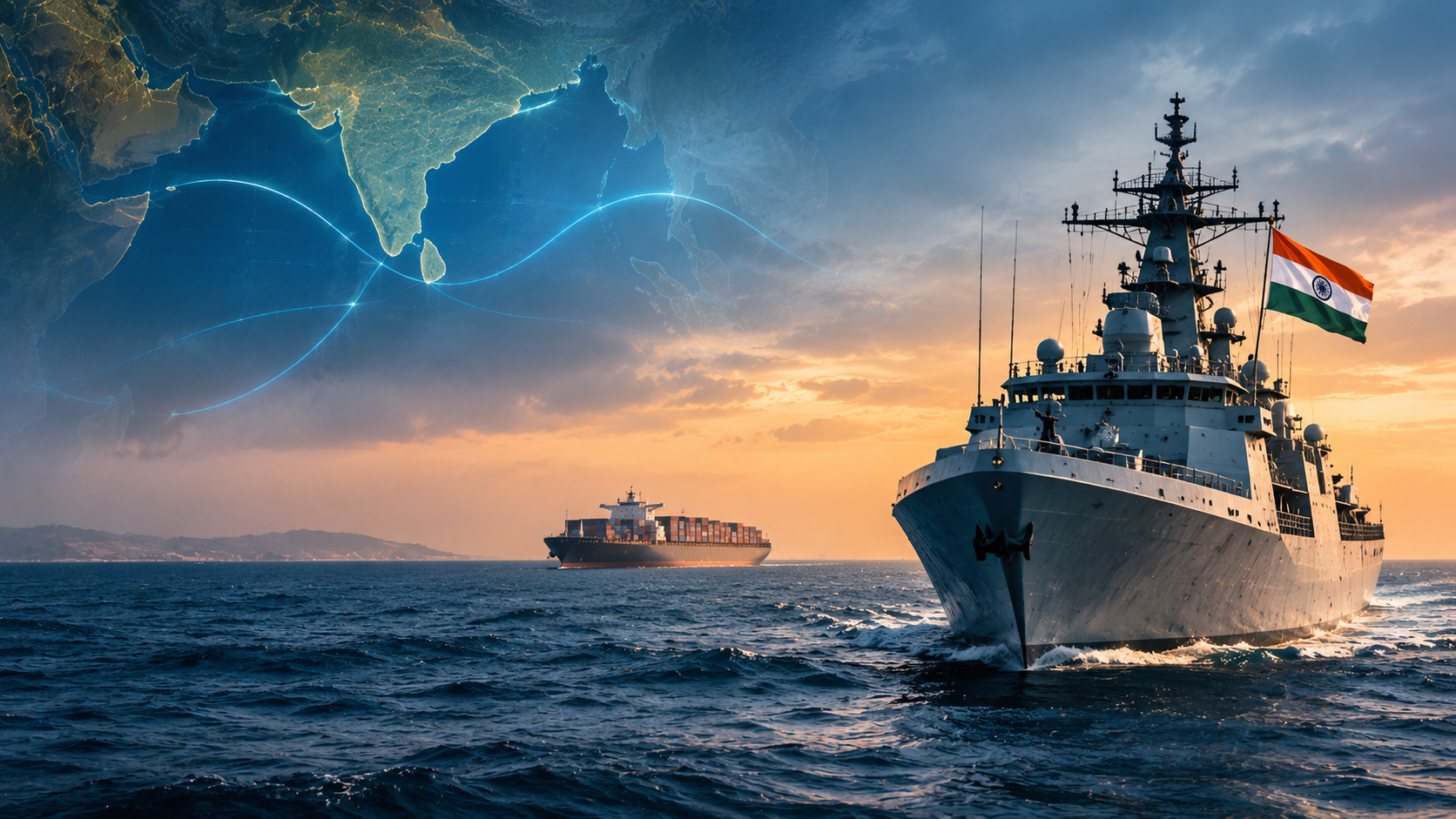
- For India, this oceanic space is not merely an extended neighbourhood but a vital strategic frontier upon which its economic modernisation, national security, and international stature depend.
- Therefore, any protracted disruption or blockade at these critical nodes directly jeopardises the energy security, industrial input stability, and economic growth of India and the broader littoral region.
- In an era marked by intense competition among global powers, New Delhi actively resists being drawn into rigid military alliances.
- The strategic goal is not total control over oceanic spaces, but rather the creation of a secure, collaborative, and interconnected maritime domain where no single power can dictate the flow of trade or compromise regional stability.
The Indian Ocean Region has re-emerged as the geographic and economic centre of twenty-first-century geopolitics. Characterised by vast oceanic expanses that connect the resource-rich regions of the Middle East and Africa to the manufacturing powerhouses of East Asia, the Indian Ocean serves as the world’s primary maritime highway. For India, this oceanic space is not merely an extended neighbourhood but a vital strategic frontier upon which its economic modernisation, national security, and international stature depend. Amid unprecedented global geopolitical friction, supply chain vulnerabilities, and frequent maritime disruptions—ranging from regional conflict and piracy to state-sponsored militia actions—New Delhi has had to radically re-evaluate its approach to ocean governance and power projection. Historically perceived as a major regional power primarily focused on continental defence along its land borders, India is rapidly transforming into a proactive maritime security provider. This evolution requires balancing kinetic naval capabilities with long-term infrastructure diplomacy, ensuring that its strategic autonomy remains intact while safeguarding the critical sea lanes of communication that sustain regional and global stability.
India’s operational approach in the Indian Ocean combines hard naval power with a focus on developing maritime infrastructure. As a historical net security provider, the Indian Navy serves as the first responder to incidents such as humanitarian disasters and maritime piracy. At the same time, New Delhi is engaged in developing various naval facilities and basing infrastructure in important countries located near the ocean. The rationale behind this is that being present physically and building up the infrastructure allows the country to maintain its influence in the region in the long run. By creating the naval and logistical facilities in the neighbouring island states, India seeks to prevent the emergence of exclusive operational domains. The combination of the security activities and the construction of infrastructure facilities gives New Delhi the possibility to act as a leader without using threats of coercion toward regional partners.
Strategic Chokepoints and the Vulnerabilities of Regional Trade
Three important maritime chokepoints define the geography of the Indian Ocean. These are the Strait of Hormuz, Bab al-Mandeb, and the Malacca Strait. These narrow channels control the movements of trade and energy supplies, thereby playing an important role in global commerce while also serving as points of vulnerability. The Strait of Hormuz is a route that carries a large part of the world’s crude oil supply and constantly faces the risk of geopolitical tensions in the Middle East. In the same vein, the Bab al-Mandeb connects the Red Sea with the Gulf of Aden and has shown extreme vulnerability to different types of warfare, which has created a tendency of missile strikes and drone attacks threatening global shipping movements worldwide. Finally, the Malacca Strait forms an essential link between the Indian Ocean and the Western Pacific Ocean and receives tankers full of oil and other cargoes bound for East Asia. Therefore, any protracted disruption or blockade at these critical nodes directly jeopardises the energy security, industrial input stability, and economic growth of India and the broader littoral region.
Mitigating risks around these maritime chokepoints requires a sophisticated strategy combining persistent surveillance, tactical naval deployments, and international operational coordination. India has increasingly deployed naval task forces to critical operational zones, conducting anti-piracy patrols, escorting commercial vessels, and securing critical shipping lanes near the Gulf of Aden and the Arabian Sea. Beyond physical maritime presence, India has spearheaded the integration of maritime domain awareness through mechanisms like the Information Fusion Centre for the Indian Ocean Region. By sharing real-time tracking data with partner nations, New Delhi enhances collective visibility over vessel movements, illegal fishing, human trafficking, and potential asymmetric threats near these narrow passages. This multi-layered defence strategy aims to insulate national and regional economies from sudden supply chain shocks while signalling that India possesses both the capacity and the political will to protect the freedom of navigation through vulnerable chokepoints.
Power Projection via the Andaman and Nicobar Islands and Regional Infrastructure Partnerships
At the core of India’s operational geography lies the Andaman and Nicobar Islands, an archipelago situated strategically at the western entrance of the Malacca Strait. Transforming this island chain from an isolated territorial outpost into a formidable strategic theatre is central to India’s maritime power projection. The establishment of the Andaman and Nicobar Command, India’s first tri-services operational command, highlights the military significance of the archipelago. By upgrading airfields, expanding port capacities, and stationing advanced surveillance assets across these islands, India gains an unhindered capability to monitor maritime traffic passing through the Malacca, Sunda, and Lombok Straits. The Andaman and Nicobar Islands serve as a natural aircraft carrier, providing an unsinkable forward base that allows the Indian Armed Forces to project power deep into the Southeast Asian maritime theatre and deter aggressive naval posturing by external powers seeking to expand their footprint in the region.
Complementing this domestic strategic asset are India’s complex infrastructure and diplomatic engagements in key littoral states like Sri Lanka and the Maldives. Located directly along critical East-West shipping lanes, these island nations hold paramount strategic value. India’s approach in Colombo, Hambantota, and Malé centres on offering sustainable development assistance, building military and civilian port facilities, providing maritime patrol assets, and enhancing local security capabilities. While political shifts in Colombo and Malé have periodically tested New Delhi’s diplomatic agility, India has consistently pursued long-term economic integration and security cooperation. By funding deep-water container terminals, dockyard development projects, and coastal radar networks, India seeks to embed itself deeply within the maritime infrastructure of Sri Lanka and the Maldives. This strategy ensures that critical port infrastructure in India’s immediate maritime backyard remains open, transparent, and aligned with shared regional security interests rather than becoming specialised footholds for external military dominance.
Strategic Autonomy and Multipolar Dynamics in Foreign Policy Execution
Navigating the increasingly complex multipolar order requires India to maintain a delicate balance between expanding its partnerships and preserving its strategic autonomy. In an era marked by intense competition among global powers, New Delhi actively resists being drawn into rigid military alliances. Instead, India relies on multi-alignment, maintaining robust security partnerships with Western nations through platforms like the Quad, while simultaneously engaging with traditional partners and regional grouping frameworks. This pragmatic approach allows India to leverage technological, intelligence, and logistical sharing with major powers to bolster its own naval capabilities without compromising its independent decision-making authority. By maintaining an autonomous operational capabilities framework, India positions itself as an indispensable balancer in the Indian Ocean Region, capable of acting independently or collaboratively depending on the demands of regional stability.
This flexible approach directly supports India’s strategic objectives under its ‘Neighbourhood First’ and ‘Act East’ foreign policies. Through the ‘Neighbourhood First’ vision, India prioritises economic connectivity, humanitarian relief, and capacity-building among its immediate maritime neighbours, fostering a safe and secure local environment through mutual trust and shared responsibility. Simultaneously, the ‘Act East’ policy anchors India’s strategic integration with Southeast Asia, using maritime security cooperation as a primary engine for diplomatic and economic outreach. By maintaining open communication channels, executing joint naval exercises, and establishing bilateral logistics-sharing arrangements with regional states, India bridges the geographic gap between South and Southeast Asia. Ultimately, India’s foreign policy framework ensures that its maritime security posture remains dedicated to upholding a rules-based order that protects national interest, promotes regional economic growth, and guarantees unimpeded access to global maritime commons.
The Path Ahead for India’s Maritime Vision
Looking toward the future, India’s trajectory as a primary maritime power in the Indian Ocean Region will depend on its ability to continually adapt to technological shifts, economic demands, and changing geopolitical realities. The ongoing modernisation of the Indian Navy—emphasising Indigenous warship construction, expanded submarine fleets, advanced unmanned surveillance systems, and integrated cyber capabilities—reflects a comprehensive effort to match expanding strategic responsibilities with concrete capabilities. Furthermore, sustainable security in the Indian Ocean requires going beyond traditional military power to encompass blue economy initiatives, climate resilience, and maritime environmental protection, areas where small island states urgently require leadership and support.
By continuing to blend proactive security enforcement, inclusive infrastructure development, and flexible diplomatic manoeuvring, India is establishing a durable operational model for regional stability. The strategic goal is not total control over oceanic spaces, but rather the creation of a secure, collaborative, and interconnected maritime domain where no single power can dictate the flow of trade or compromise regional stability. As global reliance on Indian Ocean sea lanes intensifies amidst ongoing geopolitical shifts, India’s success in securing its strategic autonomy, safeguarding critical chokepoints, and supporting its regional partners will remain a defining feature of international security in the decades to come.
References:
- Maritime chokepoints: India’s energy and trade vulnerabilities and strategic responses
- Asia-Pacific Regional Security Assessment – Chapter 5: Securing Sea Lanes: Maritime Choke Points in the Indian Ocean Region
- Chokepoints of the World: How a Handful of Narrow Waters Hold Global Commerce Hostage
- Maritime chokepoints and the politics of energy security in the Indo-Pacific
- Geopolitics Of The Indian Ocean: Maritime Security, Trade Routes, and Strategic Competition

Hridbina Chatterjee is a columnist and policy researcher with a focus on South Asian geopolitics, India’s foreign policy, and the Indo-Pacific.
 Archita Gaur
 Aayush Pal
 Anusreeta Dutta