
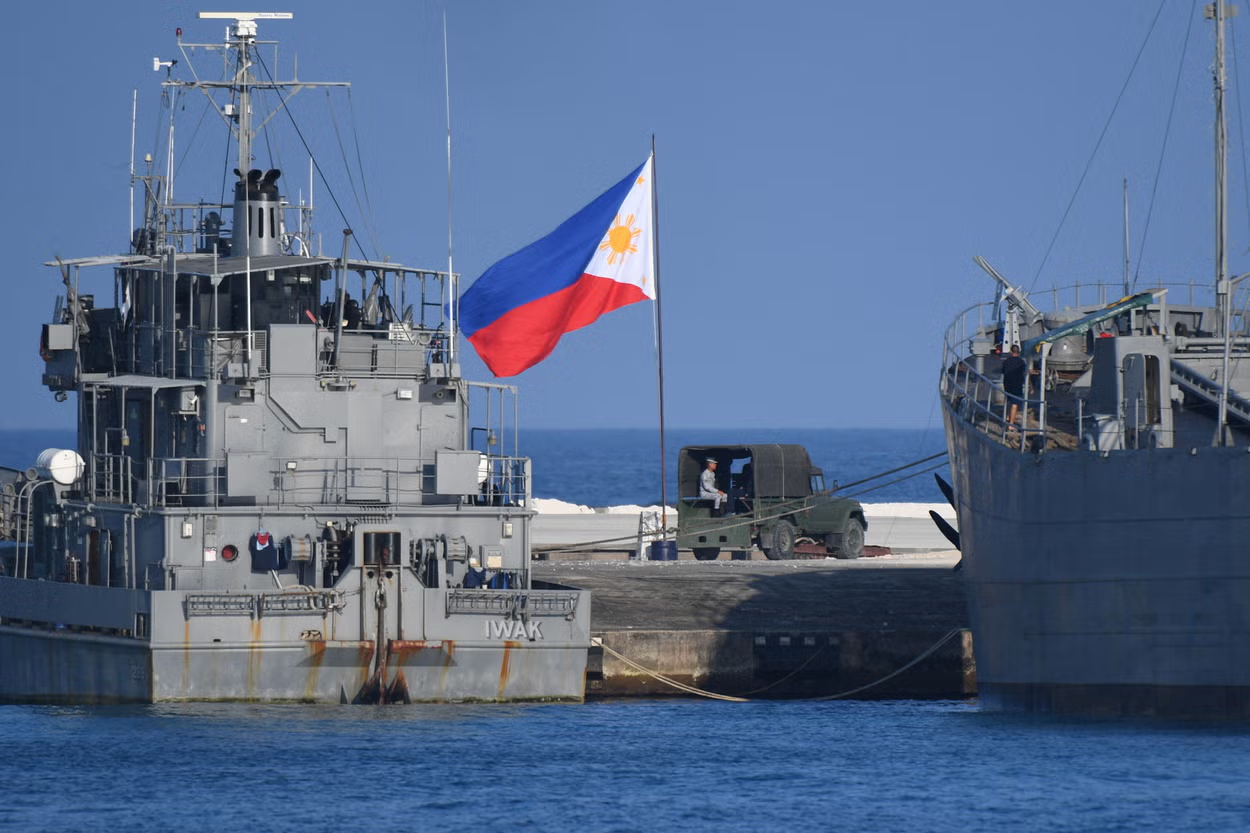
- China, over the years, has stopped the Philippines and other countries from conducting any military or economic co-operation without its consent, claiming it falls under China’s Exclusive Economic Zone (EEZ).
- The Philippines recently conducted a joint military exercise with the U.S. in the Scarborough Shoal Sea that falls within the Philippines’ economic zone, which China claims is its sovereignty.
- The Philippines and Japan have signed two defence pacts allowing their forces to exchange supplies and services and countering China’s regional hegemony.
On 26th Jan 2026, the Philippines Foreign Ministry made a “firm representation” to China’s embassy and its ambassador in Manila over an “escalation of public exchanges” between the Chinese and Philippine officials over disputes in the South China Sea. Manila and Beijing have been engaged in a series of maritime confrontations in recent years, with the Philippines accusing China of repetitive aggressive actions inside its economic zone, which includes dangerous manoeuvres, water-cannoning and the disruption of resupply missions.
The South China Sea is situated just south of the Chinese mainland and is bordered by the countries of Brunei, China, Indonesia, Malaysia, the Philippines, Taiwan and Vietnam. It extends from the Strait of Malacca in the southwest to the Strait of Taiwan in the northeast. It is connected by the Taiwan Strait with the East China Sea and by the Luzon Strait with the Philippine Sea. Different countries have disagreed over the territorial control of the sea for centuries. China, over the years, has stopped other nations from conducting any military or economic co-operation without its consent, claiming it falls under China’s Exclusive Economic Zone (EEZ). China has constructed various ports, military islands and airstrips, particularly in the Paracel and Spratly Islands, where it has 20 and 7 outposts. It has also militarised Woody Island by deploying fighter jets, cruise missiles and a radar system.
The Philippines has claimed the Spratly Islands; both China and the Philippines also claim sovereignty over the Scarborough Shoal, but China maintains de facto control over Scarborough. There has been a conflict between the Philippines and China over claims on the South China Sea, due to which the Philippines approached the Permanent Court of Arbitration (PCA) under the United Nations Convention on the Law of the Sea (UNCLOS). According to the judgment of the Permanent Court of Arbitration, the Philippines won most of its cases against China, and it was decided by the PCA that the Philippines has exclusive sovereign rights over the West Philippine Sea (in the South China Sea), and the judgment by the PCA states that China’s “nine-dash line” is invalid.
The Philippines Maritime Strategy to tackle China
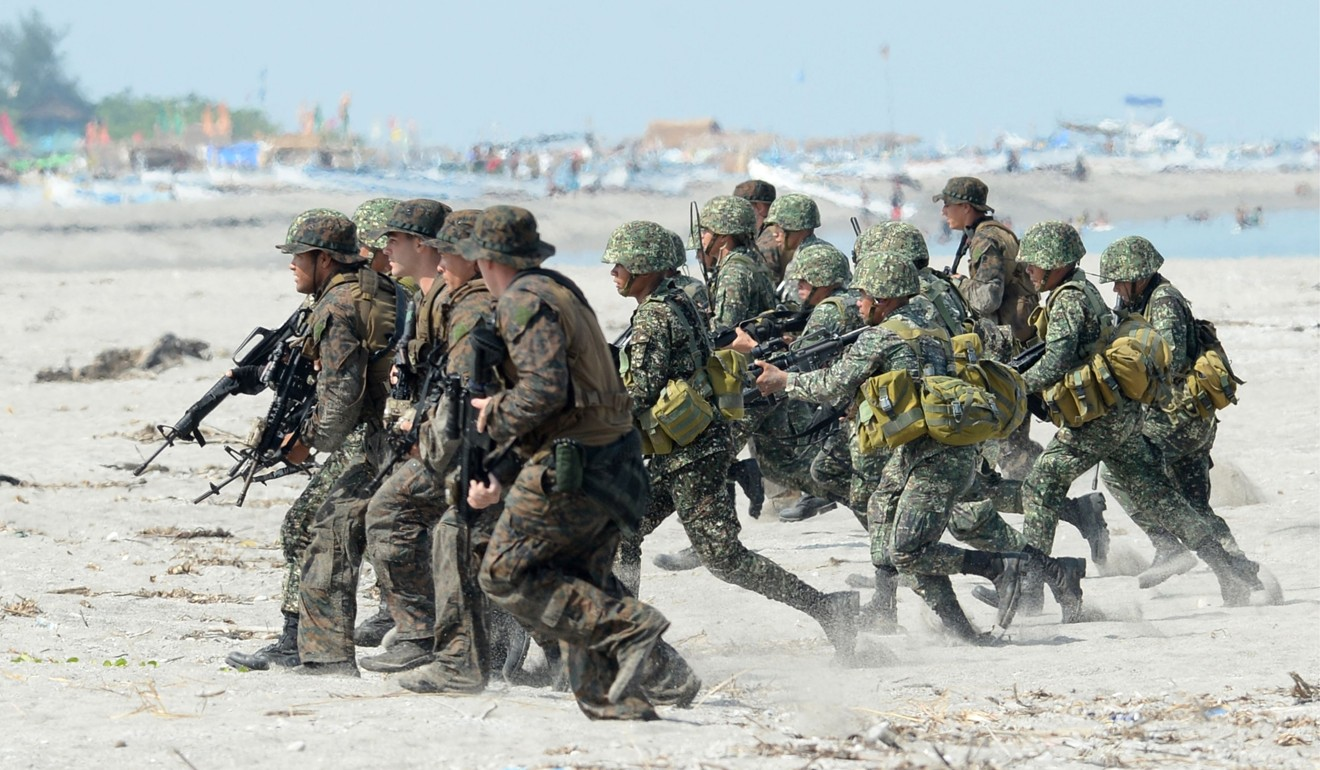
The Philippines recently conducted a joint military exercise with the U.S. in the Scarborough Shoal Sea that falls within the Philippines’ economic zone, which China claims is its sovereignty. The joint military exercise was to boost the interoperability between the two allies and to counter China’s dominance in the South China Sea. Both the Philippine Coast Guard and the US Coast Guard jointly carried out patrols of the Bakshi Channel. Taiwan also sent observers to a joint US-Philippine-Japan military exercise that took place in Batanes Islands called Kamandag in late May; both countries are trying to balance China at the South China Sea.
On the other hand, the Philippines and Japan have signed two defence pacts allowing their forces to exchange supplies and services and countering China’s regional hegemony. The Foreign Minister of Japan, Toshimitsu Motegi and the Foreign Minister of the Philippines, Foreign Secretary Theresa Lazaro, signed the Acquisition and Cross-Servicing Agreement, which allows tax-free provision of ammunition, fuel, food and other necessities. Both ministers have announced an Official Security Assistance package worth $6m to fund the facilities to house rigid-hulled inflatable boats donated by Japan to boost Manila’s naval capabilities.
In mid-2024, both Japan and the Philippines signed the Reciprocal Access Agreement, allowing the deployment of both countries’ forces for joint and larger combat exercises, including the live-fire drill. However, the agreement took effect in Sept 2024.
The growing tensions between China and the Philippines are due to sovereignty claims by both over the Spratly Islands. The Philippines interest in the South China Sea is due to the region’s potential petroleum resources. Currently, the Philippines is increasing its relations with the US and Japan to counter China’s dominance at the South China Sea after it has claimed 90% of the Sea through the nine-dash line.
References:
- https://www.cfr.org/global-conflict-tracker/conflict/territorial-disputes-south-china-sea
- –https://pppescp.com/2024/12/09/the-south-china-sea-a-complex-historical-and-geopolitical-landscape/
- –https://www.reuters.com/world/asia-pacific/philippines-lodges-firm-representations-chinese-embassy-over-escalating-war-2026-01-26/#:~:text=Manila%20and%20Beijing%20have%20been,the%20disruption%20of%20resupply%20missions
- –https://www.thehindu.com/news/international/philippines-us-hold-joint-sail-in-disputed-south-china-sea-shoal/article70555203.ece
- –https://www.aljazeera.com/news/2026/1/15/japan-philippines-sign-new-defence-pacts-amid-surging-china-tensions

Antara Deka is a student of Political Science at North Eastern Hill University and History at Indira Gandhi National Open University. Her interests include political awareness and civic engagement, and she has been actively involved in initiatives promoting informed participation among youth. Views expressed are the author’s own.
 Faareha Usmani
  Hridbina Chatterjee
  Aayush Pal