
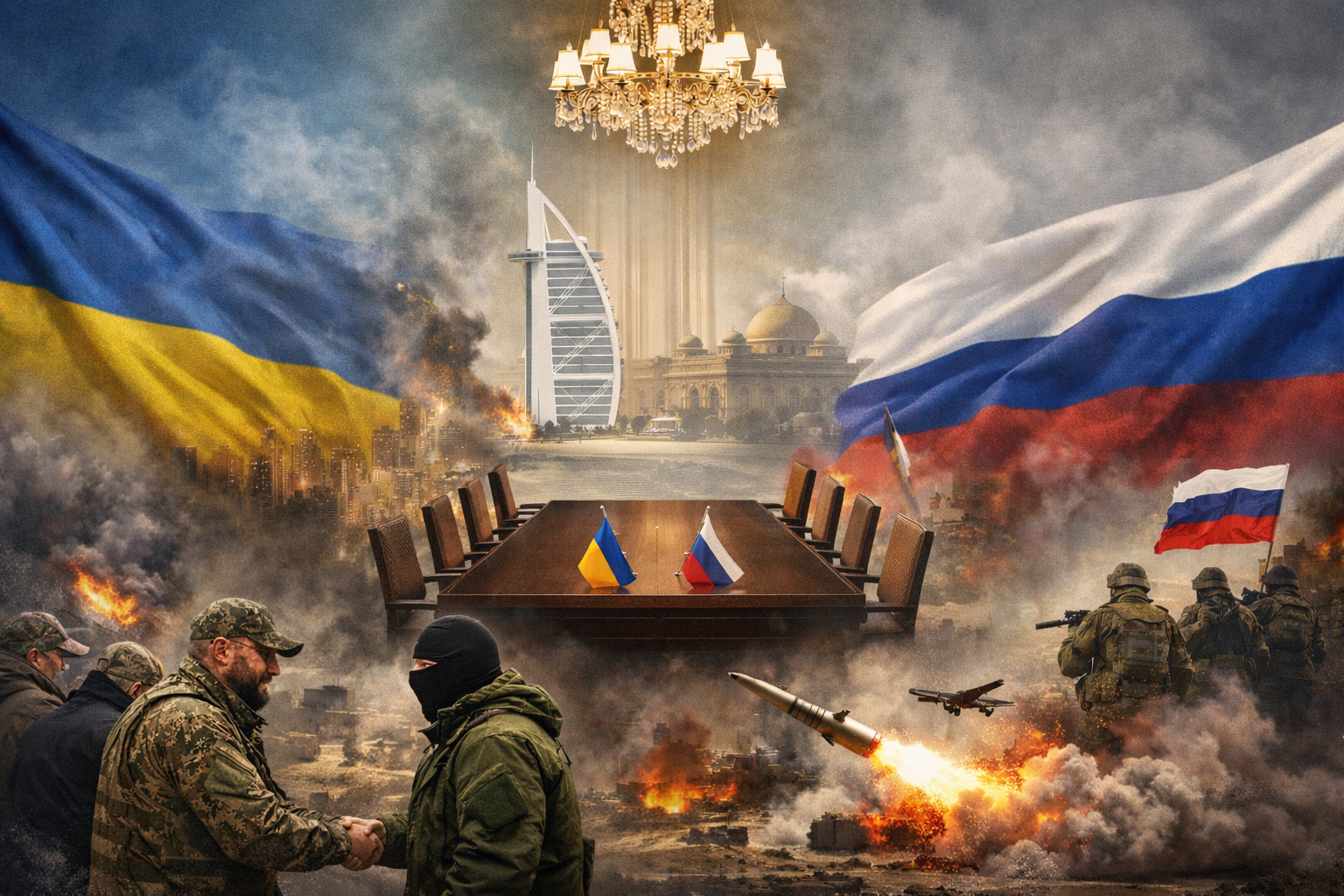
- Ukraine and Russia have concluded the second day of United States-brokered negotiations in Abu Dhabi, UAE, today, reaching no breakthrough towards ending the war.
- Despite the absence of a peace breakthrough, a prisoner exchange deal offered a limited humanitarian relief, marking the first such exchange in five months.
- During the latest talks, Russia not only wants de facto control but also de jure international recognition, including from the USA, of its claims over parts of the Donbas region.
Ukraine and Russia have concluded the second day of United States- brokered negotiations in Abu Dhabi, UAE, today, reaching no breakthrough towards ending the war. Steve Witkoff, a member of the mediation team and a representative of the USA special envoy, stated that while “significant work remains in the peace negotiations to end the war, the diplomatic engagement will be effective in advancing efforts toward a resolution“. Russia and Ukraine also agreed to establish a military-to-military dialogue, which has been suspended since 2021.
The first round of trilateral negotiations took place in late January, but failed to resolve the question of territory. This latest round has been comparatively more substantive and is expected to contribute to renewed United States–Russia diplomatic engagement.
Despite the absence of a peace breakthrough, a prisoner exchange deal offered a limited humanitarian relief, marking the first such exchange in five months. Ukraine and Russia agreed to exchange more than 157 prisoners of war. In the previous year, Moscow and Kyiv conducted three prisoner exchanges during negotiations held in Istanbul.
During the latest talks, Russia renewed its territorial demands, seeking control over an additional area in the Donbas region, a condition that President Volodymyr Zelensky has rejected. Russia not only wants de facto control but also de jure international recognition, including from the USA, of its claims over parts of the Donbas region.
Even as the prisoner exchange was being finalised, hostilities continued across Ukraine. Russia launched a ballistic missile attack and 183 drones overnight in Ukraine. These strikes left many residents of high-rise apartment buildings without electricity, disrupting elevators and heating systems amid freezing winter temperatures.
Russian drones and missile strikes have also targeted already-damaged energy infrastructure, resulting in civilian casualties and further strain on essential services.
In the broader geopolitical context, the talks reflect the growing role of third-party mediators and a pattern of humanitarian relief. Kyiv’s demand for robust security guarantees from its European allies and the US marks the pivotal role of these countries in the settlement of disputes. Negotiations are expected to continue in the coming weeks, with both sides consulting their respective capitals and preparing for subsequent rounds of dialogue.

Anshika Agrawal is a research scholar at the Centre for Russian and Central Asian Studies, Jawaharlal Nehru University, with a strong interest in current affairs, bilateral and multilateral relations, and public policy. Views expressed are the author’s own.
 Joy Aditya Phookan