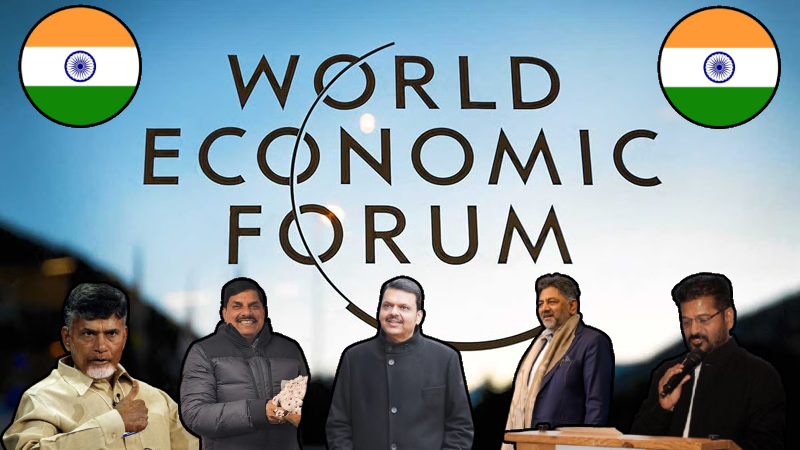
- For India, Davos 2026 represented a significant opportunity to reinforce its economic credibility and governance credentials on the global stage.
- India’s focus went beyond deal-making to long-term partnership, reinforcing India’s role as a trusted contributor to global economic resilience and technological transformation.
- While the WEF does not produce binding resolutions, it functions as a policy and governance barometer, shaping global debate and informing national reforms.
- Amid geopolitical rifts, technological disruption, and rising global risks, “A Spirit of Dialogue” defined WEF 2026—underscoring that cooperation, attentive listening, and shared purpose remain essential to collective progress.
Every January, the snow-clad resort town of Davos in the Swiss Alps becomes the epicentre of global economic discourse. The World Economic Forum (WEF) Annual Meeting brings together heads of state, global CEOs, policymakers, civil society leaders and innovators to deliberate on pressing economic, governance and geopolitical challenges. Over time, “Davos” has evolved into a critical platform for shaping global policy narratives through public–private cooperation.
Founded in 1971 by Klaus Schwab as the European Management Forum, the organisation initially focused on improving European corporate competitiveness. As globalisation deepened, the forum expanded its mandate and was renamed the World Economic Forum in 1987, marking its transition into a global policy-oriented institution. Beyond economics, the WEF has historically functioned as a neutral diplomatic space, facilitating dialogue between rival states and supporting broader governance reforms worldwide.
WEF 2026: “A Spirit of Dialogue” Amid Global Uncertainty
The 56th Annual Meeting of the World Economic Forum, held from January 19 to 23, 2026, in Davos, Switzerland, convened nearly 3,000 leaders from more than 130 countries under the official theme “A Spirit of Dialogue.” This theme encapsulated the forum’s emphasis on cooperation, mutual listening and constructive engagement as geopolitical and economic fragmentation intensifies.
“A Spirit of Dialogue” reflected the need to bridge divisions on issues ranging from global trade and climate governance to digital transformation and security cooperation. It emphasised openness, trust-building and collaborative problem-solving as essential to navigating a contesting world where unilateral approaches and rival blocs are increasingly prominent.
India’s Strategic Engagement at Davos 2026
For India, Davos 2026 represented a significant opportunity to reinforce its economic credibility and governance credentials on the global stage. Indian leaders, policymakers and state delegations used the platform to highlight reforms, attract global capital and shape discussions on technology governance, climate resilience and inclusive growth.
India projected a confident “Team India” narrative, positioning the country as a stable, high–growth and future-ready global partner. The focus went beyond deal-making to long-term partnership, reinforcing India’s role as a trusted contributor to global economic resilience and technological transformation.
Policy and Governance Priorities from an Indian Perspective
1. Digital Transformation and Responsible Innovation
India’s digital public infrastructure, including governance platforms like Aadhaar and UPI, remained central to discussions on responsible digitalisation, data protection norms and scalable AI governance.
2. Climate Action and Sustainable Growth
India’s climate engagement at Davos stressed the importance of climate finance, green energy transitions and sustainable industrial policy. States such as Gujarat, Maharashtra and Madhya Pradesh shared progress on renewable energy capacity, green hydrogen roadmaps and low-carbon industrial development.
3. Manufacturing, Trade and Global Supply Chains
India continued to position itself as a resilient manufacturing destination under “Make in India” and “Atmanirbhar Bharat.” Andhra Pradesh, Telangana and Karnataka pushed their strengths in technology, semiconductor ecosystems, life sciences and logistics.
State Spotlight: Maharashtra, Madhya Pradesh, Gujarat, Andhra Pradesh, Telangana and Karnataka
A defining feature of WEF 2026 was the elevated role of Indian states in global investment diplomacy, illustrating a new era of competitive and cooperative federalism.
Maharashtra: Investment Magnet and Growth Engine
Maharashtra emerged as India’s most prominent state at Davos, signing MoUs and investment commitments worth around ₹30 lakh crore (approximately USD 360 billion) across sectors, including AI, infrastructure, industry and sustainability.
Key agreements included major AI-led initiatives and strategic partnerships, such as a reported USD 11 billion Tata Group investment in AI and innovation infrastructure, and Mumbai Metropolitan Region deals amounting to USD 26 billion in AI and sustainable industry projects. These investments strengthen Maharashtra’s aspirations to become a $1 trillion economy by 2030, driven by diversification across manufacturing, services, technology and logistics.
Other States Driving India’s Investment and Governance Narrative
- Telangana: Positioned as a hub for life sciences, digital technologies and R&D, with proactive policy frameworks to attract global capital.
- Karnataka: Focused on deepening its leadership in tech innovation, semiconductor design and biotechnology.
- Andhra Pradesh: Highlighted logistics corridors, industrial clusters and emerging innovation districts.
- Gujarat: Showcased green energy transitions, petrochemical diversification and port-linked manufacturing.
- Madhya Pradesh: Promoted agribusiness, inclusive industrial policy and skills-driven workforce transformation.
Davos as a Policy and Governance Barometer
While the World Economic Forum does not produce binding resolutions, it functions as a policy and governance barometer, shaping global debate and informing national reforms. Discussions in Davos’ plenaries and side dialogues influence how governments calibrate economic strategies, regulatory frameworks and multilateral priorities.
For India, the robust investment figures and active state participation at WEF 2026 signal both global trust in India’s growth story and the maturation of state-led international engagement in shaping national development pathways.
Conclusion
In an era marked by geopolitical fissures, technological disruption and complex global risks, “A Spirit of Dialogue” served as the defining theme of WEF 2026, a reminder that cooperation, mutual listening and shared purpose remain crucial for collective progress. For India and its proactive states, from Maharashtra’s record investment mobilisation to Karnataka’s tech leadership, Davos 2026 affirmed not just economic ambition, but governance confidence in engaging a rapidly evolving global order.
References:
- https://www.weforum.org/about/klaus-schwab/
- https://www.weforum.org/stories/2025/10/davos-2026-convenes-under-the-theme-a-spirit-of-dialogue/
- https://www.newsonair.gov.in/maharashtra-cm-devendra-fadnavis-says-mous-worth-₹30-lakh-crore-signed-at-world-economic-forum-davos/

Megna Devkar is a Ph.D. Research Scholar at K.C. Law College with research and writing expertise in social, political, and legal issues. Views expressed are the author’s own.
 Parag Gilada
  Anusreeta Dutta
  Amit Dasgupta & Uma Sudhindra