
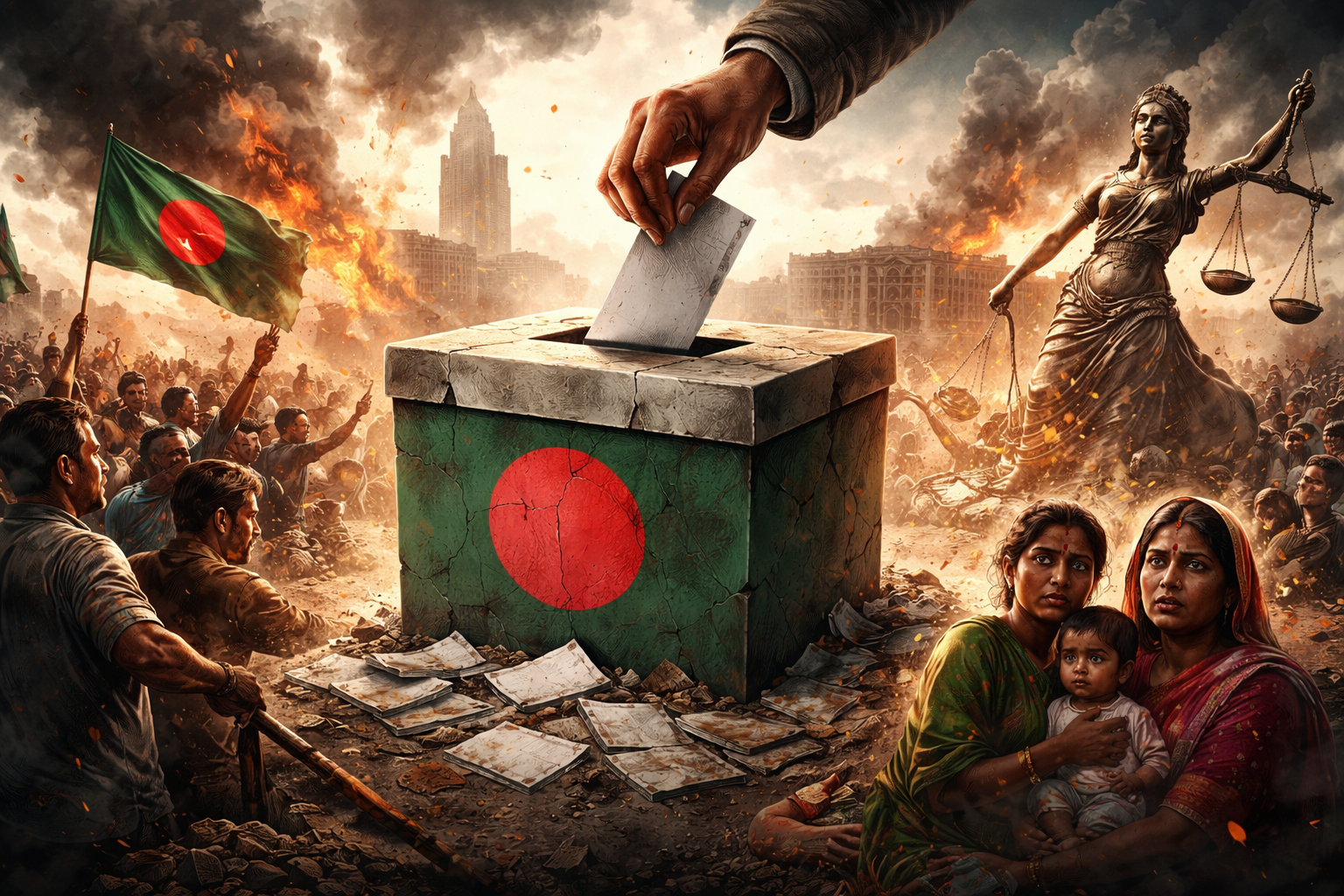
- The Awami League, which had dominated national politics since independence, has been barred from contesting the election for the first time in its history after Sheikh Hasina fled the country.
- At present, the representation of Hindus among parliamentary candidates stands at only 0.67% of the 300 seats.
- Escalation of violence against minority Hindus has attracted significant international scrutiny, a development that is likely to influence domestic political outcomes and its relations with neighbouring countries.
Bangladesh is gearing up for its general elections, which are scheduled to be held on February 12, 2026. This will mark the first national election following the unconstitutional ouster of former Prime Minister Hasina Sheikh, who was forced to leave office and live in exile amid intensifying civil unrest that erupted after nationwide student protests in 2024. The protests were directed against the 56% of reservation quota in government positions for the descendants of former freedom fighters who took part in the 1971 War of Independence. The violence grew brutal, forcing Sheikh Hasina to flee the country. Since then, Muhammad Yunus, nobel peace prize recipeient, was chosen to lead the country in an interim arrangement that has pushed the country into further chaos and mismanagement.
On March 7, 1973, Bangladesh conducted its first general election, marking a historic milestone for the newly independent nation, which had emerged after separating from East Pakistan. The founding leader of the Awami League, Sheikh Mujibur Rahman, who had led the struggle for Independence, won the election as Prime Minister with 292 seats out of 300. Under his leadership, the country laid the foundations of modern Bangladesh. Bangladesh follows a first-past-the-post parliamentary electoral system with single-member constituencies. Since then, the country has been predominantly dominated by two parties- The center-left Awami League and the centre-right Bangladesh National Party, while the other two parties, Jatiya Party (JP) and Jamaat-e- Islami (JP), have also played a major role in national politics, despite having limited vote share.
The Awami League under the leadership of Sheikh Mujibur Rahman ruled from 1972 to 1975 until he was assassinated in 1975. Later on, his daughter, Sheikh Hasina, served two terms as the Prime Minister from 1996-2000 and 2008-2013. In 2014, after the Awami League won the election, it faced a boycott by major opposition parties. The formation of Awami League was based on the ideology of socialism, secularism, non- communalism and Bengali Nationalism. The party developed close political and strategic ties with the Soviet Union and India during its initial years and has consistently maintained a strong relationship with India.
On the other hand, the Bangladesh Nationalist Party, founded in 1978 under the leadership of General Ziaur Rahman, emerged as a centre-right political force that emphasised Bangladeshi Nationalism and the Muslim identity of the country’s majority population. It also sought to establish closer relationships with the United States, Muslim majority countries and oil-rich states while adopting a policy of economic liberalisation. The Bangladesh National Party ruled the country from 1979 to 1981 under Ziaur Rahman and later from 1991 to 1996 and 2001 to 2006 under Khaleda Zia.
The other two political parties, which had a relatively smaller vote share, also played an important role in the country’s politics. On one hand, Jamaat-e-Islami Bangladesh, the country’s main Islamist Party, refused to support the freedom fighters and instead collaborated with the Pakistani military during the liberation war. Jamaat-e-Islami is ideologically opposed to the foundational principles of the Bangladeshi state; consequently, in 2009, the Awami League established the International Crimes Tribunal, which prosecuted and convicted several Jamaat-e-Islami leaders for war crimes committed during the 1971 conflict.
The current political chaos under Muhammad Yunus in Bangladesh has attracted significant international attention. The Awami League, which had dominated national politics since independence, has been barred from contesting the election for the first time in its history after Sheikh Hasina fled the country. The major contenders in the 2026 general election include the Bangladesh National Party and the Jamat-e-Islami. Following the death of former Prime Minister Khaleda Zia in January, her son, Tarique Rahman, is widely regarded as the leading contender for the post of Prime Minister.
On the other hand, Jamaat-e-Islami and its ally, the National Citizen Party, have launched their electoral campaigns. Meanwhile, a new political formation, the Bangladesh Minority Janta Party, has entered the electoral arena after receiving official registration from the Election Commission on April 9, 2025. The party aims to mobilise Hindu and other minority communities and has fielded nominations for 28 candidates out of the 300 seats in the Jatiya Sangsad, the national parliament. The party is primarily seeking to forge an electoral alliance with either of the two major parties.
The minorities of the country, neglected by the Yunus administration, are now forced to choose between Bangladesh National Front and Jamaat-e-Islami as both parties have a greater chance of winning the election, while the remaining parties at their disposal are aligned with one or the other major formation. In recent days, the surge in violence against minority Hindus has emerged as a critical factor likely to influence the electoral preferences of voters. At present, the representation of Hindus among parliamentary candidates stands at only 0.67% of the 300 seats. Meanwhile, Jamaat-e-Islami has, for the first time in its history, fielded Krishna Nanda, a Hindu candidate, from the Khulna-1 (Dacope–Batiaghata) constituency.
On the other hand, the Bangladesh Nationalist Party has also fielded two Hindu candidates, Nita Roy Chowdhury from Magura-2 and Gayeswar Roy from Dhaka-3. The minorities, therefore, are left with a limited political choice between the two major parties: on one hand, Jamaat-e-Islami, widely perceived as ideologically rigid, and on the other, the Bangladesh Nationalist Party, which seeks to balance secular rhetoric with conservative political traditions.
The 2026 General Election will prove to be a decisive moment for both the majority and the minorities of Bangladesh. Two of the country’s most influential parties are competing to secure political power in an electoral contest shaped by unprecedented political realignments. After the Awami League was barred from participation, public attention has shifted toward the prospects of political stability and institutional continuity. In recent months, the escalation of violence against minority communities has attracted significant international scrutiny, a development that is likely to influence domestic political outcomes as well as reshape Bangladesh’s future trajectory and its relations with neighbouring states.

Antara Deka is a student of Political Science at North Eastern Hill University and History at Indira Gandhi National Open University. Her interests include political awareness and civic engagement, and she has been actively involved in initiatives promoting informed participation among youth. Views expressed are the author’s own.