
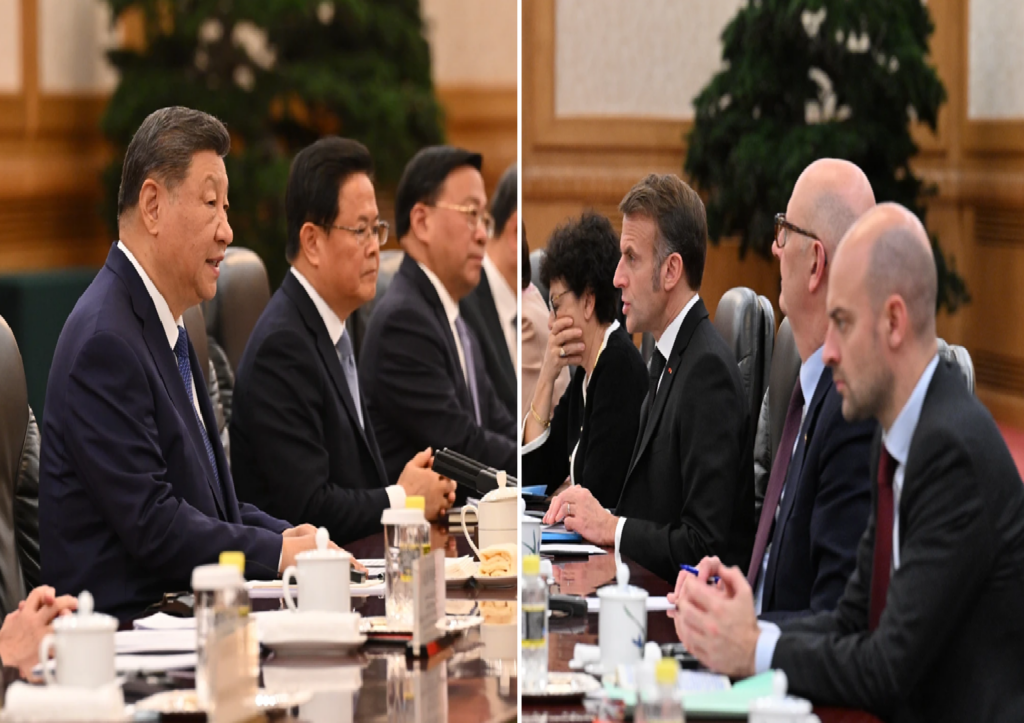
- French President Emmanuel Macron paid a three-day state visit to China amid ongoing tensions between the European Union, including France, and China, where China is viewed as a rival and strategic competitor.
- The visit also coincides with the period when France is set to assume the presidency of the G7 in 2026, and aims to address France’s large trade deficit with China and broader geopolitical issues.
- At a time when geopolitical rivalry and geo-economic differences between France, the European Union and China are increasing, France and the European Union are gradually seeking to lessen their economic dependence on China.
In an important diplomatic development, French President Emmanuel Macron paid a three-day state visit to China. This visit is significant given the ongoing tensions between the European Union, including France, and China, which is viewed as a rival and strategic competitor. It also comes at a time when the European Union is considering measures to decouple and reduce its economic dependence on China. Macron’s visit mainly focused on trade issues and contemporary geopolitical developments.
The visit also coincides with France’s planned 2026 G7 presidency. France has one of the largest trade deficits with China among European countries. France’s trade deficit with China stands at 54 billion dollars (approx.), while the overall European Union trade deficit stands at about 358 billion dollars. Therefore, Macron’s visit aims to address trade imbalances and broader geopolitical issues.
One of the major challenges in France-China relations is the widening trade deficit. President Macron has been vocal against what he calls China’s unfair trade practices. France has consistently criticised Chinese enterprises for being subsidised by the Chinese government and for dumping products into European markets. These practices make European products uncompetitive and give Chinese companies an unfair advantage.
At a time when geopolitical rivalry and geo-economic differences between France, the European Union and China are increasing, the European Union has realised that maintaining strong economic relations with China may not necessarily provide long-term strategic benefits. Europe now understands that China’s geopolitical ambitions differ sharply from those of the European Union. As a result, France and the European Union are gradually seeking to lessen their economic dependence on China. Macron’s state visit, therefore, focused on exploring avenues where both sides can still find common solutions.
During the visit, a total of twelve agreements were signed between France and China. These agreements covered cooperation in artificial intelligence, nuclear energy, aeronautics, aerospace and other strategically important sectors. Another major topic of discussion between President Macron and President Xi was geopolitics, especially the war in Ukraine. Macron emphasised the need for China’s help in advancing peace efforts.
President Xi stated that China supports a peace plan that promotes diplomacy and aims to end the war in Ukraine. However, the European Union holds a markedly different view. Many European countries, including France, have criticised China for supporting Russia by providing dual-use technologies. Macron’s expectation is based on the understanding that China has considerable influence over Russia and can potentially persuade Russia to compromise. Since Russia is economically dependent on China, the European Union hopes that Chinese pressure may lead to a constructive shift in Russia’s approach.
However, China’s geopolitical ambitions continue to align more closely with Russia than with the European Union. China calculates that a strong Russia indirectly supports China’s own strategic goals. Therefore, expecting China to take actions that may undermine Russian interests does not appear realistic in the current geopolitical context.
China, on the other hand, demands a relationship based on greater strategic autonomy from the European Union. This was clearly evident in President Xi’s speech, where he stated that relations between France and China should be guided by mutual independence. Such an autonomous relationship is beneficial for China because the European market has been an important destination for China’s export-driven heavy industries. A closer relationship with France and the European Union also helps China counterbalance European dependence on the United States. China often argues that the European Union lacks true independence because many of its decisions are influenced by the United States, and this remains a point of tension in China-EU relations.
Macron’s visit also reflects France’s intention to play a greater role in the Asian region. France already enjoys a strong strategic partnership with India, especially in defence. Within the European Union, France is seen as a close partner of India. France also recognises that the Indo-Pacific region is emerging as the new engine of global growth, and maintaining a significant presence there is essential. However, China remains the most influential player in the region. Thus, France aims to balance its relationship with China while simultaneously expanding its political and economic presence in Asia.

Aayush Pal is a freelance writer on contemporary geopolitical developments. The views expressed in his work are entirely his own.
 Pranav S
  Ajith Shetty Heranje
  Atri Patel