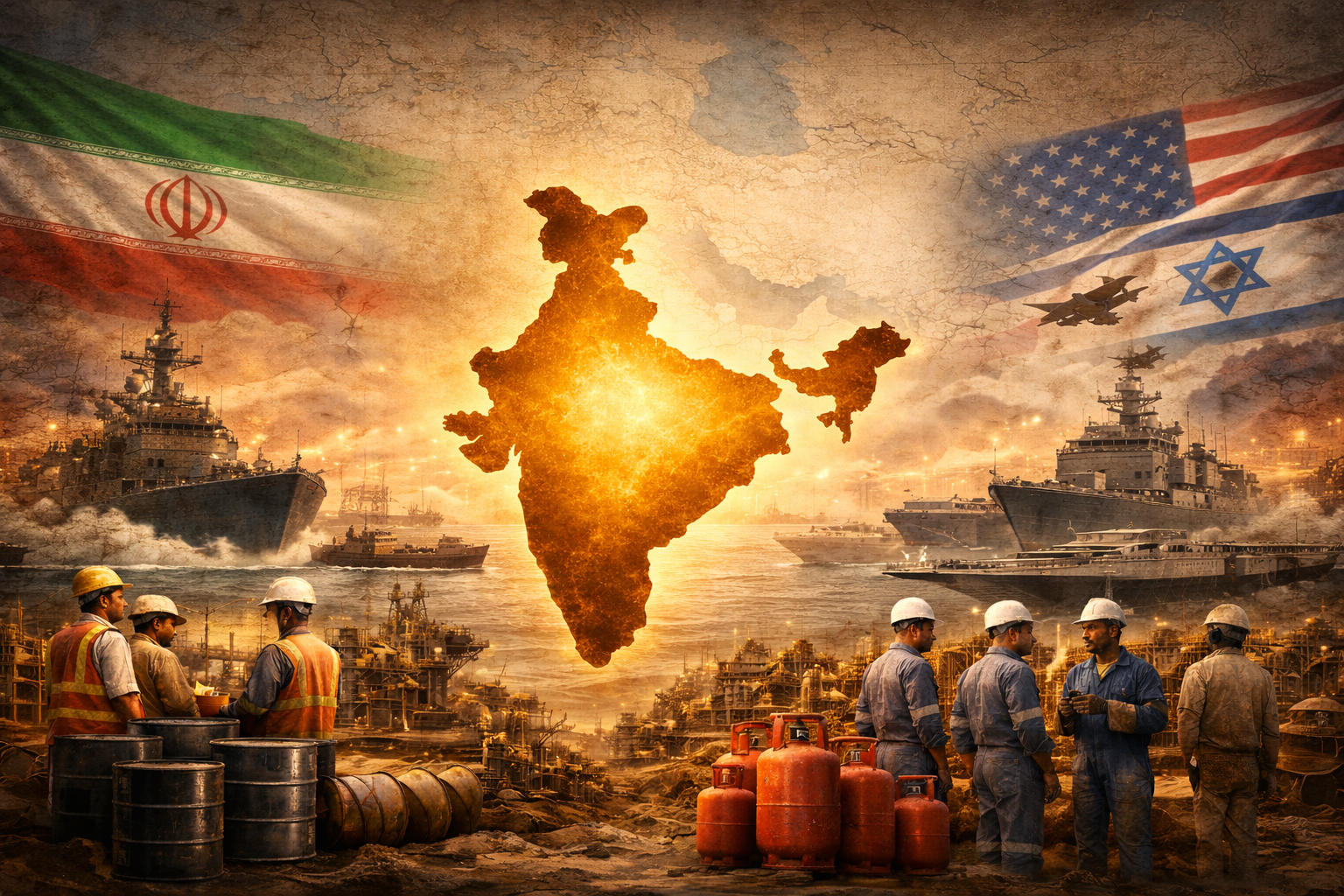
- Energy is a major concern for India as it lacks self-sufficiency in this domain, and relies on the Gulf countries for 60 per cent of its oil imports.
- India is experiencing not only an energy crisis but also LPG shortages, which have brought war to Indian households.
- India may experience fertiliser shortages, posing a significant threat to the nation’s food security.
- India lacks significant control over external difficulties, but it can address internal challenges through a pragmatic and balanced approach to West Asia.
Under Prime Minister Modi’s leadership, India’s strategy towards West Asia experienced a significant transformation. India transitioned from conventional domains of collaboration, including trade, energy, and diaspora, to establishing strategic partnerships with significant regional nations. India discontinued its ‘Look West Policy’ in favour of a ‘Think West Policy.’ The Look West Policy aimed to prioritise India’s connections with West Asian nations, established by Prime Minister Manmohan Singh in 2005. Conversely, PM Modi’s Think West Policy aims to enhance India’s involvement with West Asia and strengthen it further. India strengthened its strategic collaboration with Asia while refraining from aligning with any power blocs in West Asia.
India and West Asia engage in three principal domains of strategic collaboration. Primarily, energy is a concern as India lacks self-sufficiency in this domain. India relies on the Gulf countries for 60 per cent of its oil imports. India requires a stable and amicable West Asian area to guarantee its energy security. Secondly, there are approximately 9 to 10 million Indians residing and employed in West Asia. They remit funds from there, constituting one of the main sources of remittances to India. Third, India’s defence and military strategic engagement with West Asia experienced significant growth. There is an increase in military-to-military exchanges and joint military exercises between India and neighbouring countries. These indicators reflect India’s increasing strategic engagement in the area.
India has been adversely affected by the continuous battle between the U.S.-Israel alliance and Iran. India is experiencing not only an energy crisis but also LPG shortages, which have brought war to Indian households. India may experience fertiliser shortages, posing a significant threat to the nation’s food security. India is also unable to sell its commodities, such as fruits, to West Asia, adversely affecting Indian farmers. Despite these hurdles and India’s neutral stance, it is incapable of mediating between the two sides. Two principal categories of obstructions have hindered India’s active engagement in the region: external causes (Pakistan and China) and internal factors (strategic miscalculations).
On March 29, 2026, leaders from four Muslim countries—Pakistan, Turkey, Egypt, and Saudi Arabia—convened in Islamabad to address the situation in West Asia and to provide a foundation for a ceasefire between the U.S.-Israel alliance and Iran. The summit was initially scheduled for Ankara, Turkey, but was relocated to Islamabad due to Pakistan’s significant engagement with both Tehran and Washington. They seek the restoration of unrestricted trade and oil passage through the sea lanes of communication, which have been affected by Iran’s decision to obstruct the Strait of Hormuz. This necessitates an immediate ceasefire between the conflicting parties.
This gathering has considerable strategic implications for India, particularly in the West Asia region. The gathering attempted not only to achieve a peaceful resolution to the present conflict but also to establish a new order intended to mitigate the dominance of either Israel or Iran in post-conflict West Asia. This enhances Pakistan’s crucial role in the region, strengthened by its geostrategic proximity to major countries such as the United States and China. The officials from the other three countries support Pakistan’s role as a mediator in settling the crisis between the United States and Iran. Secondly, they discussed multilateralism as a means to handle regional difficulties and concluded that Muslim unity is the optimal solution. Third, Pakistan has adopted a clientelist position for China in West Asia. Immediately following the conference, Pakistan’s external minister visited China to brief the Chinese leadership on the meeting’s outcomes. China expressed its endorsement of Pakistan’s mediating role in the current situation.
These constitute significant obstacles to India’s strategic interests in West Asia. The rejuvenation of Pakistan’s crucial position in the area is not the sole impediment to India’s strategy for West Asia. However, India has also committed some strategic errors in the current U.S.-Israel conflict with Iran. India made significant strategic errors that contradicted its traditional position. India issued a belated condolence regarding the assassination of Iranian Supreme Leader Khamenei by the coordinated U.S.-Israel strikes on Iran. This condolence was expressed by India’s foreign secretary, Vikram Misri. Determining the rationale for India’s delayed response to Khamenei’s death is exceedingly challenging.
However, it was mostly interpreted that India is aligned with the United States and Israel. This was reinforced by the Indian Prime Minister. Indian Prime Minister Modi’s visit to Israel occurs during a period of international isolation for the nation under Netanyahu’s leadership. Prime Minister Modi stated that India consistently supports Israel, providing the latter with essential diplomatic backing. Shortly following this visit, Israel and the United States conducted a coordinated assault on Iran. India maintained silence over the U.S. assault that resulted in the sinking of the Iranian Moudge-Class frigate, leading to the deaths of over 80 personnel, when it was returning from a peaceful naval exercise conducted by India in the Indian Ocean.
As previously said, India has strengthened its strategic partnerships with all regional nations without aligning itself with any major bloc. Consequently, India is perceived as a neutral and responsible participant in West Asia. However, the present trajectory of India’s foreign policy does not position India as a neutral entity in the area, but it aligns itself with Israel. India’s proximity is also connected to recent developments in the area, like the Pakistan-Saudi Defence Pact and Turkey’s overt backing for Pakistan. However, this cannot serve as a justification for India’s position regarding Iran, given India’s extensive history of civilisational and cultural connections with the nation. Since the 1979 Islamic Revolution, Tehran has maintained a diplomatic and military alliance with India.
This article examined the two primary problems with India’s foreign policy with West Asia: external and domestic factors. India lacks significant control over external difficulties, but it can address internal challenges through a pragmatic and balanced approach to West Asia, which includes fostering stronger economic ties and engaging in diplomatic dialogues with all regional powers. This may also assist India in overcoming external obstacles.

Mohmmad Rizwan is a PhD scholar in Political Science at Jamia Millia Islamia and is currently awaiting his final defence. His doctoral research examines Pakistan’s relations with key global powers. Views expressed are the author’s own.
 Anusreeta Dutta
  Aayush Pal
  Hridbina Chatterjee