
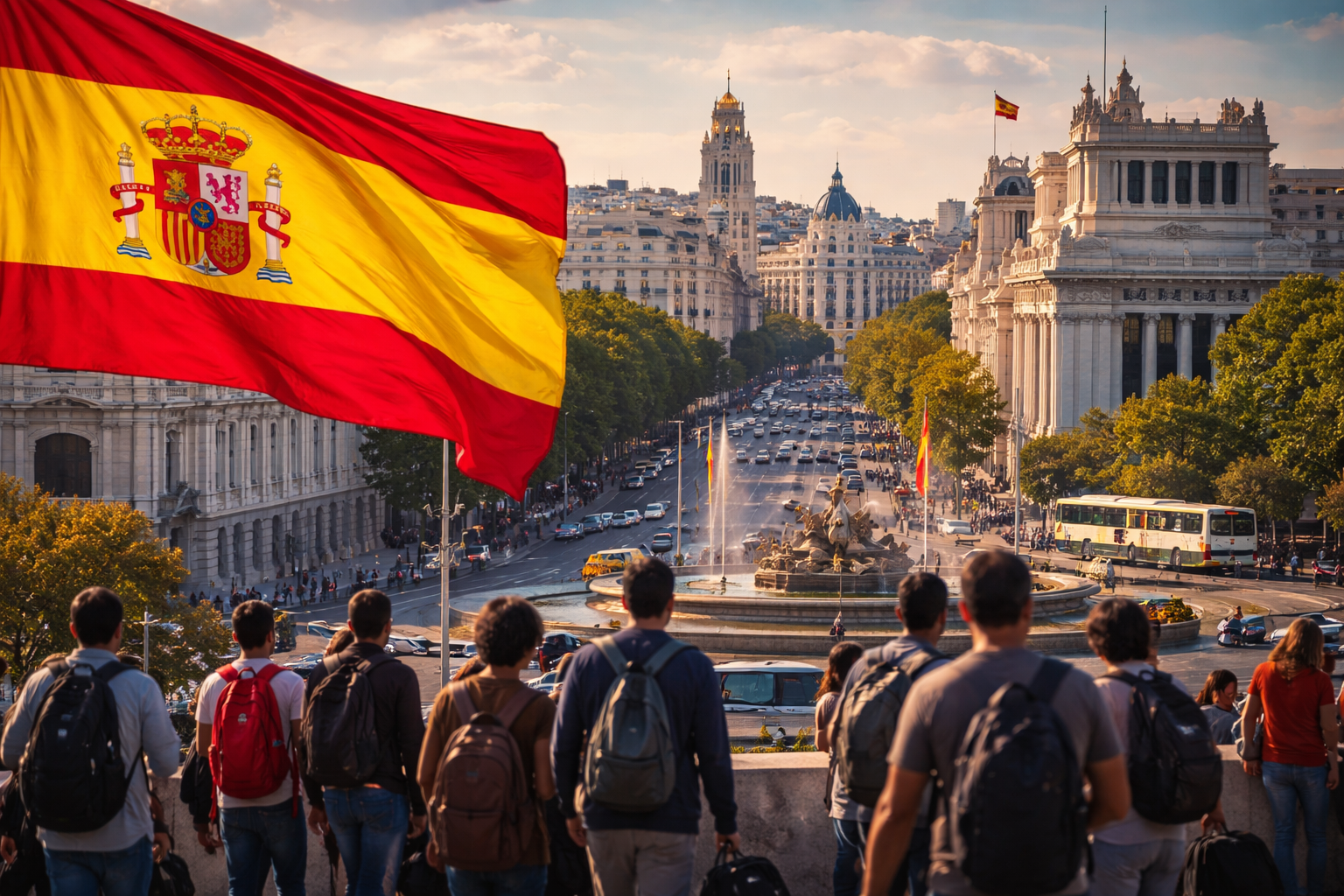
- A Spanish cabinet decree grants temporary legal residency to nearly 500,000 undocumented migrants through one-year residence permits.
- Native Spaniards increasingly express fears that illegal immigration strains public order and security.
- Official crime data from Spain’s National Statistics Institute for 2024 suggests that people of foreign nationality have a higher conviction rate per 1,000 inhabitants compared with Spanish nationals.
- Spain’s approach stands in contrast to the broader European trend, where many countries have moved sharply towards restrictive migration control through concrete policies.
At a time when immigration and the management of immigrants have become a major international issue, where detention and deportation have become increasingly common, countries across the world are effectively leading a war against illegal immigration. States are rushing to protect their borders, arguing that without effective border controls, a country cannot be sovereign. Interestingly, this shift is most visible in the Euro-Atlantic world. Yet, within the same Euro-Atlantic space, there exists an exception in the form of Spain.
Spain’s socialist government has gone against the prevailing Western tide with a highly controversial move. As per a decree passed by the Spanish cabinet, temporary legal residency has been granted to nearly 500,000 undocumented migrants through one-year residence permits. This decision gives legal status to undocumented migrants who have arrived in Spain from different parts of the world.
Responding to the criticism, Spain’s Prime Minister Pedro Sánchez stated that he does not consider this move to be extreme. According to him, it is only perceived as extreme because the world is not accustomed to such measures anymore. He argued that this step would help the country. This decision has been enabled through the Popular Legislative Initiative mechanism enshrined in the Spanish Constitution, which allows the government to regularise undocumented migrants.
Spain’s approach stands in contrast to the broader European trend, where many countries have moved sharply towards restrictive migration control through concrete policies. Italy, for instance, has reinforced naval and coast guard interdictions, increased deportations, limited humanitarian protections, and formalised externalisation of migration control through agreements with Tunisia and Libya to block departures before they reach Italian waters. Germany, meanwhile, under the Common European Asylum System reforms, has expanded border checks with neighbouring countries, accelerated deportations to so-called safe countries of origin, and approved third-country processing concepts for rejected applicants.
This is not the first time Spain has adopted such a policy. In 2005, under former Prime Minister José Luis Rodríguez Zapatero, a similar move was undertaken, granting legal status to around 570,000 undocumented migrants.
As per the recent cabinet order, any immigrant who has been living in Spain before December 31, 2025, and can prove at least five months of continuous residence in the country, will be eligible for legal status. It is important to note that this does not amount to permanent citizenship. Instead, migrants will receive the right to reside in Spain for one year, after which the permit may be extended under domestic laws. This status does not grant voting rights or assure permanent citizenship.
One of the primary justifications offered by the ruling Socialist Party, PSOE, is economic. The government argues that thousands of undocumented migrants currently residing in Spain remain outside the formal economy and do not contribute to the tax structure. As a result, the state does not benefit directly from their presence. This policy is an attempt to bring these individuals under the tax umbrella. By granting legal status, the government aims to collect taxes, increase revenue, and strengthen social security contributions.
Although the fiscal impact of regularisation remains debated, evidence suggests limited gains in the short to medium term. Studies conducted by the OECD indicate that while regularisation can expand the formal tax base over time, the initial effects often skew towards higher public spending, particularly on housing assistance, healthcare, and other social measures. Even where net fiscal gains occur, they tend to materialise only in the longer run and are highly dependent on sustained employment and skill upgradation.
From the migrants’ perspective, this move protects them from detention and deportation. In exchange, the Spanish government expects increased fiscal contributions. However, the decision has faced sharp criticism from right-wing parties across Europe. In Spain, the far-right party VOX has strongly opposed the move, calling it a political distraction. VOX has claimed that the Sánchez government is using this policy to divert attention from the recent train incident that claimed 46 lives on January 18, along with other governance failures.
The conservative People’s Party has also criticised the decision, arguing that it could undermine national security. In response, the government has assured that strict due diligence will be conducted and that migrants with criminal records or security risks will be excluded from the regularisation process.
This policy comes at a time when Spain is experiencing political deadlock. No single party holds a clear majority in Parliament, and coalition arrangements remain fragile. The Socialist government survives with the support of the Sumar party. Meanwhile, the conservative People’s Party emerged as the largest party in the 2023 general elections, while VOX strengthened its parliamentary presence, but neither was able to secure a majority or form a stable governing alliance.
The Sánchez government is also facing mounting domestic pressure. The Socialist Party has performed poorly in recent regional elections, and anti-incumbency sentiment is rising. Public dissatisfaction is growing over security concerns, unemployment, and limited job opportunities. Native Spaniards increasingly express fears that illegal immigration strains public order and security.
There is some basis to the concerns raised by Spaniards. Official crime data from Spain’s National Statistics Institute for 2024 suggests that people of foreign nationality have a higher conviction rate per 1,000 inhabitants compared with Spanish nationals. The conviction rate for foreign persons is about 16 per 1,000, compared with around 6 per 1,000 for Spaniards. Similarly, EU integration data shows that the unemployment rate among the foreign-born population in Spain is close to 20 per cent, while unemployment among Spaniards stands at around 10 per cent.
Additionally, there is strong public resistance to increasing defence spending to 5 per cent of GDP under the new NATO defence plan. Many Spaniards oppose taking greater responsibility for Ukraine’s security amid Spain’s own economic struggles. Corruption allegations have further weakened the government, with two close allies of the Prime Minister having been imprisoned over corruption charges.
This development also coincides with a broader ideological shift across Europe. Right-wing politics are gaining momentum as progressive and liberal parties struggle. European societies are increasingly questioning the impact of immigration on cultural identity and social cohesion.
Against this backdrop, Spain stands out as an exception. It has taken a fundamentally different stance not only on immigration but also on broader geopolitical issues. Spain has emerged as one of the prominent pro-Palestinian voices in the West, has adopted a critical position toward Israel, and has declined to increase defence spending to NATO’s proposed levels. It has also developed visible policy differences with the United States, with President Trump repeatedly criticising Spain and questioning its role within NATO.
Prime Minister Pedro Sánchez is therefore under immense pressure domestically and internationally. This comes at a time when President Trump has been vocal about immigration, repeatedly stating that Europe has changed and that cities like London, Madrid, and Paris are no longer the same due to open-border policies. In the United States, immigration enforcement actions by ICE have intensified, generating controversy and criticism, particularly following recent incidents in cities such as Minneapolis.
This decision by Spain comes amid the wider European debate between multiculturalism and assimilation. Some countries, such as Denmark, have moved towards explicit assimilationist frameworks following the post-2015 migration backlash. Spain, however, has avoided a clear legal break with multiculturalism and appears to be continuing along that path, placing itself partially outside the post-2015 migration backlash consensus. One reason for this approach is the experience of countries such as Denmark and Germany, where assimilation-first models have relied on selective adaptations without sufficiently blending economic pragmatism, contributing to labour market frictions and economic strain. Spain, by contrast, is using multiculturalism as an economic tool, combining labour-market pragmatism with enforcement measures while stopping short of an overt assimilation-first doctrine.

Aayush Pal is a freelance writer on contemporary geopolitical developments. The views expressed in his work are entirely his own.
 Ajith Shetty Heranje
  Anusreeta Dutta