
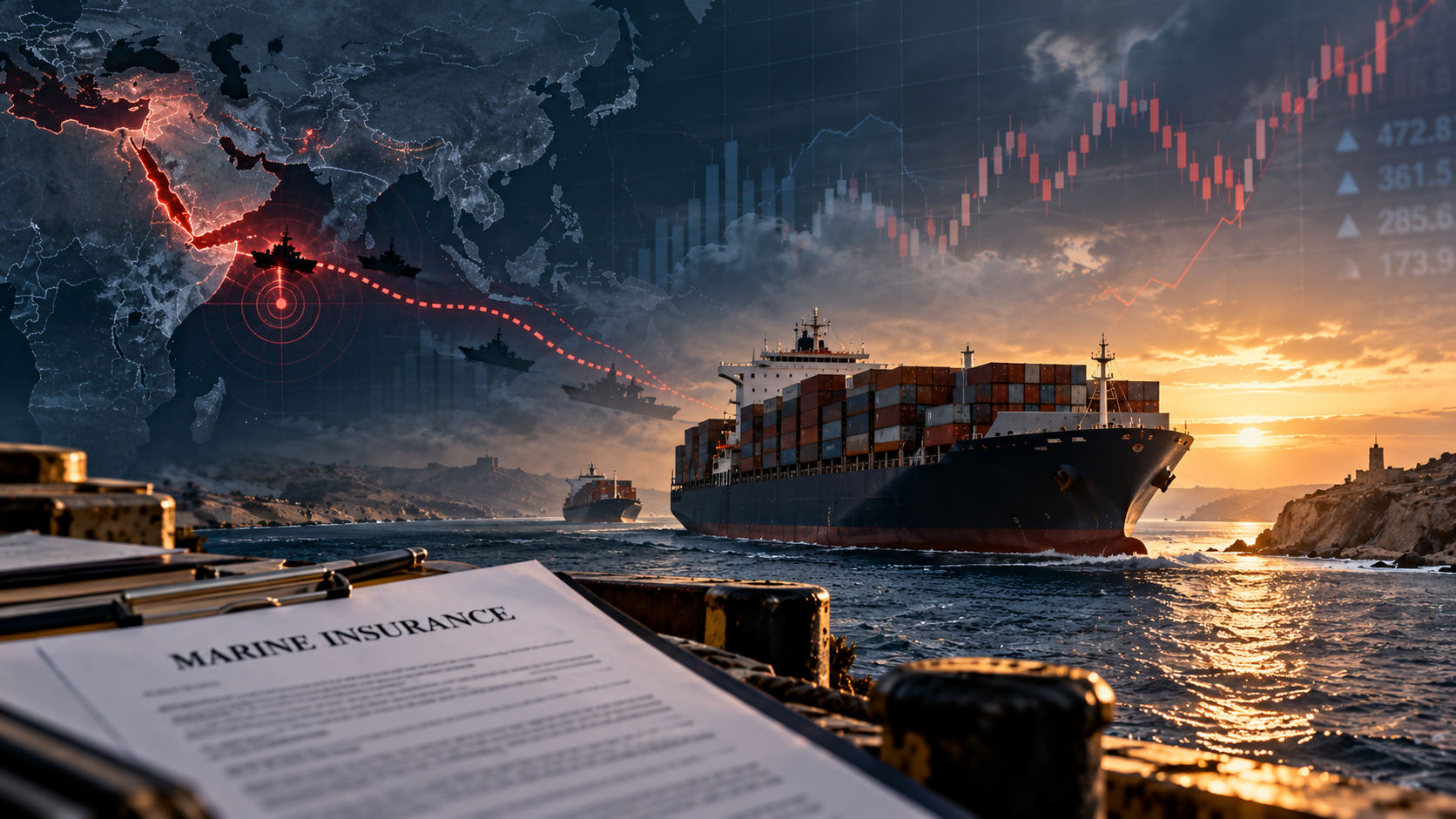
- Rising maritime insurance premiums, higher freight rates, tighter credit conditions and the withdrawal of commercial coverage can make a shipping route economically unviable long before it becomes physically inaccessible.
- A security crisis can therefore generate cascading effects across interconnected financial and commercial systems.
- The Red Sea crisis demonstrates that geopolitical power is exercised not only through control over physical shipping routes but also through the financial conditions under which those routes remain commercially viable.
- Ultimately, understanding contemporary geopolitical power requires looking beyond who controls strategic chokepoints to examine who prices the risks of using them.
When geopolitical conflicts disrupt global trade, the immediate focus is usually on missiles, naval blockades, sanctions and the closure of strategic shipping routes. Yet, beneath these visible disruptions lies a less examined mechanism through which conflict reshapes the global economy: the financial cost of moving goods through contested waters. Rising maritime insurance premiums, higher freight rates, tighter credit conditions and the withdrawal of commercial coverage can make a shipping route economically unviable long before it becomes physically inaccessible. In this sense, geopolitical risk is not merely a security concern; it is a financial variable that influences where goods move, what they cost and which economies can afford to participate in global trade.
The Red Sea crisis has demonstrated how insecurity along a critical maritime corridor can force shipping companies to reroute vessels, extend delivery times and absorb additional costs. Such disruptions reveal that the functioning of global trade depends not only on the freedom of navigation but also on the willingness of insurers, lenders and other financial intermediaries to support commercial activity in high-risk environments. These institutions do not determine the course of a conflict, but their decisions can influence its economic consequences across borders.
This raises a larger question for international relations: who bears the financial burden of geopolitical instability, and who possesses the power to determine its distribution? As global trade becomes increasingly exposed to strategic rivalry and regional conflicts, understanding the financial architecture of maritime commerce is essential to understanding how geopolitical power operates beyond the battlefield.
The Financialisation of Maritime Risk
The normal functioning of the global shipping industry depends on the ability to assess, price and distribute commercial risks among a broad range of actors. Maritime insurance lies at the heart of this system. Shipping involves numerous risks, ranging from adverse weather conditions and piracy to damage to vessels and their cargo. When geopolitical tensions rise in a particular region, insurers reassess the probability and potential severity of losses, often increasing premiums or imposing additional restrictions on vessels entering high-risk areas. In extreme cases, coverage may become unavailable or prohibitively expensive. These adjustments transform political instability into a directly measurable commercial cost.
This relationship is particularly evident in war-risk insurance. Unlike standard marine insurance, which covers risks associated with routine shipping operations, war-risk coverage protects against potential losses arising from armed conflict, hostile acts and related perils. Premiums for such policies can rise sharply in response to military escalation, attacks on commercial vessels or threats to critical maritime infrastructure. Shipping companies must then decide whether to absorb the additional costs, pass them on to customers or reroute their vessels through alternative corridors.
However, the consequences extend beyond insurance premiums. Longer voyages increase fuel consumption, crew expenses and vessel utilisation costs. Delays can disrupt inventory management, postpone production and increase the working capital requirements of importers and exporters. Banks and trade-finance providers may also reassess their exposure to transactions involving high-risk routes or counterparties. A security crisis can therefore generate cascading effects across interconnected financial and commercial systems.
The significance of this process lies in how risk is distributed. Large shipping companies may possess the financial resources and bargaining power to absorb or negotiate higher costs, whereas smaller operators may have fewer alternatives. Import-dependent economies, particularly those reliant on essential commodities, can face higher landed costs even when their vessels are not directly exposed to an attack. Consumers and domestic producers may ultimately bear part of the burden through higher prices and more expensive inputs.
Maritime risk is consequently not priced in a geopolitical vacuum. Insurance markets respond to assessments of security threats, but their decisions also shape the economic feasibility of trade. Access to affordable insurance and financing becomes an important determinant of whether commercial activity can continue through a contested region. Financial intermediaries thus occupy a consequential position between geopolitical instability and its real-economy effects, even though their decisions are primarily driven by commercial assessments rather than explicit foreign-policy objectives.
The Red Sea Crisis: When Geopolitical Risk Becomes a Financial Cost
The Red Sea crisis illustrates how regional conflict can alter the financial landscape of global trade. Since late 2023, the Houthi movement in Yemen has targeted commercial vessels, prompting major shipping companies to reroute vessels away from the Suez Canal and around the Cape of Good Hope, increasing transit times and operating costs. According to UN Trade and Development (UNCTAD), Suez Canal transits remained significantly below normal levels in May 2025, with tonnage approximately 70 per cent lower than in 2023.
The impact of these disruptions extended beyond longer voyages. Higher fuel consumption, elevated war-risk insurance premiums and reduced vessel availability contributed to rising container freight rates in 2024. UNCTAD’s Review of Maritime Transport 2025 identifies Red Sea rerouting as one of the factors behind the increase in spot container rates.
Rerouting, however, redistributes risk rather than eliminating it. Importers face higher logistics costs and uncertain delivery schedules, while developing economies dependent on maritime trade may experience higher import prices. Insurers and lenders also shape these outcomes by influencing the cost and availability of coverage and financing for high-risk routes.
The Red Sea crisis demonstrates that geopolitical power is exercised not only through control over physical shipping routes but also through the financial conditions under which those routes remain commercially viable. Consequently, decisions made by insurers and financial intermediaries can amplify the economic consequences of conflict far beyond the immediate region.
Conclusion: The Financial Frontiers of Geopolitical Power
Geopolitical conflicts increasingly shape global trade through mechanisms that extend beyond military action, sanctions and territorial control. Maritime insurance, freight pricing and trade finance influence how the costs of instability are distributed across economies. While these institutions operate primarily on commercial considerations, their decisions can amplify the consequences of conflict and determine which trade routes remain economically viable.
For India and other import-dependent economies, this highlights the importance of strengthening supply-chain resilience, diversifying trade routes and reducing exposure to external disruptions. Ultimately, understanding contemporary geopolitical power requires looking beyond who controls strategic chokepoints to examine who prices the risks of using them. In an interconnected global economy, financial institutions may not determine where conflicts occur, but they play a significant role in determining how far their economic consequences travel.

Archita Gaur is a postgraduate student at the School of International Studies, JNU. She specialises in the World Economy and has a strong interest in public policy, economic research, and governance. The views expressed are the author’s own.
 Aayush Pal