
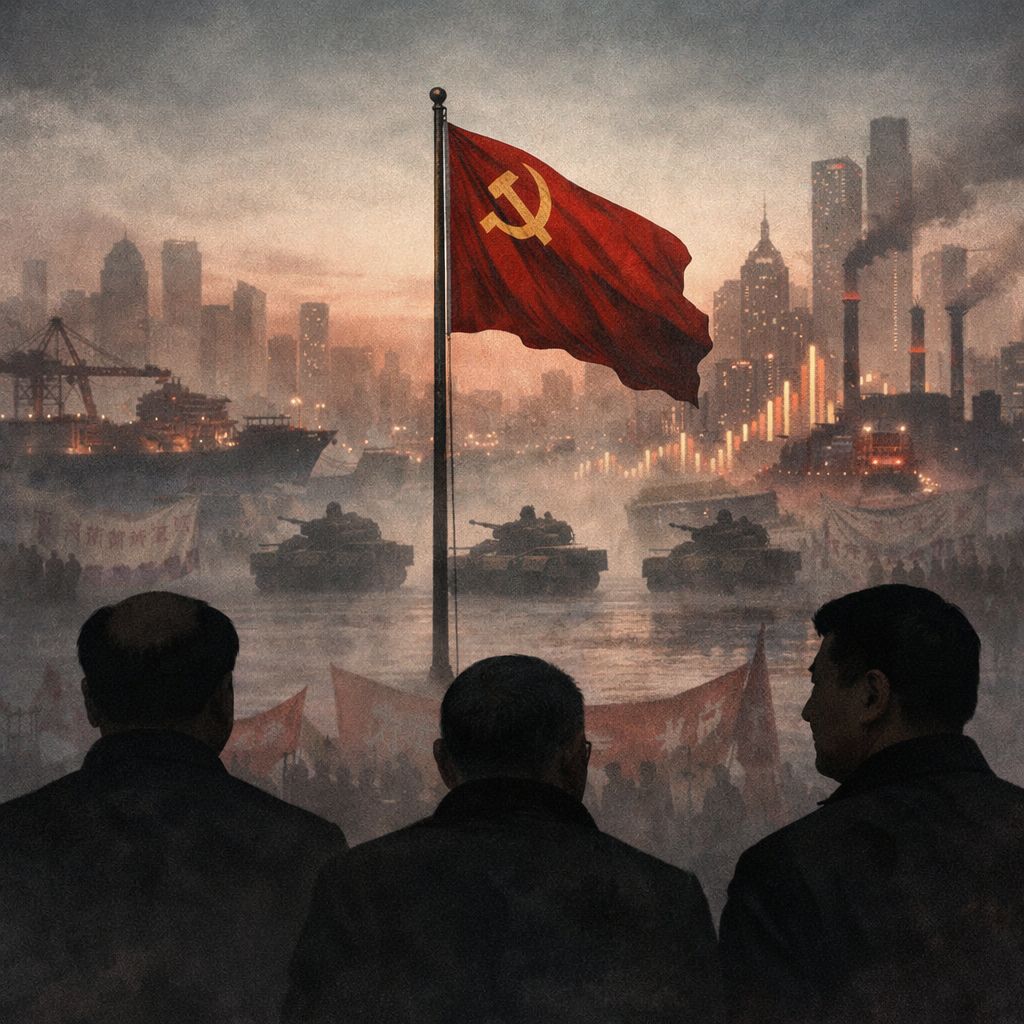
- The peaceful demonstrations and the ensuing suppression by the Chinese Communist Party’s leadership resulted in the collapse of the ‘Social Contract’ between the party and the populace.
- Contrary to Western expectations, this economic prosperity solidified the Communist Party’s leadership in China via a new social contract.
- The social contract established post-Tiananmen massacre indicates that the current Communist regime cannot derive its legitimacy solely from ideological elements; economic concerns must also be significant.
On June 4, 1989, the Chinese authorities resolved to suppress the peaceful demonstrations conducted by civilians, primarily students, at Tiananmen Square. In April 1989, the demonstration was started by Chinese students to commemorate the death of pro-reform politician Hu Yaobang. It soon evolved into a platform for protesting the escalating corruption and inflation in the nation. The severe application of oppressive force by the Chinese leadership on the protestors resulted in the deaths of approximately 200 individuals, including Chinese students, and injuries exceeding 3,000. The peaceful demonstrations and the ensuing suppression by the Chinese Communist Party’s leadership resulted in the collapse of the ‘Social Contract’ between the party and the populace.
The social contract serves as an analytical framework in political science that elucidates the formation of a state and the basis of its legitimacy. The English philosopher John Locke contended that the legitimacy of the state relies on its ability to safeguard the three natural rights—life, liberty, and property—of its citizens. In China, the legitimacy of the Chinese Communist Party’s rule is predicated on its role in liberating the nation during the Second World War. The Tiananmen Square protest and its ensuing suppression resulted in the dissolution of the existing social contract. It was regarded as a ‘life and death crisis’ for the party’s governance in China. A rewritten social compact is necessary to solidify the party’s governance in the nation.
In addition to the domestic crisis, Chinese leadership was also apprehensive about the developments in Eastern Europe and the USSR. The Polish authorities yielded to the collective pressure of independent labour unions to conduct elections in the country. There was a significant prevalence of anti-communist feeling throughout Eastern Europe. The Chinese leadership examined the factors contributing to the collapse of communism in Eastern Europe. The final blow occurred with the collapse of the Berlin Wall in 1989 and the dissolution of the Soviet Union in 1991. This compelled the authorities in Beijing to investigate the underlying issues and amend the social contract.
Two factions developed, each presenting distinct theories for the collapse of communism in Russia and Eastern Europe. The initial faction was designated as the ‘Hard Left Group,’ attributing the decline of communism mostly to ideological contamination. They contended that Gorbachev’s reforms were the primary catalyst for the dissolution of the Soviet Union. They contended that China should revert to the authentic communist tenets established by Lenin and Mao. The second faction, termed the ‘Reformist Group,’ contended that the collapse of communism in Eastern Europe was not due to ideological frailty but rather a consequence of its inability to address economic challenges. They did not fulfil the economic ambitions of their populace. This faction was directed by Deng Xiaoping and his associates.
Deng’s reforming strategy was predicated on the belief that the party could no longer obtain legitimacy from its involvement in the liberation era. They need to ensure the economic well-being of their citizens, which can’t be done with the old socialist economic system. His reforms aimed to transition China from a socialist economic model to a more market-oriented economic framework. This was also predicated on the disintegration of two fundamental pillars: public ownership and the welfare system. These two must be substituted with the appropriate alternatives for delivering work, housing, and healthcare. The radical left faction opposed it, claiming it would demolish socialism and establish capitalism in China. Deng justified his changes on two principal grounds: firstly, they would reduce the fervour of the Tiananmen protests through economic improvements. Secondly, he contended that it is a necessity of the present moment. He contended that we cannot behave like a vessel navigating upstream against the current. He deemed both planned and market economies essential.
Deng's reforming strategy was predicated on the belief that the party could no longer obtain legitimacy from its involvement in the liberation era.
The primary point of dispute between the reformists and the extreme left was China’s economic involvement with the West and international trade organisations like the WTO. In October 1989, Deng informed the U.S. president of his willingness to permit American merchants to conduct business in China. This contact would facilitate the ‘peaceful evolution’ in China, as advocated by the West, according to the hard-left perspective. They claimed that the United States orchestrated the Tiananmen protests and the collapse of communism. This tranquil transformation would not only terminate socialism but also abolish the one-party governance in China. Deng contended that attaining the essential double-digit growth necessitates engagement with Western economies. He contended that we cannot behave like women with chained feet. Secondly, he contended that these foreigners cannot facilitate peaceful evolution, as they would be compelled to operate under Chinese policies and rules. China will have the advantage over them.
Following this protracted intellectual conflict, the reformists were victorious in the political struggle in China. The reformists implemented a novel economic system in China, termed ‘Socialist Market Economy’ by Jiang Zemin. It received final approval at the Fourteenth Party Congress in 1998. The Chinese constitution designated economic development as the primary objective. This initiative resulted in the incorporation of the Chinese economy into the global economic system. China’s trade connections with the U.S. experienced a significant increase. Hundreds of U.S. corporations inked contracts in China valued at over $2 billion. President Bill Clinton of the United States started a strategy of engagement, while China submitted its application for membership in the General Agreement on Tariffs and Trade (GATT). These two measures greatly stimulated the cooperation between the U.S. and China.
Economic success instilled confidence in Chinese leadership, ultimately resulting in the emergence of an assertive China.
From 1993 to 2010, China’s economic growth had yearly double-digit increases. China’s foreign direct investment, formerly in single digits, increased to an average of US$35 billion annually from 1993 to 1997. The liberal West, spearheaded by the U.S., anticipated that this economic boom would concurrently effectuate a political transformation in China. Contrary to Western expectations, this economic prosperity solidified the Communist Party’s leadership in China via a new social contract. This economic success instilled confidence in Chinese leadership, ultimately resulting in the emergence of an assertive China.
The social contract established post-Tiananmen massacre indicates that the current Communist regime cannot derive its legitimacy solely from ideological elements; economic concerns must also be significant. Under this new contract, the party will guarantee the welfare of its constituents and will disengage from political affairs. The economic well-being of the Chinese populace is crucial for the sustenance of the existing communist regime in China. The dictatorship cannot tolerate a rapid interruption of the Chinese economy. This imperative for sustained economic growth shapes China’s domestic and foreign policy. The Malacca Dilemma pertains to the Strait of Malacca, a critical gateway for Chinese oil and energy imports, which may be obstructed by China’s adversaries in the future. The obstruction of the Malacca Strait will adversely affect Chinese oil imports and impede China’s economic progress, ultimately resulting in political instability. The One Belt and One Road Initiative, China’s ambitious initiative, is associated with the nation’s quest for natural resources, international markets, and the establishment of an alternate route to the Malacca Strait. All of these are associated with China’s quest for economic stability.

Dr Mohammad Rizwan holds a PhD in political science from Jamia Millia Islamia. His doctoral research focuses on Pakistan’s relations with major global powers. Views expressed are the author’s own.
 Anjali Singh
  Archita Gaur