
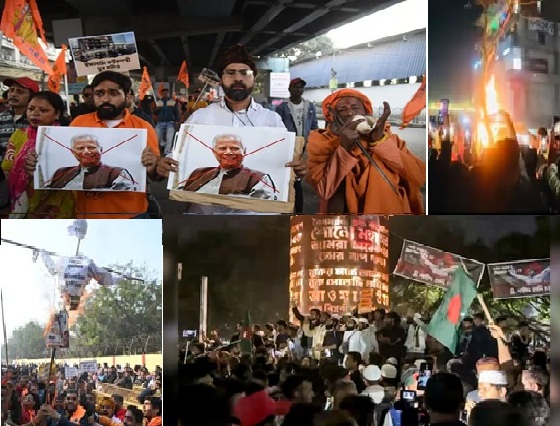
- Bangladesh today poses a qualitatively different challenge to India, one that cannot be clubbed with New Delhi’s experiences with other neighbouring states over the last few years.
- Anti-India sentiment is no longer an incidental byproduct; it has become a central component of certain radical ideologies.
- Street violence, attacks on media houses, and property destruction by mobs have become a recurring feature of Dhaka’s political landscape.
- When hatred becomes normalised and mainstreamed, policy choices become hostage to populism.
Over the years, India’s eastern frontier with Bangladesh was considered one of its relatively manageable borders – porous, yes, but politically conducive, yet complicated but anchored in historical and cultural linkages forged during the 1971 liberation war. Today, that optimistic assumption is fraying rapidly. What confronts India is not just a diplomatic challenge, a tactical misunderstanding or an incompatible policy, but a complex, unsettling transformation unfolding in Bangladesh. One that carries long-term implications for India’s security, internal cohesion and emerging power aspirations. Bangladesh today poses a qualitatively different challenge to India, one that cannot be clubbed with New Delhi’s experiences with other neighbouring states over the last few years. The concern is not episodic. It is structural, ideological and deeply geopolitical.
Bangladesh and India: From Liberation to latent bitterness
On 16th December 2025, India and Bangladesh celebrated the 54th anniversary of Victory Day (which is called ‘Bijoy Dibosh’ in Bangladesh) – the living proof of a collaborative fight for the liberation of East Pakistan (present-day Bangladesh), which remains one of the most defining moments in the history of this part of the world. For decades, this shared history was expected to anchor a durable partnership. Indeed, for a significant period, particularly during the Awami League’s rule, New Delhi and Dhaka cooperated closely on economic integration, transit connectivity, and infrastructure projects, promising mutual growth.
Yet in the game of international relations, history has demonstrated that gratitude is the basis for perpetual goodwill. National identities evolve, generations shift, and socio-political attributes transform, often through selective history and political manipulation. India, once a co-combatant, began to be portrayed as an overbearing neighbour.
What is emerging today is not simply a continuation of that course, but it’s an expansion in a highly negative form. Anti-India rhetoric has moved from the margins to the mainstream, speeches at political rallies, viral posts on social media platforms and public showdowns in educational institutions increasingly frame India as a threat to Bangladeshi sovereignty, religious identity and political change.
Radicalisation of Youth: An ideological explosive
Demographically, Bangladesh is a young country with an average age of 26 years. In this backdrop, economic anxieties and unemployment have combined to push a generation towards radical ideologies – shaped and guided by preachers, ideologues and peer groups that have been infiltrated into the system by radical extremist organisations such as Jamaat-e-Islami, and its affiliated networks. These groups have gained significant socio-political space over the years by embedding themselves in educational institutions, the online ecosystem, and civil society organisations, thereby enabling them to enjoy a greater influence in the public discourses of Bangladesh.
Anti-India sentiment is no longer an incidental byproduct; it has become a central component of certain radical ideologies. Such ideas are deliberately cultivated with India portrayed as a Hindu majoritarian power that supports leaders like Sheikh Hasina to dominate Bangladesh, undermine its identity, culture and nation as a whole.
Street Violence and the Normalisation of Chaos
Street violence, attacks on media houses, and property destruction by mobs have become a recurring feature of Dhaka’s political landscape. Notably, over the last few years, protests that begin with domestic issues often devolve into attacks on symbols associated directly or indirectly with India. For instance, most recently, the death of youth leader Sharif Osman Hadi sparked massive protests across multiple cities in Bangladesh. During this same time, violent protest marches were reported heading toward Indian diplomatic missions, with anti-India chants ruling the streets of Dhaka. It is no longer confined to radical groups; members of political parties and youth leaders are openly employing the same anti-India eloquence. This is not just symbolic or a bid for political attention; it creates a premissive atmosphere for hostility, legitimises further violence and most importantly, socialises a generation into viewing India not as a neighbour with legitimate security concerns, but as an inexhaustible adversary.
And when hatred becomes normalised and mainstreamed, policy choices become hostage to populism.
Why Bangladesh is not Sri Lanka, Nepal or the Maldives
India’s strategic and foreign policy community often draws comfort from its experience in managing headwinds in other neighbouring states. Bangladesh, however, is fundamentally different, given the nature of the challenge itself. Since 2022, following the Sri Lankan people’s uprising, its closeness to China, and Nepal’s political upheaval, while disruptive, have not revolved around existential hostility towards the Indian state. In the Maldives, where political campaigns championed ‘India-Out’ rhetoric, India managed these tactical shifts through a combination of diplomacy, restraint, economic leverage and strategic patience.
Bangladesh, by contrast, combines a set of factors that go beyond the realm of mere politics. First, the depth of ideological hostility penetrating the socio-cultural fabric of the society, reflected in irredentist fantasies of isolating India’s Northeastern states, blocking the Siliguri corridor, and promoting the idea of ‘Greater Bangladesh’ (envisaging the curving out of eastern and northeastern states of India, including West Bengal, Bihar, Odisha and the entire Northeast, along with Myanmar’s Arakan/Rakhine state) – signals a corrosive trajectory. It is not just opposition to Indian policies, but rather constitutes an explicit challenge to India’s territorial sovereignty. Second, Bangladesh’s position amplifies the threat – India’s Northeast to the state of West Bengal shares a long border, which can facilitate multiple channels through which arms smuggling, terror outfits, infiltration and radical ideologies can easily permeate.
Third, Bangladesh’s past and present have Pakistani links, from Kashmir to Punjab – Islamabad’s noxious strategy has been well documented. In this context, Dhaka, the once separated twin with a now radicalised ecosystem, presents another opportunity for Pakistan and its supported terror outfits to intimidate India, at a time when political will and societal cohesion to curb such anti-India sentiments are at their lowest.
The upcoming election and the Democratic Dilemma
The announcement of the election scheduled for February 2026, along with the banning of Sheikh Hasina’s Awami League from participating in the election, adds another layer of complexity to New Delhi’s Dhaka policy. Whatever one’s critique of Hasina’s governance, her leadership has provided India with a predictable and cooperative partner – particularly on issues of cross-border infiltration and containing anti-India rhetoric at bay.
The political gap left by Awami League’s proscription, possibly the return of the Bangladesh Nationalist Party (BNP) and the growing influence of a coalition between Jamaat and National Citizens Party (NCP) together present a profound dilemma. Supporting democratic processes is a cornerstone of India’s foreign policy rhetoric. Yet, what happens when procedural electoral democracy produces regimes fundamentally hostile to India’s core interests? This no longer remains a theoretical question; it is an immediate strategic challenge.
Rethinking India’s Approach – From optimism to Pragmatism
What should India do? First, New Delhi must shed any residual complacency about Bangladesh and confront uncomfortable realities by accepting that the problem is no longer limited to political boundaries; rather, it has moved deep within society, requiring layered investment ranging from border security to comprehensive counter-radicalisation strategies. Second, India must prioritise securing its borders, with zero tolerance towards infiltrators, their collaborators, and supporters operating both inside and outside India. At the same time, it must actively contest hostile narratives, internationalise the issue and expose the true face of youth radicalisation through strategic communication. Economic engagement must be conditional on security cooperation.
Because what happens in Dhaka today has direct implications for India’s eastern and northeastern states, and certainly New Delhi.
Conclusion: Clouds That Demand Attention
The growing concern over the Bay of Bengal is not merely a meteorological metaphor; it is a warning of a gathering storm. Bangladesh today stands at a critical juncture, and the direction it takes will profoundly influence India’s security environment in the decades to come.
For years, New Delhi has viewed Dhaka through the propitious lens of historical gratitude and economic pragmatism. That lens is now dangerously outdated. The rise of radicalisation, the normalisation of anti-India hatred, territorial revisionist fantasies, and external manipulation together form an ignitable mix.
India’s aspiration to be a great power will not be determined solely by how it engages the world but by how effectively it secures its porous borders, counters hostile ideologies in its immediate sphere, and safeguards the sovereignty that underpins its national strength.

Pritam Sarbabidya is a postgraduate in Politics and International Relations from Pondicherry University. He writes on India’s foreign policy, security and strategic affairs, with bylines in Samvada World, Modern Diplomacy, Firstpost, The Dialectics and other platforms. He tweets at @Psarbabidya. Views expressed are the author’s own.
 Aayush Pal
  Anusreeta Dutta
  Archita Gaur