
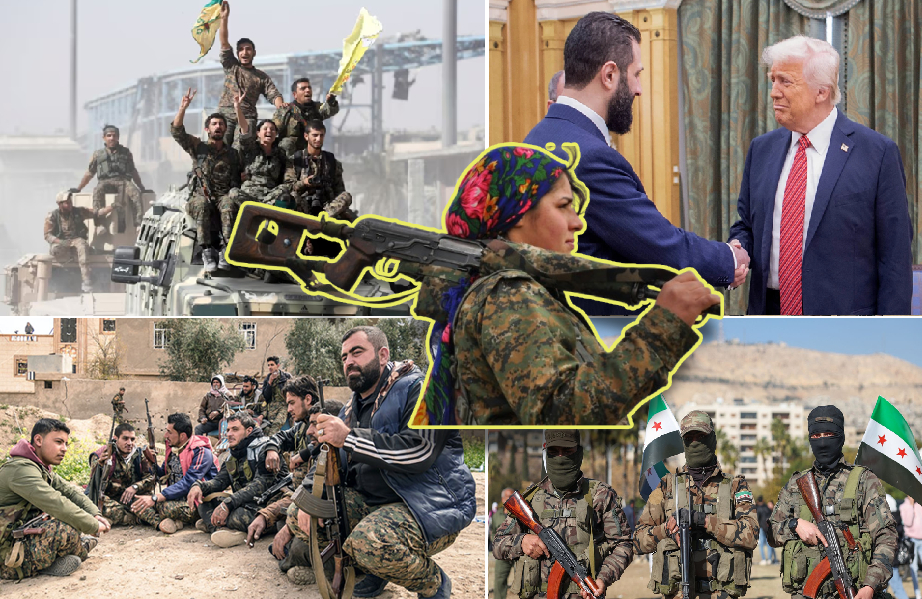
- U.S. assurances to the Kurds are now unravelling, with their latest betrayal becoming evident after December 2024, when the Iranian-backed Assad government collapsed and HTS—an offshoot of Al Qaeda in Iraq—rose to power.
- The US viewed the ideologically driven Kurdish forces as a reliable proxy for territorial control, but their hostility with Turkey and opposition from Iranian-aligned forces made them a persistent strategic liability.
- Today, the Kurds stand isolated, abandoned by regional actors and great powers alike, after their survival—entirely dependent on American backing—was undercut by yet another U.S. strategic shift.
Syria is a country that has been witnessing continuous war, famine, disaster, and an unending civil war since the outbreak of the Arab Spring in 2011. What began as anti-Assad protests soon escalated into a full-scale civil war. With the rise of ISIS, the intensity of the conflict increased further, turning Syria into a major geopolitical playground. President Assad was supported by Iran and Russia, while the United States entered Syria, claiming to fight ISIS but pursuing a different proxy strategy.
A very interesting connection developed between the United States of America and the Syrian Democratic Forces. The Syrian Democratic Forces are American proxies, primarily consisting of Kurdish militias. The SDF was formed in 2015, and its backbone is the YPG, the People’s Protection Units. They have ideological and organisational links with the Kurdish Workers’ Party, also known as the PKK.
The Syrian civil war became extremely complex and evolved into an indirect conflict between the United States of America and Iranian proxies. The United States sought to secure its geopolitical interests in Syria. It wanted a long-term presence and aimed to control key resources, especially oil fields, which served American interests. This is one of the major reasons why the United States interfered in the Syrian civil war. Most importantly, the United States understood that the only way to achieve its goals was to keep Iranian proxies at bay. Under the pretext of fighting ISIS, marginalising Iranian influence, and maintaining regional presence for geoeconomic interests, the United States created and supported the Syrian Democratic Forces.
The Syrian Democratic Forces were an appropriate choice for the United States because Washington did not want direct involvement in the war. The United States viewed the ideologically driven Kurdish forces as a reliable proxy for territorial control, but their hostility with Turkey and opposition from Iranian-aligned forces made them a persistent strategic liability.
After the fall of ISIS in 2019, the Syrian Democratic Forces, with American backing, gained control over almost one-third of Syria, including Raqqa, which served as the ISIS capital, Hasakah, and Deir ez Zor. These regions were placed under SDF control, and the SDF was also tasked with extracting oil resources. It is important to note that the majority of Syria’s oil reserves are located in the northeastern region, which came under SDF control.
This was a win-win strategy for the United States. If the Syrian Democratic Forces controlled the northeastern oil and agricultural fields, profits from these regions would indirectly serve American interests. This is why the SDF was chosen. The SDF would fight ISIS, the United States would eliminate ISIS as a territorial threat, and Washington could then focus directly on Iranian proxies while benefiting from Syria’s resources. The United States also promised continued military support, without which the Syrian Democratic Forces cannot survive. The SDF has always faced hostility from Turkey and mistrust from Arab populations. Their control over northeastern Syria existed solely due to cooperation with the United States.
However, U.S. assurances to the Kurds are now unravelling, with their latest betrayal becoming evident after December 2024, when the Iranian-backed Assad government collapsed and HTS—an offshoot of Al Qaeda in Iraq—rose to power. On paper, HTS claims to oppose ISIS, but ideologically, both groups share deep similarities rooted in Al Qaeda in Iraq.
Historically, both HTS and ISIS emerged from the same jihadist ecosystem. Although they later split due to strategic differences, their ideological connection remains significant. This is why HTS cannot be trusted when it comes to containing ISIS. Since Al Julani’s rise to power, ISIS flags have been spotted again in northern and eastern Syria, indicating a resurgence of ISIS activity.
Despite HTS projecting itself as independent, there is growing evidence of indirect facilitation of ISIS resurgence, especially in northeastern Syria. One of the primary ways this is happening is by attempting to dismantle the Syrian Democratic Forces. The SDF controls northeastern Syria, where the majority of ISIS fighters and commanders are held in prisons guarded by the SDF, particularly around Raqqa.
HTS has made it clear that the Syrian Democratic Forces cannot remain autonomous, cannot control borders, and cannot manage oil fields independently. HTS demands that the SDF integrate into the Syrian National Army. The SDF has resisted this demand because the Kurds do not trust Al Julani or HTS. What happened to the Alawites in Latakia and the Druze community elsewhere serves as a warning. Although HTS claims inclusivity, ground realities show systematic targeting of minorities.
This has become a red flag for the Syrian Democratic Forces. They fear that demilitarisation and integration into the national army could lead to the same fate faced by the Alawites and Druze. For the past two weeks, clashes have continued between HTS forces and the Syrian Democratic Forces. Although a ceasefire has been announced and an understanding reached regarding gradual integration, violations continue, and uncertainty remains.
At present, the Kurds stand isolated. No major power or regional faction is willing to support them. Their existence depended entirely on American backing, and the United States has once again changed its strategy. Washington has reached an understanding with HTS primarily due to improving relations with Turkey. The personal rapport between President Erdogan and President Trump has also contributed to this shift.
The United States now believes that since Turkey influences HTS, reaching an understanding with Ankara eliminates the need to support a Kurdish proxy. American policy remains opportunistic and interest-driven. The Kurds, who sacrificed men, women, and children, including female fighters who fought ISIS on the ground, now stand abandoned.
This also raises serious concerns regarding the future of ISIS. The United States appears more focused on resources and strategic arrangements with Turkey than on long-term stability. There are visible signs of changing dynamics where HTS and ISIS may arrive at an informal understanding, allowing ISIS autonomy in parts of northern Syria while HTS consolidates control elsewhere.
References:
- https://mecouncil.org/publication/the-litmus-test-post-assad-syria-and-the-sdf
- https://icct.nl/publication/threat-isis-fragmentated-syria
- https://amp.dw.com/en/syria-sdf-kurdish-clashes-is-prisoners-escape-shaddadeh/a-75572648

Aayush Pal is a freelance writer on contemporary geopolitical developments. The views expressed in his work are entirely his own.
 Diksha Bharti