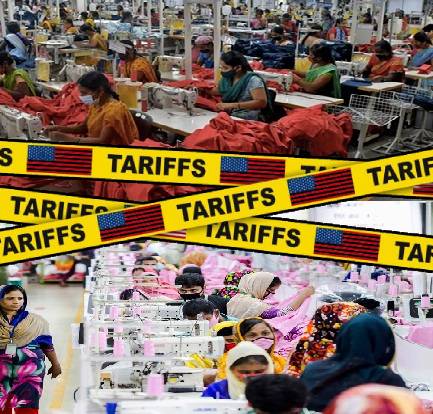
- Under recent arrangements, Bangladeshi exports face a 19% reciprocal tariff, while India secured a slightly lower 18% rate, which will preserve India’s advantage among Asian exporters.
- To fully utilise the zero-tariff window, Bangladesh would have to overhaul its sourcing patterns, replace established suppliers, and invest in spinning and fabric-processing capacity.
- India is also negotiating and signing trade agreements that could offset any marginal loss in the U.S. market.
The recent U.S.–Bangladesh trade agreement is not expected to significantly undermine India’s export competitiveness or erode the benefits India secured under its own interim agreement with Washington. It has raised concerns among the Indian textile industry and exporters, who were expecting a competitive advantage over Bangladesh after Indian goods secured an 18% tariff rate in the U.S. under the India–U.S. trade deal.
Under the U.S.–Bangladesh Agreement on Reciprocal Trade, Washington has agreed to create a system through which selected Bangladeshi textile and apparel products can enter the American market at a zero reciprocal tariff. The concession, however, will apply only to a limited quantity of exports. The size of this quota will be linked to how much Bangladesh imports from the United States in the form of textile inputs, such as American cotton and man-made fibres. In effect, the greater the use of U.S.-origin raw materials, the larger the volume of Bangladeshi garments that can qualify for the reduced tariff rate.
Different Export Baskets Reduce Direct Competition
One of the central reasons is the relatively small tariff differential between India and Bangladesh in the U.S. market. Under recent arrangements, Bangladeshi exports face a 19% reciprocal tariff, while India secured a slightly lower 18% rate. This preserves India’s relative advantage among Asian exporters.
Even under the zero-tariff clause, the benefit applies only to garments produced with U.S. cotton or man-made fibres. In practical terms, the base U.S. MFN tariff of around 12% continues to apply to such shipments, meaning that the overall tariff advantage is narrower than headline figures suggest. This suggests that the agreement does not significantly change the competitive balance, particularly because the cost structures and product mixes of the two countries are different.
The structure of exports from India and Bangladesh to the United States is not identical. Both countries ship roughly $7.5 billion worth of textiles to the U.S., but Bangladesh’s strength lies primarily in non-knitted garments. At the same time, India, on the other hand, has a stronger presence in other made-up textiles and diversified segments. This differentiation limits the degree of direct head-to-head competition. India’s export mix includes higher-value and more varied products, reducing vulnerability to tariff-driven price competition in basic garments.
Bangladesh’s supply-chain constraints
Perhaps the most decisive factor is Bangladesh’s dependence on imported raw materials. The zero-tariff concession is conditional on using U.S. cotton or man-made fibres, but Bangladesh’s existing supply chains are built around Asian inputs.
In 2024, Bangladesh imported $16.1 billion worth of fibres, yarns, and fabrics. China supplied about $9 billion, India $3.1 billion, and the United States only $274 million. For cotton fibre imports worth $2.5 billion, India accounted for $655 million and Brazil $604 million, while the U.S. supplied just $255 million. Similarly, India provided $1.6 billion out of $1.8 billion in cotton yarn imports. These numbers highlight the structural dependence of Bangladesh’s garment sector on Indian and Chinese intermediates. Less than one-third of its apparel production begins from raw fibre; most relies on imported yarns and fabrics.
To fully utilise the zero-tariff window, Bangladesh would have to overhaul its sourcing patterns, replace established suppliers, and invest in spinning and fabric-processing capacity—changes that are neither quick nor cost-effective.
Cost economics still favour India
Even if Bangladesh attempts to shift to U.S. inputs, the economics may not work in its favour. Importing cotton and fibres from the United States is significantly more expensive than sourcing them from nearby suppliers like India. This cost disadvantage could offset much of the tariff benefit, limiting any major surge in Bangladeshi exports to the U.S.
India’s concern is not just finished garments but also its role as a supplier of raw materials to Bangladesh. At present, India exports about $2.7 billion worth of cotton to Bangladesh, accounting for roughly 31% of its imports, and about $119 million of man-made fibres. Even in a pessimistic scenario where Bangladesh replaces some Indian supplies with U.S. inputs, the estimated loss for India would be only around $1 billion, according to the SBI report, which is considered marginal in the context of India’s overall textile exports.
India is also negotiating and signing trade agreements that could offset any marginal loss in the U.S. market. For instance, recent arrangements have opened up a textile market worth about $260 billion in the European Union with zero-duty access. In addition, India’s interim trade understanding with Washington positions it among the lowest-tariff Asian exporters across multiple sectors, including textiles.
The U.S.–Bangladesh textile arrangement is more nuanced than its zero-tariff headline suggests. The small difference in tariff rates, the variation in export profiles, Bangladesh’s reliance on Asian supply chains, and the higher costs of sourcing inputs from the United States all reduce the real impact of the agreement. Even in worst-case scenarios, projected losses for India remain modest and could be offset by gains in other markets. India is diversifying its export base and expanding trade agreements, which provide a cushion against competitive shocks.
References:
- https://www.thehindu.com/business/us-bangladesh-trade-agreement-a-cause-of-concern-for-indian-apparel-exporters/article70614408.ece#google_vignette
- https://timesofindia.indiatimes.com/business/india-business/trumps-zero-tariff-on-bangladesh-textiles-no-reason-for-india-to-worry-why-exports-are-unlikely-to-rise-much/articleshow/128196651.cms
- https://indianexpress.com/article/explained/explained-economics/bangladesh-zero-tariffs-us-impact-india-textile-10523955/
- https://upstox.com/news/business-news/latest-updates/why-is-us-bangladesh-trade-deal-unlikely-to-erode-india-s-textile-advantage-sbi-research-explains/article-189385/
- https://economictimes.indiatimes.com/news/industry/bangladesh-us-trade-deal-fails-to-rattle-indias-apparel-market-exporters/articleshow/128200616.cms?from=mdr

Anshika Agrawal is a research scholar at the Centre for Russian and Central Asian Studies, Jawaharlal Nehru University, with a strong interest in current affairs, bilateral and multilateral relations, and public policy. Views expressed are the author’s own.
 Dr Mohmmad Rizwan
  Parag Gilada
  Archita Gaur