
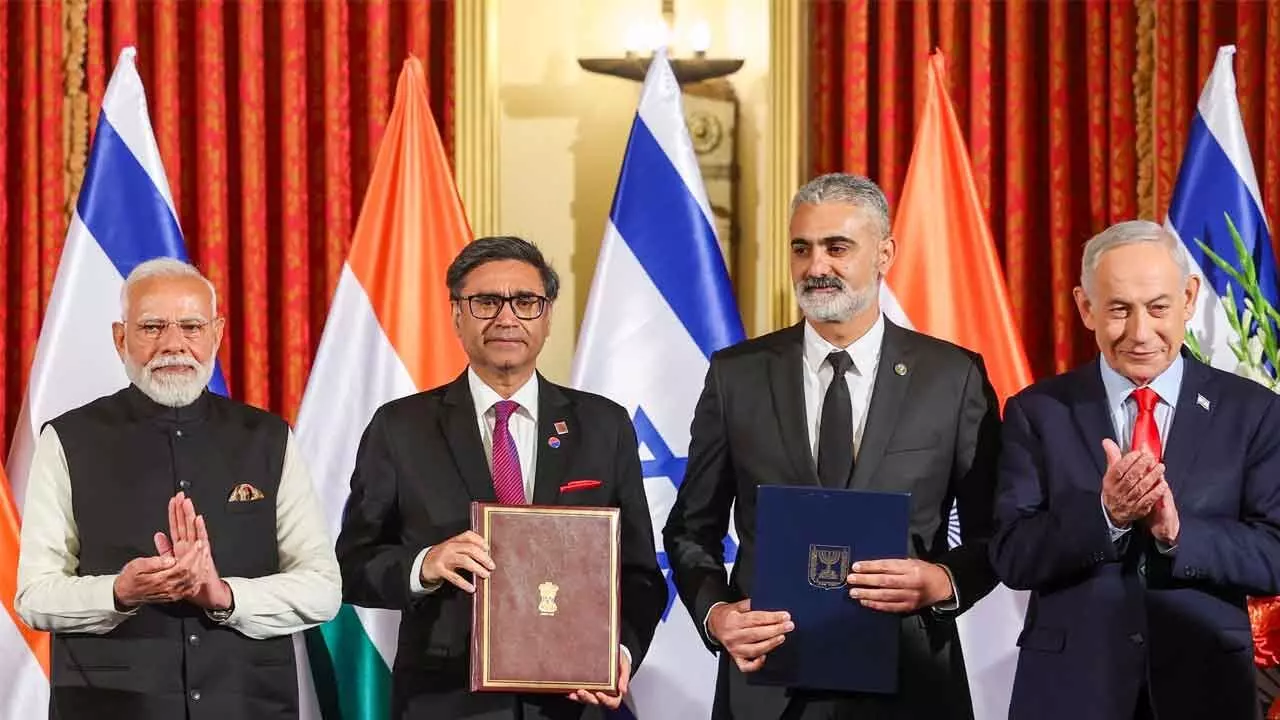
- Prime Minister Narendra Modi announced a new framework that elevates bilateral ties to a ‘Special Strategic Partnership for Peace, Innovation, and Prosperity,’ while also underlining the two nations’ developing strategic connection.
- The signing of more than 17 agreements and memoranda of understanding spanning numerous sectors was one of the visit’s main results.
- With both nations committing to strengthening their collaboration in artificial intelligence, semiconductors, biotechnology, and quantum computing, these technologies will be a key area of focus.
- Increasing cooperation in emerging technologies, artificial intelligence, cybersecurity, agriculture, defence, and space exploration were the main topics of discussion.
Following a two-day visit to Israel, Prime Minister Narendra Modi announced a new framework that elevates bilateral ties to a “Special Strategic Partnership for Peace, Innovation, and Prosperity,” while also underlining the two nations’ developing strategic connection. The trip was yet another turning point in the growing defence, technology, commercial, and security collaboration between Israel and India.
Both Modi and Israeli Prime Minister Benjamin Netanyahu emphasised that their nations’ friendship has developed into a complex strategic relationship during their lengthy discussions. Increasing cooperation in emerging technologies, artificial intelligence, cybersecurity, agriculture, defence, and space exploration were the main topics of discussion.
Addressing the Knesset, Israel’s parliament, PM Modi reaffirmed India’s unwavering support for Israel in the wake of the Hamas assault on October 7, 2023. “India shares the anguish and pain” caused by the incident and stands firmly against terrorism in all its manifestations,” he said, expressing sympathy with the Israeli people.
In addition to praising PM Modi’s leadership, PM Netanyahu said that the two leaders were close friends. He called PM Modi “more than a friend” during his speech to the Knesset, highlighting the two nations’ burgeoning friendship. The highly reported “Modi hug” that PM Netanyahu mentioned during his speech served as a symbol of the two leaders’ personal chemistry, which was evident throughout the visit.
The signing of more than 17 agreements and memoranda of understanding spanning numerous sectors was one of the visit’s main results. These accords cover collaboration in fields such as artificial intelligence, cybersecurity, geophysical exploration, research in agriculture, fisheries and aquaculture, education, financial technology, and cross-cultural interactions.
With both nations committing to strengthening their collaboration in artificial intelligence, semiconductors, biotechnology, and quantum computing, these technologies will be a key area of focus. The alliance, according to officials, combines India’s vast talent pool and growing manufacturing capability with Israel’s standing as a worldwide innovation hub.
The leaders highlighted the expanding scope of bilateral collaboration in the defence industry and talked about a plan to further fortify cooperative R&D and defensive technology partnerships. Both parties stressed how crucial defence cooperation is to maintaining both technological growth and regional security.
Additionally, economic cooperation was a major topic of discussion. In order to increase trade and investment flows, the two nations decided to expedite negotiations for a Free Trade Agreement (FTA). In order to improve cross-border financial connectivity, the parties have looked into connecting Israel’s quick payment systems with India’s Unified Payments Interface (UPI).
Israel’s decision to permit up to 50,000 more Indian migrants to work in the nation over the course of the following five years in industries like manufacturing, services, and construction was another noteworthy statement. The leaders also emphasised how critical it is to safeguard migrant workers’ safety and rights.
The long-standing cornerstones of India-Israel collaboration, agriculture and water management, were again emphasised. The development of agricultural centres of excellence, which have been built throughout India and have trained over a million farmers in cutting-edge crop and irrigation technologies, was evaluated by both leaders.
In addition to bilateral collaboration, the leaders talked about more general regional and global concerns, such as the necessity of better international coordination in the fight against terrorism. They applauded diplomatic efforts to stabilise the Middle East and reaffirmed their commitment to world peace.
The growing geopolitical significance of the India-Israel friendship was again highlighted by the visit. In addition to discussing the India-Middle East-Europe Economic Corridor’s potential to improve connectivity and trade throughout Asia, the Middle East, and Europe, both presidents reiterated their engagement in regional frameworks like the I2U2.
Analysts consider this visit as another move in the direction of the progressively improving relations between India and Israel after PM Modi’s historic 2017 visit, which was the first by an Indian prime minister. According to the most recent agreements and strategic statements, both countries intend to expand their cooperation in the areas of technology, security, and economic development.
Both leaders underlined their commitment to maintaining high-level engagement and fostering people-to-people ties as PM Modi wrapped up his visit, indicating that India-Israel cooperation will remain a crucial tenet of their respective foreign policies in the years to come.

Anjali Singh is a postgraduate student of Political Science and International Relations, a Social Media Analyst, and a former Research Intern at the Indian Council of World Affairs. Views expressed are the author’s own.
 Aayush Pal
  Archita Gaur
  Diksha Bharti