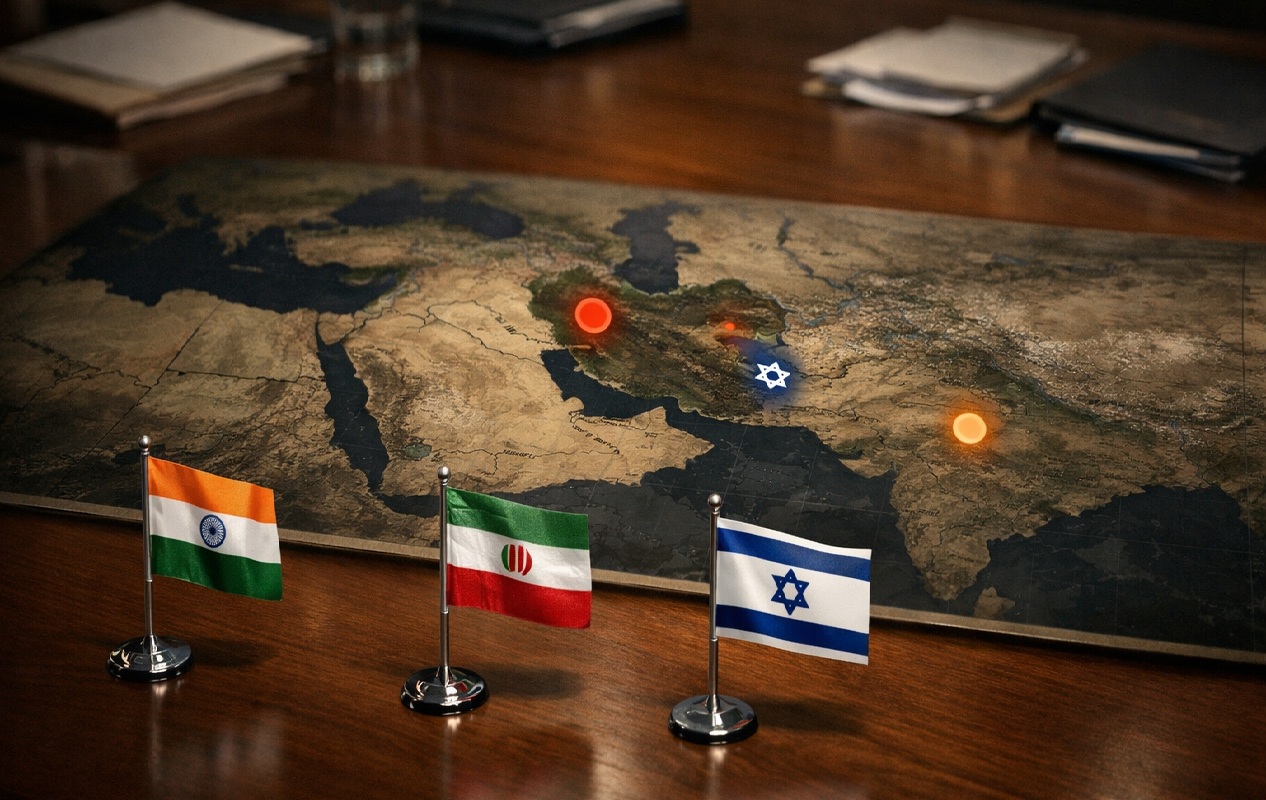
- From a game theory perspective, the crisis can be understood as a multi-player strategic interaction under conditions of uncertainty, in which each actor seeks to maximise security while avoiding catastrophic escalation.
- This was not a symbolic strike or a warning shot, but a deliberate decapitation of the highest authority in the Islamic Republic, crossing a red line that many assumed would never be crossed because of its unpredictable consequences.
- Historically, external military pressure has rarely weakened revolutionary regimes; more often, it has strengthened their most uncompromising elements.
- For India, the challenge is not to shape the conflict’s outcome, but to navigate its consequences with prudence, clarity, and resolve.
The joint strike carried out by Israel and the United States on Iran on 28 February 2026 represents one of the most consequential geopolitical ruptures in West Asia in decades. The confirmation by Iran’s own official media that Ayatollah Ali Khamenei and several senior leaders were killed removes any ambiguity about the gravity of the event. This was not a symbolic strike or a warning shot. It was a deliberate decapitation of the highest authority in the Islamic Republic, crossing a red line that many assumed would never be crossed because of its unpredictable consequences.
The timing of the strike adds a critical geopolitical layer. It occurred immediately after Narendra Modi concluded his visit to Israel. Even if India had no advance knowledge or involvement, optics matter in international politics. In Tehran, sections of the political elite and public opinion will inevitably connect the dots, however tenuously. In Washington and Tel Aviv, the moment will be read as a demonstration of strategic confidence.
For New Delhi, the coincidence complicates diplomacy, requiring careful signalling to preserve strategic autonomy while managing relationships with all sides involved. At the core of the unfolding crisis lies the question of regime change. The killing of a supreme leader appears, on the surface, to be the ultimate form of regime disruption. Yet Iran is not a personalised autocracy that collapses with the removal of one individual. It is a deeply institutionalised system where clerical authority, revolutionary legitimacy, and military power are intertwined. Khamenei’s death creates a leadership vacuum, but not a power vacuum. The structures that sustained the Islamic Republic for over four decades remain intact, particularly the Islamic Revolutionary Guard Corps, which has both coercive power and economic reach.
In the immediate aftermath, Iran’s most rational move is consolidation rather than fragmentation. Emergency constitutional mechanisms and informal power arrangements are likely to emerge rapidly. The Guard will position itself as the guarantor of stability, framing internal unity as an existential necessity in the face of external aggression. This dynamic reduces the likelihood of immediate internal collapse and increases the probability of hardline dominance. Historically, external military pressure has rarely weakened revolutionary regimes; more often, it has strengthened their most uncompromising elements. The regional repercussions of the strike are already visible and are likely to intensify. West Asia has long functioned under a fragile balance of deterrence, characterised by proxy warfare and calibrated escalation. The killing of Iran’s supreme leader disrupts that balance. Proxy theatres in Iraq, Syria, Lebanon, and Yemen are likely to experience renewed activity as Iran seeks asymmetric responses that avoid direct conventional war while signalling resolve. Such actions allow Tehran to impose costs without triggering an immediate all-out confrontation.
Gulf states now face an acute strategic dilemma. Their security architectures depend heavily on American protection, yet they are geographically vulnerable to Iranian retaliation. Even limited missile or drone attacks would have outsized psychological and economic effects. Infrastructure, ports, and energy facilities are soft targets in a conflict where signalling matters as much as damage. As a result, Gulf capitals will publicly call for restraint while privately preparing for contingencies that include internal security tightening and quiet diplomatic outreach to Tehran. The maritime dimension is particularly sensitive. Any disruption, real or perceived, to shipping lanes in the Persian Gulf and the Strait of Hormuz will reverberate through global markets. Energy prices respond not only to physical shortages but to risk perception. Insurance costs, freight delays, and speculative trading can generate economic shockwaves even without a formal blockade. This vulnerability gives Iran leverage even in a weakened state and magnifies the global consequences of regional instability. Israel, meanwhile, may find that tactical success brings strategic complications. While the strike may degrade Iranian command structures in the short term, it increases incentives for long-term retaliation against Israeli interests. These need not be immediate or geographically proximate. The logic of delayed and deniable response favours actors who lack conventional parity but possess patience and networks. In this sense, the strike may lengthen the conflict horizon rather than shorten it.
Against this backdrop, India’s response will be shaped by necessity rather than ideology. New Delhi has cultivated strong ties with Israel in defence and technology, deepened strategic convergence with the United States, and maintained civilisational, cultural, and economic links with Iran. Any overt alignment in this conflict risks alienating one partner or another. India’s initial emphasis on restraint, dialogue, and protection of civilians reflects this balancing instinct and is consistent with its long-standing foreign policy posture. India’s concerns are not abstract. The Indian diaspora in West Asia numbers in the millions and constitutes a vital economic and social bridge. Their safety is an immediate priority. While Iranian territory itself hosts a relatively small Indian population, the wider region does not. Escalation affects airspace, shipping, employment, and internal security conditions across the Gulf.
India’s experience in evacuations during regional crises suggests that contingency planning will be robust, even if exercised quietly to avoid panic. Energy security is another critical dimension. India remains heavily dependent on imported crude oil, and West Asia plays a central role in that supply chain. Even though sanctions have limited direct imports from Iran, instability in the region affects global prices. Volatility increases import bills, widens fiscal pressures, and transmits inflationary effects into the domestic economy. Strategic petroleum reserves offer a buffer, but they are not a long-term solution. This crisis reinforces the urgency of diversification, energy diplomacy, and accelerated transition planning.
The coincidence of the strike with Modi’s departure from Israel introduces political sensitivities. Domestically and internationally, questions may be raised about perception and proximity. India will need to clearly signal that its bilateral relationships do not translate into endorsement of unilateral military actions. Strategic autonomy, in this context, is not rhetorical positioning but practical risk management. Maintaining credible neutrality enhances India’s ability to protect its interests and its people. Whether the strike constitutes regime change depends on intent and outcome.
Regime change, in strategic terms, requires not only the removal of leadership but also the establishment of a new governing order aligned with external objectives. There is little evidence that such a roadmap exists. Without internal elite defection or sustained popular uprising, external force alone is unlikely to produce a compliant successor regime. More plausibly, the strike aims to induce long-term weakening and deterrence rather than immediate transformation. If regime change does occur, it is more likely to be endogenous and gradual, driven by economic stress, elite competition, and societal fatigue rather than by foreign military action. Conversely, if regime change does not occur, Iran may emerge more militarised, more secretive, and more determined to secure ultimate deterrence capabilities. Either outcome complicates the strategic environment rather than stabilising it.
From a game theory perspective, the crisis can be understood as a multi-player strategic interaction under conditions of uncertainty. Each actor seeks to maximise security while avoiding catastrophic escalation. One plausible pathway is controlled escalation followed by re-deterrence, where limited retaliation gives way to a harsher but stable equilibrium. Another is prolonged proxy conflict, producing sustained instability without direct war. A third possibility is internal consolidation within Iran, strengthening hardliners rather than weakening them. Less likely but still plausible are scenarios of internal fragmentation leading to gradual transformation or, at the extreme, direct regional war triggered by miscalculation. Assigning probabilities highlights the absence of clean outcomes. Controlled re-deterrence may be the most likely scenario, but it still entails high costs. Proxy intensification remains a strong possibility, as it allows signalling without confrontation. Internal consolidation is a realistic response to an external threat. Gradual internal change is possible but uncertain. Direct war is least likely, yet its consequences are severe enough to shape all strategic calculations.
For India, this crisis reinforces fundamental lessons. West Asian stability is integral to India’s national security. Strategic autonomy provides flexibility in uncertain environments. Non-kinetic diplomacy often yields greater long-term security than visible alignment. India’s role, therefore, is likely to be that of a stabilising interlocutor rather than an active partisan. This is not moral neutrality but strategic realism. The killing of Iran’s supreme leader closes one chapter in West Asian history and opens another defined by uncertainty. It does not resolve the underlying conflicts that have shaped the region for decades. Instead, it intensifies them, redistributing risks and responsibilities across states that may not have chosen this moment. For India, the challenge is not to shape the conflict’s outcome, but to navigate its consequences with prudence, clarity, and resolve.

Dr. Nanda Kishor M. S. is an Associate Professor at the Department of Politics and International Studies, Pondicherry University, and former Head of Geopolitics and International Relations at Manipal University. His expertise spans India’s foreign policy, conflict resolution, international law, and national security, with several publications and fellowships from institutions including UNHCR, Brookings, and DAAD. The views expressed are the author’s own.
 Kumar Satish
  Anjali Singh
  Aayush Pal