
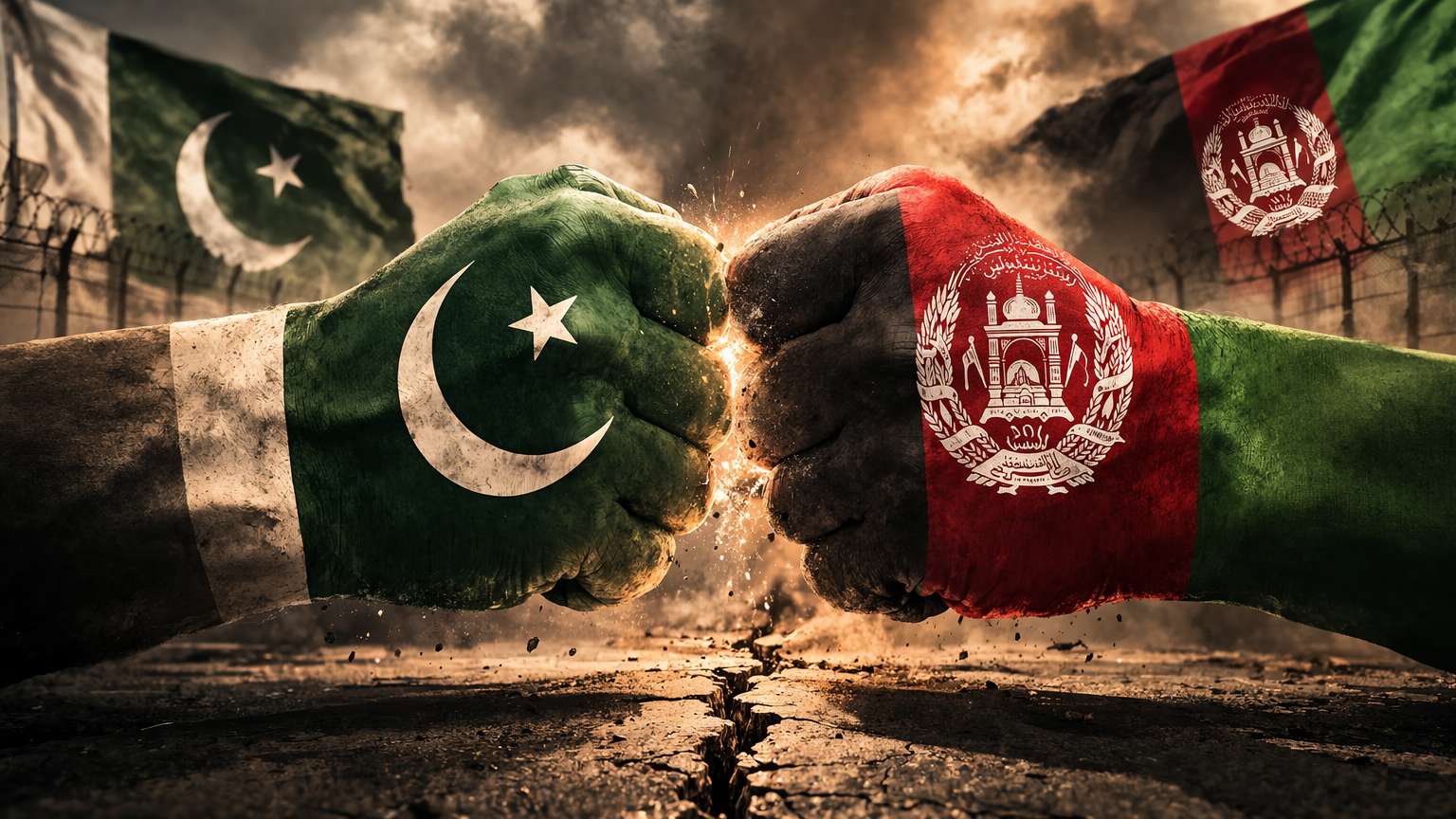
- The Durand Line has neither been formally recognised by successive Afghan governments nor accepted as a legitimate international boundary, making it one of the most politically and socially contested frontiers in the world.
- The border cuts across tribal networks that have historically moved freely across the frontier, thereby leaving modern states struggling to impose rigid territorial controls.
- Pakistan is confronting the paradox of attempting to stabilise a border that it once sought to leverage for strategic advantage, yet continues to view with suspicion and alarm.
- The Durand Line is more than just a line on the map; it is increasingly emerging as a fault line in regional security, where historical legacies continue to shape present-day instability.
The recent surge of drone strikes and cross-border missile attacks between Pakistan and Afghanistan highlights the persistent instability of a frontier whose insecurity is historically bred, as opposed to being born only of present-day security imperatives. Islamabad has repeatedly accused the Afghan Taliban authorities of providing a haven to Tehrik-e-Taliban Pakistan (TTP), which continues to operate from Afghan territory while carrying out cross-border attacks and retaliatory strikes inside Pakistan, incidents that have increased in frequency in recent years. Simultaneously, Pakistan’s efforts to fortify and fence its western border have led to recurrent clashes with Taliban forces, as well as protests from local communities residing along the frontier, who view such measures as disruptive to traditional cross-border movement.
However, the Pakistan–Afghanistan crisis cannot be reduced solely to questions of militancy or counterterrorism. At its core lies the Durand Line, a boundary demarcated in 1893 by British colonial authorities, which bisected Pashtun tribal lands between present-day Pakistan and Afghanistan. Unlike most internationally recognised borders, the Durand Line has neither been formally recognised by successive Afghan governments nor accepted as a legitimate international boundary, making it one of the most politically and socially contested frontiers in the world.
More than a century after its demarcation, the Durand Line continues to shape the geopolitics of the region. The border cuts across tribal networks that have historically moved freely across the frontier, thereby leaving modern states struggling to impose rigid territorial controls. As Pakistan grapples with resurgent militancy and increasingly strained relations with the Taliban authorities in Kabul, the enduring legacy of this colonial-era boundary has once again assumed central importance in explaining persistent volatility along the Pakistan–Afghanistan border.
Colonial Origins of the Durand Line
The Durand Line is a result of nineteenth-century geopolitics and rivalry. The British Indian government, on behalf of which Sir Mortimer Durand concluded negotiations with Afghan ruler Abdur Rahman Khan in 1893, demarcated the frontier between British India and Afghanistan. It was not intended to be a lasting national boundary, but to serve as a buffer zone protecting British India from potential Russian encroachment in the opium-laden “Great Game”.
The line drawn under this agreement ran straight through the Pashtun tribal areas, which had traditionally been a unified social and cultural space. Tribal communities, whose loyalties were to kinship and tribe and not confined by territorial borders, had been crossing the rugged frontier for centuries. Consequently, the Durand Line was more of an administrative boundary for the colonial authorities than one grounded in local realities.
The political ambiguity surrounding the Durand Line persisted even after the end of British rule in 1947. Successive Afghan governments have refused to formally recognise the border as an international boundary, arguing that the agreement was imposed under colonial circumstances. This historical contestation has continued to shape the uneasy relationship between Kabul and Islamabad, thereby making the frontier one of the most politically sensitive borders in South Asia.
The Tribal Frontier and the Limits of State Control
The Durand Line has existed on maps for over a century, but it has remained markedly different in practice on the ground. The frontier region was largely a Pashtun tribal society, politically organised by customary law and tribal councils (jirgas), and linked by kinship networks that operated on both sides of the border. For these populations, moving back and forth across the mountains and valleys of the region was simply a way of life. The drawing of a fixed territorial frontier thus conflicted with established patterns of movement and local governance.
At the time of Pakistan’s formation in 1947, the state inherited this intricate frontier configuration. Much of the area was designated as the Federally Administered Tribal Areas (FATA), bringing it under Pakistani administration on a more direct, but still limited, basis. Governance was largely conducted on the basis of indirect arrangements with tribal leaders. This limited administrative presence meant that the Durand Line functioned less like a heavily guarded international border and more like a porous frontier, where people, goods, and eventually militant groups flowed with relative ease.
Over the decades, weak state capacity in the border areas has facilitated militant organisations. During the Soviet–Afghan War in the 1980s, and later during the U.S.-led intervention in Afghanistan, the frontier emerged as a strategic corridor for insurgent networks. These developments further blurred the lines between tribal sovereignty, cross-border movement, and militant activity. In turn, this has reinforced the Durand Line’s status as one of the most volatile borders in the region.
Pakistan’s Strategic Depth Doctrine
Pakistani policymakers have long sought to secure what they term “strategic depth” in Afghanistan. Parts of Pakistan’s security apparatus and government have argued since the 1990s that a friendly government in Kabul is critical to counter India and prevent what it perceives as Indian encirclement. Support for the Taliban during the civil war in Afghanistan was viewed as a means of securing influence over the country’s political future while enhancing security along Pakistan’s western frontier.
This approach, however, yielded unintended consequences. The militant networks that developed in the wake of the anti-Soviet jihad evolved into a constellation of armed groups operating across the Pakistan–Afghanistan border. The Afghan Taliban focused much of their efforts within Afghanistan, but groups such as the Tehrik-e-Taliban Pakistan (TTP) directed their activities against the Pakistani state. These groups have since used the porous border along the Durand Line, as well as entrenched tribal ties, to regroup, recruit, and launch attacks.
The fall of Kabul to the Taliban in 2021 initially raised hopes in Islamabad that a friendly regime in Kabul would help curb anti-Pakistan militancy. However, the relationship between the two has become progressively more fraught. Taliban authorities have been hesitant to confront the Tehrik-e-Taliban Pakistan (TTP) head-on. At the same time, Pakistan’s attempts to gain greater control over the Durand Line, especially through border fencing, have met with opposition from militants and local communities alike. This has left Pakistan confronting the paradox of attempting to stabilise a border that it once sought to leverage for strategic advantage, yet continues to view with suspicion and alarm.
From Strategic Depth to Strategic Blowback
Pakistan’s Afghanistan policy has traditionally been guided by the idea of “strategic depth.” Since the 1990s, parts of Pakistan’s security establishment have believed that a friendly government in Kabul would provide geopolitical leverage against India and protect Pakistan from hostile forces arrayed along both its eastern and western borders. The emergence of the Taliban after the Afghan civil war was, therefore, seen in Islamabad as an opportunity to gain influence in Kabul and to stabilise the border in Pakistan’s favour.
However, the networks that were formed in this era gradually produced unintended outcomes. Cross-border militant groups operating along the Afghanistan–Pakistan border also diversified their aims and allegiances. While the Afghan Taliban were primarily concerned with Afghanistan, other groups, such as the Tehrik-e-Taliban Pakistan (TTP), were formed with the clear purpose of confronting the Pakistani state. They have exploited the permeability of the Durand Line and the social networks among the Pashtuns living on either side of the border.
But the networks established in this period began to produce unintended effects. Cross-border militant groups operating along the Afghanistan–Pakistan border have also diversified their objectives and alliances. While the Afghan Taliban remained primarily focused on Afghanistan, other formations, including the Tehrik-e-Taliban Pakistan (TTP), emerged with the explicit aim of confronting the Pakistani state. They have exploited the porous nature of the Durand Line and the cross-border social networks among Pashtun communities.
In recent years, the focus of tensions between Pakistan and Afghanistan has come to revolve increasingly around the Durand Line itself. Pakistan has been trying to transform the traditionally porous border into a more regulated frontier through fencing, surveillance infrastructure, and the augmentation of military patrols. Islamabad considers these measures necessary to prevent cross-border militancy, especially from organisations such as the Tehrik-e-Taliban Pakistan (TTP), which has intensified its attacks within Pakistan.
Conclusion
Tensions along the Pakistan-Afghanistan border are a vivid reminder of the long-term effects of borders imposed through colonial geopolitics, which remain poorly aligned with local socio-political realities. More than a century after its demarcation, the Durand Line still separates communities and kinship networks, making effective localised governance difficult and, at times, nearly impossible. Pakistan’s efforts to tighten border control through fencing and enhanced military measures have contemporary security implications. Still, they also reveal the deeper historical and political complexities of the frontier. As fresh flare-ups in the region suggest, the Durand Line is more than just a line on the map; it is increasingly emerging as a fault line in regional security, where historical legacies continue to shape present-day instability.
References:
- Dalrymple, W. (2013). The Durand Line: The British Empire’s most successful failure. Foreign Affairs, 92(5), 50–63.
- Barfield, T. (2010). Afghanistan: A cultural and political history. Princeton University Press.
- Fair, C. C. (2014). Fighting to the end: The Pakistan army’s way of war. Oxford University Press.
- Shah, S. A. (2017). The Durand Line: History, consequences, and future. Asian Affairs, 48(2), 284–298.

Archita Gaur is a postgraduate student at the School of International Studies, JNU. She specialises in the World Economy and has a strong interest in public policy, economic research, and governance. The views expressed are the author’s own.
 Aayush Pal
  Rajeev KS
  Hridbina Chatterjee