
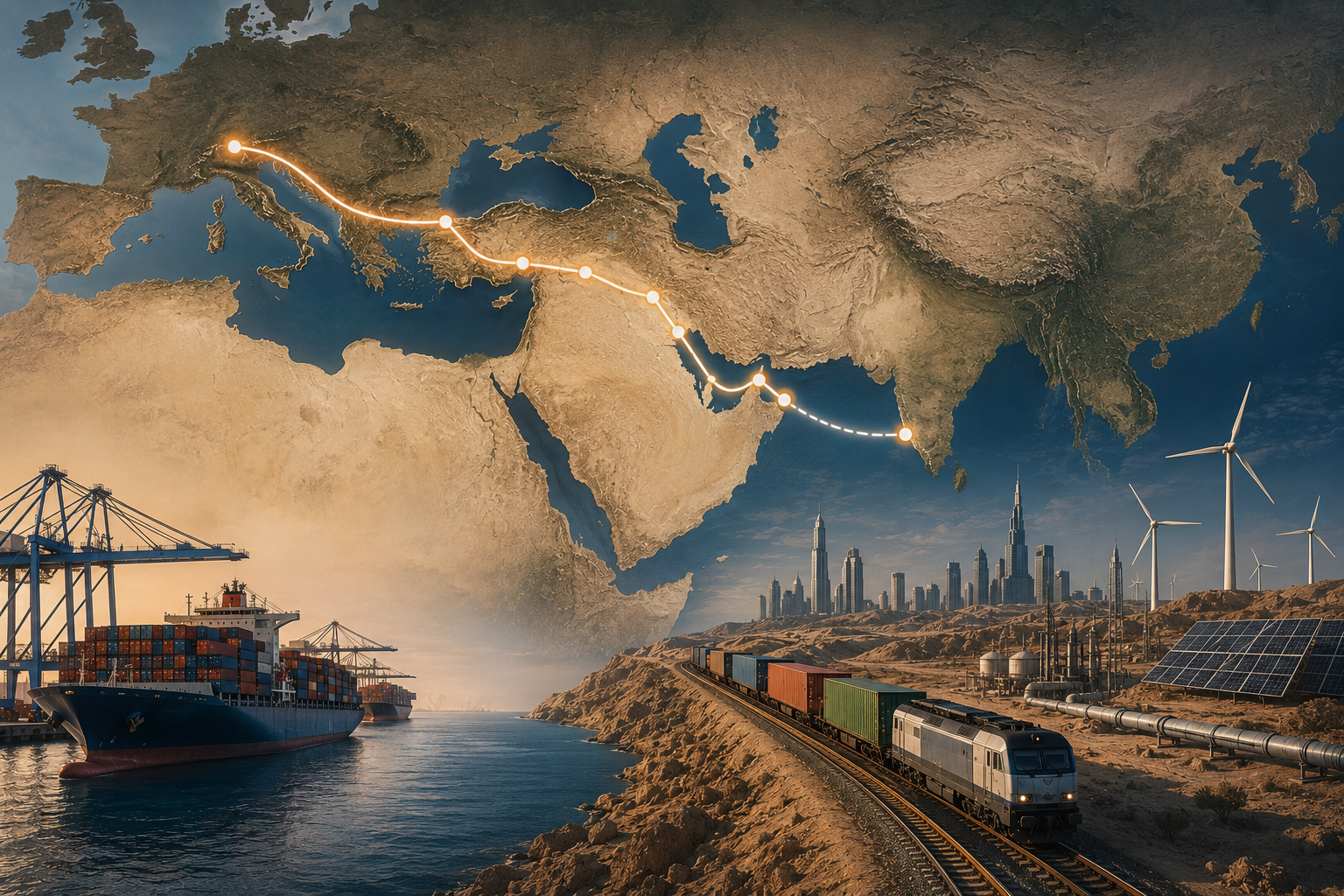
- IMEC is more than a logistical project. It is the emergence of competing visions of globalisation, connectedness, and geopolitical power in the 21st century.
- IMEC is a reflection of New Delhi’s desire to shape regional economic architecture rather than simply responding to it.
- The battle for influence in the twenty-first century will increasingly be fought over trade routes, ports, railways, energy grids and digital connectivity rather than military power or diplomacy.
One of the decade’s most ambitious geopolitical connectivity projects was launched at the 2023 G20 Summit in New Delhi: the India-Middle East-Europe Economic Corridor (IMEC). The corridor, supported by India, the United States, the European Union, Saudi Arabia, the United Arab Emirates, France, Germany and Italy, seeks to link India with Europe via a multi-modal network of ports, trains, digital infrastructure and energy connectivity across West Asia.
IMEC seems primarily a commercial and infrastructure project. But under the language of economic cooperation is a deeper strategic calculus. Over the past decade, China’s BRI has extended Beijing’s influence in Asia, Africa, Europe and the Middle East, making the corridor a more strategic response. IMEC is therefore more than a logistical project. It is the emergence of competing visions of globalisation, connectedness, and geopolitical power in the 21st century.
China’s Belt and Road Initiative has turned infrastructure into a tool of geopolitical power. Since launching the Belt and Road Initiative in 2013, Beijing has poured billions into the ports, highways, trains and industrial corridors of Eurasia and the Global South. Projects such as the China-Pakistan Economic Corridor, the Port of Gwadar in Pakistan, Hambantota in Sri Lanka and railway investments across Africa have extended China’s economic and political reach. Finance and infrastructure diplomacy have created long-term strategic dependency on Beijing. Many countries turned to Chinese investment to compensate for the gap left by Western financial institutions.
But the BRI has not been without its critics. Many of the countries involved were dealing with mounting debt loads, uncertain sources of funding and worries about political reliance on Beijing. Western governments have increasingly viewed the program as a geopolitical tool for China to reshape trade routes, supply chains and regional influence, not just an economic one.
IMEC emerged in this context. The corridor aims to connect Indian ports to the Gulf through maritime routes and further into Europe through rail connectivity via Saudi Arabia, Jordan and Israel. The idea also contains plans for energy grids, hydrogen pipelines and digital cables, meaning the corridor is to be regarded not just as a route for transportation but a broader geoeconomic architecture.
IMEC and India’s Supply Chain Ambition
IMEC is a very big strategic opportunity for India. New Delhi has viewed the BRI with suspicion for some time, particularly as it goes through Pakistan-occupied Kashmir, territory that India claims as its own. India refused to join the BRI and pursued alternative connectivity initiatives that better matched its strategic interests. The IMEC will enable India to avoid trade networks controlled by both Pakistan and China and also enhance its connectivity to West Asia and Europe.
The corridor also fits with India’s increasing ambition to establish itself as a global industrial and supply chain hub. Multinational companies seeking to move away from supply chains centred on China see connectivity infrastructure as key for India to attract investment and increase exports. The IMEC has the potential to reduce the time of transportation between India and Europe significantly, and also to diversify the maritime commerce routes beyond dangerous chokepoints like the Suez Canal.
IMEC and the Western Push for Alternative Global Connectivity
The United States also views IMEC from a strategic perspective. Washington has tried several alternative measures over the years but has not been able to resist the growing influence of the BRI. The IMEC will help the United States boost strategic partnerships with India and Gulf countries and expand its footprint in the Indo-Pacific and Middle East. Instead, the project is a case in point of a broader American strategy of coalition building and connectivity agreements, not a copycat of China’s state-led finance.
The corridor strengthens Europe’s economy and geopolitics. The European Union wants to diversify trade routes and reduce strategic dependence following disruptions caused by the COVID-19 pandemic and the Russia-Ukraine conflict. Vulnerabilities in the supply chain, energy security and Chinese economic power are increasingly on the minds of Europeans, sparking interest in alternative connectivity initiatives. IMEC thus complements Europe’s Global Gateway program, which aims to promote transparent and long-term partnerships in the infrastructure sector.
The Gulf states are critical actors in this geopolitical dynamic. Saudi Arabia and the UAE want to become logistics and connectivity hubs that will link Asia, Africa and Europe. Their participation in the IMEC is part of wider efforts to diversify economically beyond reliance on oil. The corridor provides the Gulf monarchs with an opportunity to enhance their geopolitical importance by placing themselves at the heart of growing trade and energy networks.
At the same time, IMEC has huge diplomatic implications for West Asia. The corridor’s initial raison d’etre was largely based on regional reconciliation, particularly between Saudi Arabia and Israel. The planned rail connectivity throughout Israel reflected the aims of economic integration in the region. However, their plans were disrupted by the escalation of the Gaza conflict following October 2023. Regional instability, security concerns and political difficulties hampered the speed of the project and the vulnerability of connection programs to geopolitical crises was exposed.
This brings up a very important question: can IMEC really compete with the BRI?
The Geopolitical Challenges facing IMEC
China still has major financial advantages. Beijing has infrastructure funding institutions, global construction companies and years of experience delivering major projects. Many BRI projects are already operational, giving China significant leverage in many places. IMEC, on the other hand, is still mostly conceptual with several infrastructural gaps, governance issues and finance concerns to be solved.
Centralised decision-making in China also benefits the BRI. Once political agreements are in place, projects can move fast. “IMEC is a coalition of several democratic governments, each with its own political priorities, regulatory systems and strategic considerations. Bridging the gap between India, the Gulf monarchies, European countries and the United States may prove more difficult than expected.
There are also political and topographical problems. Turkey and Egypt, among other countries, have voiced fears that the corridor will bypass them. This is especially true of Egypt, which fears that IMEC could threaten the strategic value of the Suez Canal, a major source of state revenue. But Iran believes that alternate routes linking India and the Gulf are against its connectivity goals linked to China and Eurasian trade lines. The future course of the project may be influenced by competing regional interests.
But IMEC’s importance goes beyond the question of whether it will completely supplant the BRI. What makes it important is that it introduces strategic competition into global infrastructure politics. China led the diplomacy of massive connectivity for years. Now other big countries are trying to develop alternative economic corridors based on different political and institutional arrangements, the IMEC says.
Supporters argue that IMEC promotes a model of openness, sustainability and diverse partnerships, rather than debt-driven dependency. It’s uncertain whether this aim will be realised. But the corridor is part of a wider shift in global geopolitics where infrastructure has become inextricably linked to geopolitical rivalry.
The corridor also indicates the changing geopolitics of India. Historically, India has been cautious about global strategic competition, but is increasingly participating in coalition-based efforts on connectivity and supply chains. IMEC is a reflection of New Delhi’s desire to shape regional economic architecture rather than simply responding to it. It is India’s wish to be a balancing power in Asia, and a bridge between the Indo-Pacific, the Middle East and Europe.
The success of IMEC will hinge on political stability in West Asia, long-term financial commitment, institutional coordination, and strategic patience. You don’t build infrastructure routes on summit announcements. They require decades of political consistency, of economic confidence and of regional cooperation.
But the creation of IMEC does reveal a key geopolitical reality: the battle for influence in the twenty-first century will increasingly be fought over trade routes, ports, railways, energy grids and digital connectivity rather than military power or diplomacy. In that rivalry, IMEC marks the beginning of a new stage in the global race to construct the future architecture of globalisation.

Anusreeta Dutta is a columnist and climate researcher with experience in political analysis, ESG research, and energy policy. Views expressed are the author’s own.
 Hridbina Chatterjee
  Divyanka Tandon
  Aayush Pal