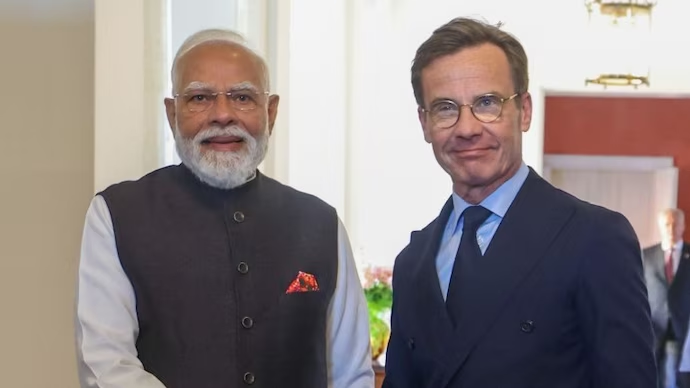
- PM Modi and PM Kristersson are reinforcing their bilateral relationship by elevating it to a Strategic Partnership based on four primary pillars of cooperation: Strategic Dialogue, Next Generation Economic Cooperation, Emerging Technologies, and Sustainable Development.
- The two nations aspire for their two-sided trade flow to climb from $7.75 billion by 2025 to 200% more over the next five years.
- India and Sweden announced new initiatives focused on increasing their collaboration on cutting-edge technologies, including the India-Sweden Technology and AI Corridor and the Joint Innovation Partnership 2.0.
- There has also been an increase in joint projects related to defence and strategic cooperation with emphasis on both co-development and the ‘Make in India’ initiative.
Prime Minister Narendra Modi of India made a two-day trip to Gothenburg, which signifies a major milestone and progression in the close cooperation and partnership between India and Sweden and the economic, technological and strategic cooperation between the two countries. The trip was made at the request of Swedish Prime Minister Ulf Kristersson and is part of PM Modi’s larger European Tour and follows closely after the implementation of the India-EU (European Union) Free Trade Agreement (FTA), which is expected to lead to a significant increase in trade and investment between the two countries.
PM Modi and PM Kristersson are reinforcing their bilateral relationship by elevating it to a Strategic Partnership based on four primary pillars of cooperation: Strategic Dialogue, Next Generation Economic Cooperation, Emerging Technologies, and Sustainable Development. The two leaders approved the India-Sweden Joint Action Plan (2026-2030) to implement this vision in cooperation in multiple sectors including defence, innovation, sustainable (green) transition, and digitalisation.
An essential purpose of the trip was to promote the economic relationship between the two countries. The two nations aspire for their two-sided trade flow to climb from $7.75 billion by 2025 to 200% more over the next five years. Swedish investments into India are steadily rising as well. The expected conclusion of the India-EU FTA is expected to further support this trend by providing enhanced market access for Indian exports as well as facilitating the transfer of high-technology investment from Europe to India. PM Modi emphasised India’s role as a trusted partner on the world stage and a likely future manufacturing, technological and resilient supply chain hub in his address to the European Round Table for Industry with Ursula von der Leyen.
The common themes of both countries were around innovation and sustainability. The Parties reiterated their commitment to the LeadIT Initiative (Leadership Group for Industry Transition), which works towards decarbonising energy-intensive industries. India and Sweden announced new initiatives focused on increasing their collaboration on cutting-edge technologies, including the India-Sweden Technology and AI Corridor and the Joint Innovation Partnership 2.0.
There has also been an increase in joint projects related to defence and strategic cooperation, with emphasis on both co-development and the ‘Make in India’ initiative. An example of this growing depth of scientific and technological cooperation between the two countries can be seen in Sweden’s involvement in India’s Venus Mission, Shukrayaan, through collaboration between the Indian Space Research Organisation and the Swedish National Space Agency.
The outcome of the visit by PM Modi also highlights the liberal institutionalist and strategic partnership diplomatic elements, both defined by co-operation as a means of addressing global issues such as technological disruption and climate change through trade agreements, multilateral engagements and institutional frameworks (for example, LeadIT). The current state of India-Sweden relations will further solidify as countries increasingly depend upon one another through co-operation, their interdependence and the same norms to address global challenges. The emphasis placed upon developing resilient supply chains and trust relationships also supports a realist strain as a result of uncertainty in the geopolitical environment and the need for nations to protect their strategic autonomy.
PM Modi ended the visit by articulating optimism for future developments in the areas covered, suggesting that they would create a “new momentum” for bilateral relations between India and Sweden in the coming years. PM Modi now moves on from Gothenburg (for the next leg of his tour, to the India-Nordic Summit) with a clear indication of India’s growing engagement with Europe and a commitment to creating an egalitarian, innovative and inclusive global system.

Anjali Singh is a postgraduate student of Political Science and International Relations, a Social Media Analyst, and a former Research Intern at the Indian Council of World Affairs. Views expressed are the author’s own.
 Kumar Satish