
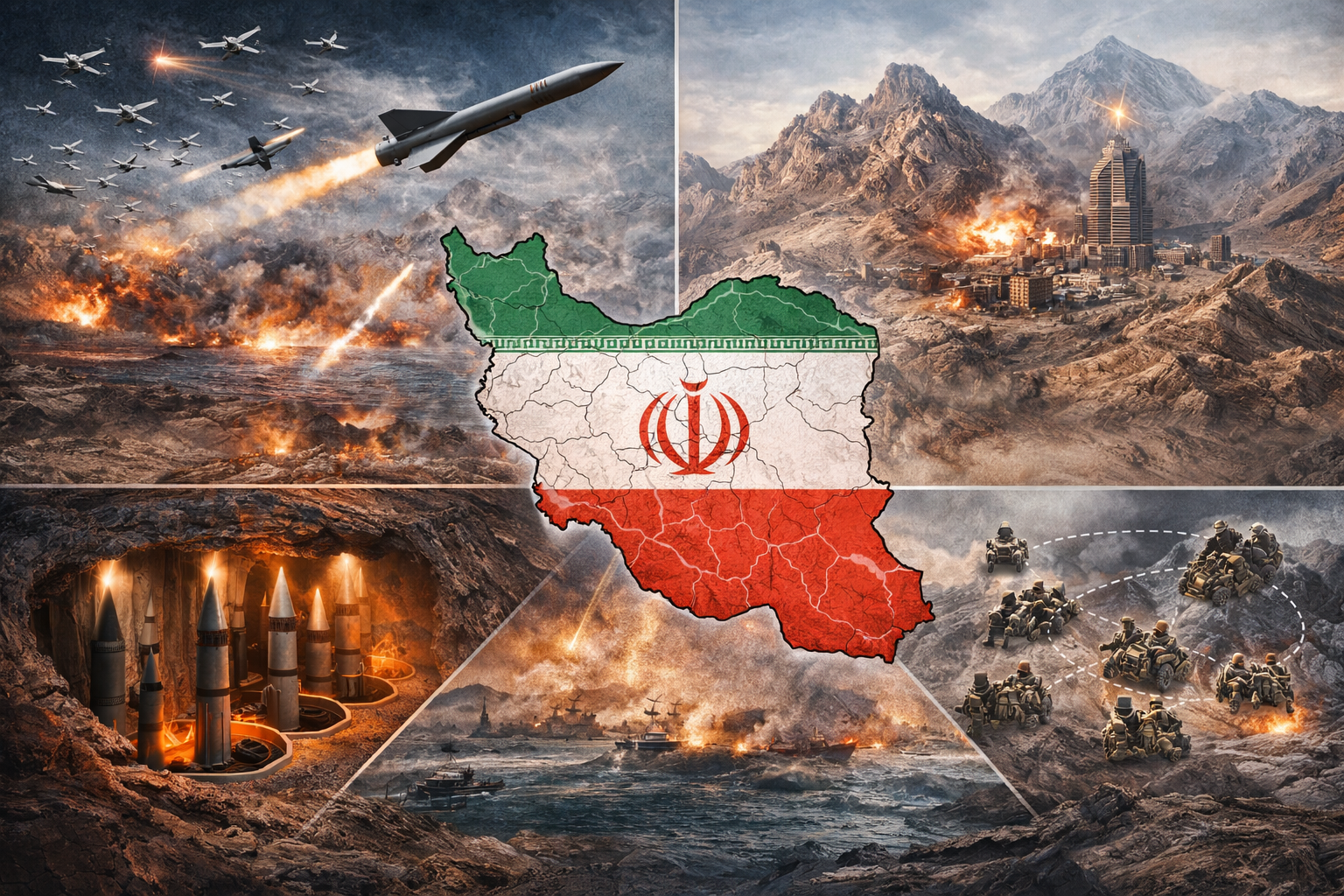
- Iran has developed a system not designed to secure decisive battlefield dominance, but to ensure strategic endurance through resilience.
- Iran’s endurance is rooted in asymmetric warfare, where victory is not achieved by defeating a materially superior adversary, but by rendering the costs of war prohibitively high.
- One of the most important aspects of Iran’s defence plan is its extensive use of underground infrastructure. These installations are usually referred to as “missile cities.”
- Once access is restored, underground facilities can resume operations, underscoring a fundamental limitation of airpower: its ability to degrade and disrupt does not necessarily translate into permanent destruction.
- The Mosaic Doctrine prioritises survivability and continuity over centralised control, an approach that is particularly effective in protracted conflicts.
The Paradox of Air Supremacy
Twenty days into what has been described as a high-intensity conflict, dubbed “Operation Epic Fury,” it appears that the United States and its allies have established significant military dominance over Iran. Thousands of targets have reportedly been struck, air defence systems degraded, naval capabilities disrupted, and elements of leadership targeted. By conventional military standards, such conditions would suggest the possibility of an imminent victory for the United States and its allies.
However, Iran continues to fight while imposing substantial costs on its adversaries. Missile and drone strikes persist, regional stability is under increasing strain, and global energy security faces mounting pressure. The Strait of Hormuz remains vulnerable to disruption, and U.S. allies in the region are facing heightened security risks. This situation presents a strategic paradox: how can a state that has been significantly degraded continue to impose such high costs on materially superior adversaries? The answer lies in Iran’s defence strategy. Unlike conventional military powers, Iran has developed a system not designed to secure decisive battlefield dominance, but to ensure strategic endurance through resilience.
A Natural Fortress
Iran’s geography alone makes it one of the most challenging environments in the world for large-scale invasion. The country spans approximately 1.65 million square kilometres and is home to more than 90 million people, providing substantial strategic depth that would compel any invading force to operate across extended distances and multiple axes of advance.
The country’s terrain further compounds these challenges. The presence of the Zagros Mountains along its western frontier forms a formidable natural barrier, characterised by narrow passes that are highly defensible. Such mountainous terrain significantly constrains military mobility and coordination, particularly for heavy armoured units, which are less effective in these conditions. Even with air superiority, sustaining operational momentum in such terrain remains difficult.
Beyond these natural defences lies the challenge of urban warfare in Tehran. With a metropolitan population exceeding 15 million, the city represents a most complex urban battlespace. Military doctrine suggests that stabilising a megacity of this scale would require extraordinarily large troop deployments, potentially in the hundreds of thousands to millions, well beyond the practical capacity of most contemporary military coalitions.
Historical precedent reinforces these constraints. The United States’ failure in Afghanistan demonstrated that even with overwhelming airpower and a prolonged military presence, controlling rugged mountainous terrain against a determined adversary remains exceptionally difficult. Iran presents an even more complex operational environment, given its larger population, more developed infrastructure, and stronger sense of national cohesion.
Asymmetric Warfare: Redefining Victory
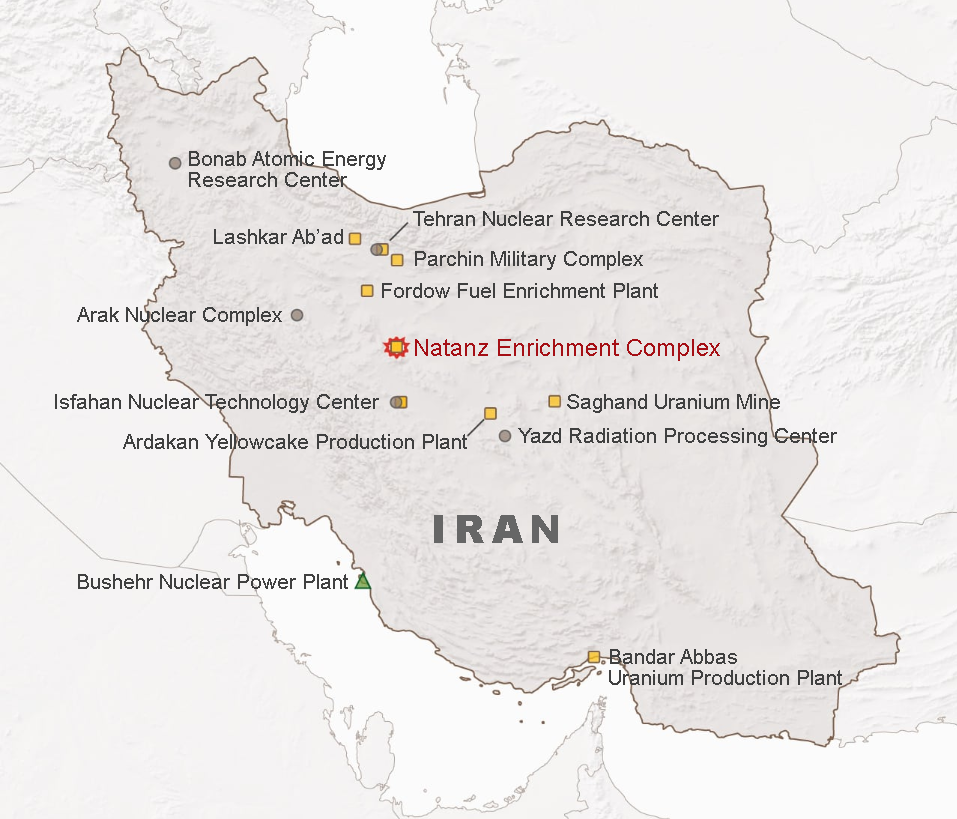
U.S. Installations Damaged in Srikes
Iran’s endurance is rooted in asymmetric warfare, where victory is not achieved by defeating a materially superior adversary, but by rendering the costs of war prohibitively high. Unlike the United States, which typically engages in conflict to achieve defined strategic objectives, Iran frames conflict in terms of regime survival and national security, leveraging economic pressure and strategic disruption to impose costs on its adversaries.
A strategic element of this approach is cost asymmetry: the use of relatively inexpensive drones and missiles to compel adversaries to expend significantly more costly defensive resources. The Strait of Hormuz, a critical global energy chokepoint, does not require sustained occupation to generate strategic effects; even limited disruption can trigger significant volatility in global oil markets. Iran also targets regional vulnerabilities, particularly energy infrastructure, thereby expanding the battlespace and forcing adversaries into a reactive posture across multiple domains.
Iran’s network of regional allies allows for distributed resistance on various fronts, which works even when central capabilities are weakened. In cyber warfare, Iran strikes at the power grid and financial systems, which creates confusion between the battlefield and the homeland.
Time is Iran’s greatest asset. Democracies are under pressure to produce immediate results, while Iran has a strategy for the long term. Victory is not achieved through winning the war, but through making the enemy want to end the war.
The Underground Fortress
One of the most important aspects of Iran’s defence plan is its extensive use of underground infrastructure. These installations are usually referred to as “missile cities.” These have been developed over the course of decades to provide survivability in the event of airstrikes. New bunker-buster bombs have the potential to breach hardened targets, but they have their own limitations.
Iran’s most important installations are buried deeper than the penetration limit of these conventional bombs. These installations are usually buried hundreds of meters deep and are surrounded by rock. As these sites cannot readily be destroyed, an emphasis may be placed on attacking entrances and external infrastructure. This limits their ability for a time, although it does not destroy the capability entirely.
Once access is restored, these facilities can resume operations, underscoring a fundamental limitation of airpower: its ability to degrade and disrupt does not necessarily translate into permanent destruction. Consequently, Iran retains elements of its strategic capabilities even under sustained military pressure.
The Mosaic Doctrine: A New Model of Warfare
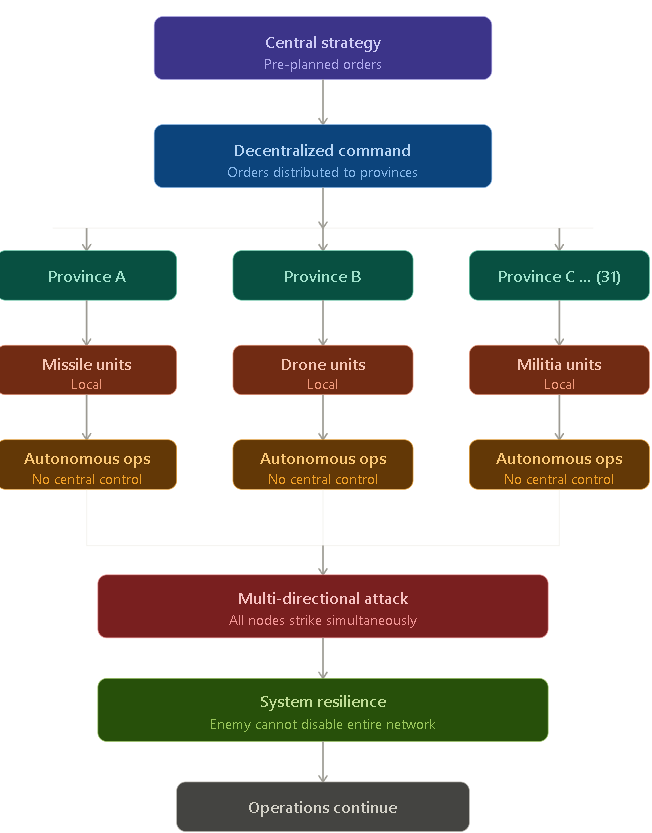
The most innovative aspect of Iran’s military approach may be its decentralised command structure, often referred to as the “Mosaic Doctrine.” Rather than relying on a highly centralised chain of command, Iran’s military forces are organised into multiple semi-autonomous units distributed across the country. These units operate with a degree of independence, guided by pre-defined operational doctrines, strategic objectives, and rules of engagement.
This structure is designed to ensure continuity of operations even in the event of a significant disruption to central command. By delegating authority downward, Iran reduces the risk that a single point of failure could halt military activity. As a result, traditional “decapitation strikes” targeting leadership are less likely to produce systemic paralysis. In centralised systems, leadership removal can significantly degrade operational coherence; in contrast, a decentralised structure is more resilient to such disruptions.
The dispersion of resources and decision-making authority further complicates efforts to neutralise the system through targeted strikes, as there are no singular nodes whose destruction would incapacitate the entire network. However, this approach is not without trade-offs. Decentralisation can complicate coordination, increase the risk of miscommunication, and reduce operational precision. Nevertheless, the model prioritises survivability and continuity over centralised control, an approach that is particularly effective in protracted conflicts.
Iran Attacks and Bypasses Air Defence
| Phase | What Iran Does | Purpose | Effect on Air Defense |
| 1. Saturation (Swarm) | Launch hundreds of cheap drones (e.g., Shahed-136) | Overload defenses | Forces expensive interceptors to be used |
| 2. Multi-Layer Attack | Combine drones + cruise + ballistic missiles | Confuse detection systems | Different speeds/altitudes overwhelm radar |
| 3. Wave Attacks | Continuous small attacks instead of one big strike | Exhaust enemy | Keeps defences always active |
| 4. Decoy Usage | Use dummy drones / low-value targets | Distract interceptors | Real weapons slip through |
| 5. Precision Strike Phase | Launch high-precision missiles after saturation | Hit key targets | Higher success probability |
Iran operationalises this approach by attempting to bypass and saturate air defence systems through layered, multi-vector strikes. Initially, large numbers of inexpensive, low-flying drones, often possessing reduced radar signatures, are deployed to compel defenders to activate radar systems and expend interceptor munitions. These attacks are frequently launched from multiple directions simultaneously, increasing the complexity of detection and response.
This is followed by cruise missiles, which utilise terrain-following flight profiles, and ballistic missiles, which employ high-speed terminal trajectories. Together, these systems are designed to exploit gaps and delays created during the initial saturation phase. In parallel, Iran employs reconnaissance drones, electronic warfare capabilities, and GPS jamming to degrade situational awareness and targeting accuracy.
Sustained, wave-based attacks are intended to deplete interceptor inventories, strain command-and-control systems, and fatigue personnel. The objective is not necessarily to achieve comprehensive penetration, but to ensure that a limited proportion of strikes successfully reach high-value targets. In this sense, the approach reflects a strategy of cumulative attrition, transforming air defence into a contest of endurance rather than decisive interception.
| STEP 1 → Drone Swarm Launch (cheap, large numbers) |
| ↓ |
| STEP 2 → Air Defense Activated (radars + interceptors) |
| ↓ |
| STEP 3 → Radar Saturation + Confusion |
| ↓ |
| STEP 4 → Cruise Missiles (low altitude, stealth) |
| ↓ |
| STEP 5 → Ballistic Missiles (high speed, terminal phase) |
| ↓ |
| STEP 6 → STRIKE ON HIGH-VALUE TARGET |
List of Weapons
| Category | Sub-Type | Key Weapons/Systems | Range/Capability | Primary Role |
| Ballistic Missiles | MRBM/ IRBM | Shahab-3, Ghadr, Emad, Sejjil | 1500–2000 km | Strategic deterrence |
| Heavy MRBM | Khorramshahr, Kheibar Shekan | ~2000 km | High payload strike | |
| SRBM | Fateh-110, Zolfaghar, Dezful | 300–1000 km | Tactical precision | |
| Advanced | Fattah (hypersonic claimed) | Very high speed | Defense penetration | |
| Cruise Missiles | Land attack | Soumar, Hoveyzeh | >1000 km | Long-range precision strike |
| Anti-ship | Noor, Ghadir, Nasr-1 | Short–long range | Naval warfare | |
| Anti-ship ballistic | Khalij Fars | High-speed | Carrier/ship targeting | |
| Drones (UAVs) | Combat UAV | Shahed-129, Mohajer-6, Mohajer-10 | Long endurance | Surveillance + strike |
| Loitering (kamikaze) | Shahed-136, Shahed-131 | ~1000–2000 km | Suicide attacks | |
| Tactical UAV | Ababil, Rezvan | Short range | Recon + battlefield attack | |
| UAV weapons | Qaem bombs, Akhgar missile | ~30 km | Precision targeting | |
| Air Defense | Long-range SAM | Bavar-373, S-300 | High altitude intercept | Airspace protection |
| Medium SAM | Khordad-15, Raad | Medium range | Aircraft interception | |
| Short-range | Majid system | Short range | Drone interception | |
| Naval Forces | Submarines | Ghadir, Fateh, Kilo-class | Stealth ops | Underwater warfare |
| Surface tactics | Fast attack boats | Swarm attack | Naval harassment | |
| Strategic tools | Naval mines | Area denial | Strait blockade | |
| Coastal defense | Anti-ship missile batteries | Shore-based | Maritime control | |
| Ground Forces | Tanks | Karrar, Zulfiqar, T-72 | Armored combat | Land warfare |
| Artillery | Fajr-5, Zelzal rockets | Long-range | Rocket strikes | |
| Guided rockets | 122mm precision rockets | Tactical range | Battlefield support | |
| Air Force | Fighter jets | F-14, F-4, MiG-29, Su-24 | Combat aircraft | Air operations |
| Indigenous jets | Saeqeh, Azarakhsh | Limited | Support role | |
| Cyber & EW | Cyber units | Offensive cyber teams | Digital attacks | Infrastructure disruption |
| Electronic warfare | Jamming systems | Signal disruption | Counter UAV/missiles | |
| Navigation warfare | GPS spoofing | Guidance disruption | Target deviation | |
| Proxy Warfare | Regional groups | Hezbollah, Houthis, Iraqi militias | Multi-theatre | Strategic depth |
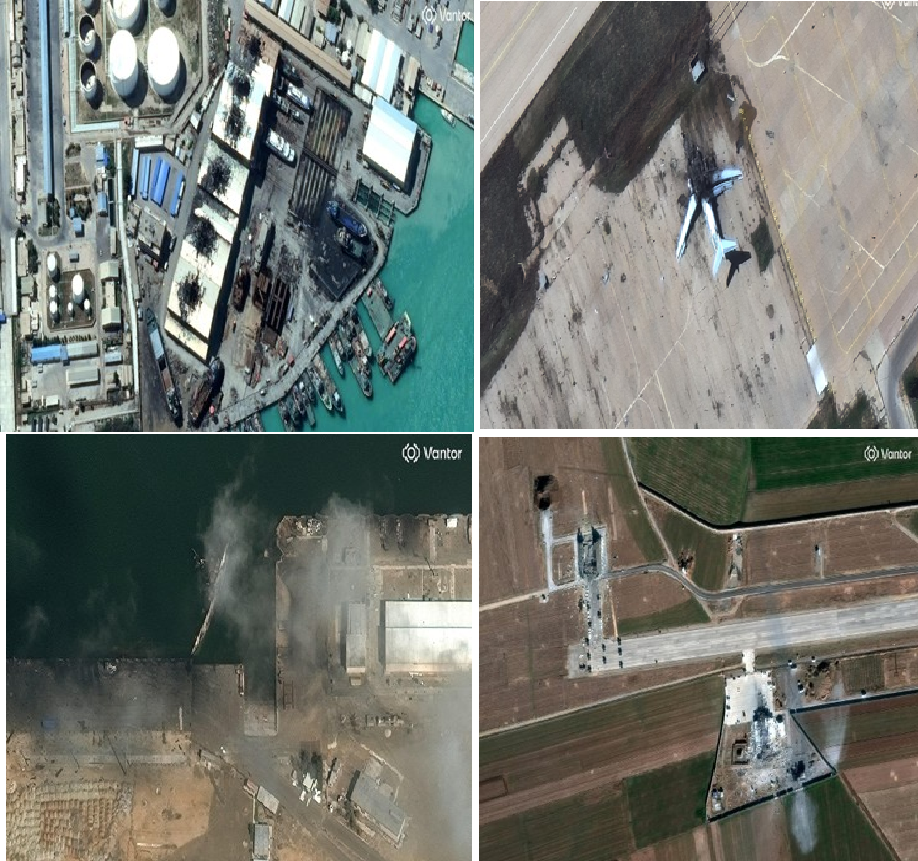
List of Defence Bases
| S. No. | Location | Country | Target Type | What Satellite Shows | Damage Type | Damage Level | Strategic Significance |
| 1 | Shiraz Airbase | Iran | Airbase | Destroyed aircraft on the runway | Aircraft destruction | Severe | Airpower reduction |
| 2 | Konarak Naval Base | Iran | Naval Base | Capsized ship | Naval vessel loss | Severe | Maritime capability hit |
| 3 | Bushehr Naval Facilities | Iran | Naval Facility | Structural damage | Infrastructure damage | Moderate–Severe | Weakens naval ops |
| 4 | Choqa Baulk-e Alireza | Iran | Drone Base | Destroyed buildings & equipment | Base destruction | Severe | UAV capability degraded |
| 5 | Bandar Abbas Harbour | Iran | Military Port | Fires across the harbour | Fire + ship damage | Severe | Strategic port disruption |
| 6 | Bandar Barkhuh Naval Base | Iran | Naval Base | Damaged base structures | Structural damage | Moderate | Secondary naval impact |
| 7 | Ahvaz Drone Base | Iran | UAV Base | Damaged installations | Equipment + base damage | Moderate–Severe | Drone ops affected |
| 8 | Bushehr Airbase | Iran | Airbase | Damaged aircraft shelters | Shelter destruction | Moderate | Aircraft protection reduced |
| 9 | Fujairah Port | UAE | Oil Export Port | Smoke plumes | Fire damage | Moderate | Oil logistics disruption |
| 10 | Ras Tanura Refinery | Saudi Arabia | Oil Refinery | Fire & smoke | Refinery fire | Moderate | Energy supply disruption |
| 11 | Konarak Storage Area | Iran | Military Storage | Destroyed bunkers | Bunker destruction | Severe | Ammo/logistics loss |
| 12 | Shiraz Airbase (2nd image) | Iran | Airbase | Additional destroyed aircraft | Aircraft loss | Severe | Reinforces heavy losses |
| 13 | Bushehr Airbase | Iran | Airbase | Large crater in the bunker | Direct strike impact | Severe | Precision strike confirmed |
| 14 | Natanz Facility | Iran | Nuclear Site | Enrichment complex view | No clear visible damage | Unclear | Strategic high-value target |
| 15 | Isfahan Airport | Iran | Aviation Infrastructure | Destroyed buildings | Structural destruction | Moderate–Severe | Civil/military aviation impact |
| 16 | Isfahan Garrison | Iran | Military Base | Damaged buildings | Structural damage | Moderate | Ground force disruption |
| 17 | Bandar Abbas Port | Iran | Port | Vessel hit in the harbour | Ship damage | Moderate–Severe | Naval logistics impact |
| 18 | Konarak Naval Base | Iran | Naval Base | Frigate on fire | Vessel fire/destruction | Severe | Major naval loss |
| 19 | Konarak Air Shelters | Iran | Military Facility | Damaged shelters | Infrastructure damage | Moderate | Airbase vulnerability |
| 20 | Tehran (Khamenei Compound) | Iran | Leadership Compound | Smoke + heavy damage | High-value strike | Severe | Strategic/political shock |
| 21 | Bushehr Airbase | Iran | Airbase | Destroyed aircraft | Aircraft loss | Severe | Continued air asset loss |

Piyush Anand is a Biotechnology Engineering student at Chandigarh University. His primary interest lies in International Affairs, Defence and Strategy. Views expressed are the author’s own.
 Dr Mohmmad Rizwan
  Parag Gilada
  Archita Gaur