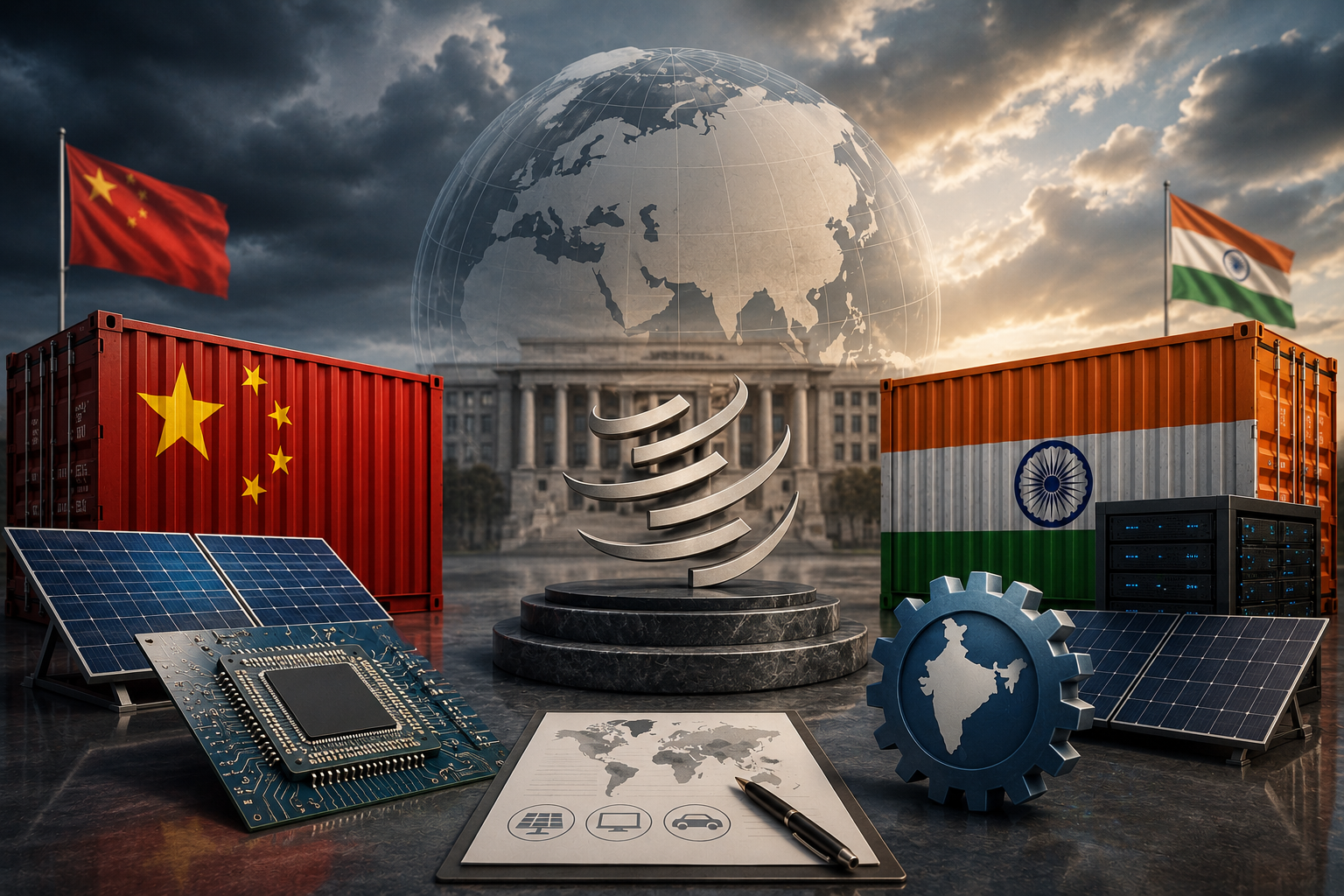
- China had suggested establishing a dispute resolution panel through the World Trade Organisation (WTO) based on India’s policies regarding solar cells and modules and the information technology sector.
- This gives a clear indication of how China feels towards India’s protectionist approach in the country’s industries.
- Significantly, this is not the first case. There had been an attempt by China to have a WTO panel set up against India on similar issues related to incentives provided for automobiles and electric vehicles.
China had suggested establishing a dispute resolution panel through the World Trade Organisation (WTO) based on India’s policies regarding solar cells and modules and the information technology sector. The discussion between the two countries on this issue did not yield any result in bilateral negotiations on February 10, 2026. In its attempt to get justice from the WTO, China claims that India is discriminating against Chinese products through differential tariffs and subsidies aimed at boosting indigenous production contrary to international trade policies.
To put it plainly, China claims that India is violating various WTO agreements, including GATT 1994, Subsidies and Countervailing Measures, and TRIMs agreements. This gives a clear indication of how China feels towards India’s protectionist approach in the country’s industries.
In terms of international relations, the dispute highlights the rising tensions between two of Asia’s most economically integrated powers, even as their interdependence continues to deepen. China is still India’s second-biggest trading partner, but the association is characterised by a large imbalance in trade. During the previous fiscal year, the country’s exports to China increased to $19.47 billion, whereas its imports from the country spiked to $131.63 billion, resulting in a historic trade gap of $112.6 billion.
This dispute also illustrates how global multilateral organisations such as the WTO have become venues for strategic contestation. Although both countries speak on behalf of the Global South within the organisation, they frequently hold opposing stances based on their distinct economic objectives – India’s focus on domestic capacity building and China’s export-oriented model.
Significantly, this is not the first case. There had been an attempt by China to have a WTO panel set up against India on similar issues related to incentives provided for automobiles and electric vehicles. The result of this case would not only have implications for the bilateral trade relationship, but would also highlight the functioning of the WTO dispute resolution process on a complex issue.

Anjali Singh is a postgraduate student of Political Science and International Relations, a Social Media Analyst, and a former Research Intern at the Indian Council of World Affairs. Views expressed are the author’s own.
 Aayush Pal
  Pranav S
  Hridbina Chatterjee