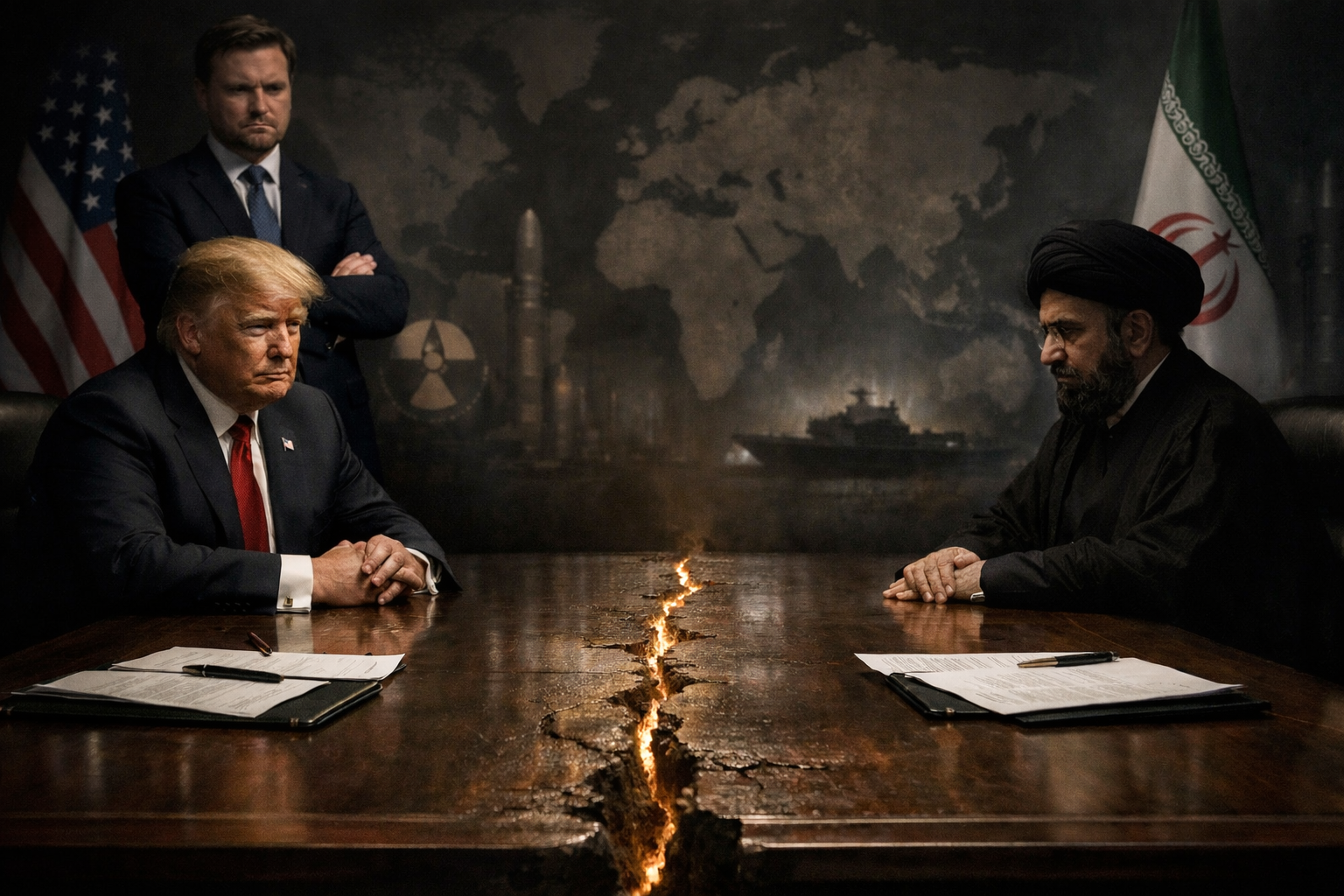
- In international relations, negotiations fall apart due to the fundamental structure of the situation, where either an agreement would be irrational for the parties or would be unsustainable after the fact.
- While the US attempts to include Iran within a reliable international system based on rules and verification, Iran sees this process as a possible threat to both their national sovereignty and their own ideology.
- Negotiators have to satisfy both their domestic audiences and their foreign counterparts.
- It can therefore be said that negotiations fail not because of poor management on the part of the parties, but simply because they are doomed from the outset.
A failure in negotiations does not stem solely from the parties’ difficulties reaching an agreement. This statement is simplistic in nature and fails to understand the structural dynamics at play here. In international relations, negotiations fall apart due to the fundamental structure of the situation, where either an agreement would be irrational for the parties or would be unsustainable after the fact. The lengthy stagnation and eventual falling apart of the negotiations between the United States and Iran can be seen as such. When one takes into consideration five major books on the subject, including “Diplomacy” by Henry Kissinger, “The Back Channel” by William J. Burns, “International Negotiation in a Complex World” by Brigid Starkey, Mark Boyer, and Jonathan Wilkenfeld, “International Negotiation: Process and Strategies” by Ho Won Jeong, and “Power and Negotiation” by I. William Zartman and Jeffrey Z. Rubin, this phenomenon seems quite predictable.
In its most basic form, it can be seen that the negotiations carried out by the United States and Iran are based on incompatible worldviews, an idea that is best captured in Henry Kissinger’s book, Diplomacy. As noted by Kissinger, “the statesman’s task is to reconcile what is possible with what is necessary,” thus showing that any negotiation that succeeds must have some connection between strategy and reality. Unfortunately, this has not been achieved in the case of the US and Iran. For Iran, however, the driving factor behind its conduct emanates from an ideologically based approach characterised by regime survival, resistance to any form of outside intervention, and ideology. This is no simple case of different approaches to policymaking but represents a deeper dispute on the basis of international relations itself. While the US attempts to include Iran within a reliable international system based on rules and verification, Iran sees this process as a possible threat to both their national sovereignty and their own ideology. Kissinger further observes that “no country can act wisely simultaneously in every part of the globe at every moment,” but US policy toward Iran has frequently been constrained by the overly optimistic view that includes all of these objectives in its strategy for dealing with Iran, including nuclear rollback, containment, and moderation. On the contrary, Iran has remained clear on its strategic aims in terms of regime preservation, capacity for deterrence, and regional influence.
The next important element is the lack of trust channels, which is addressed by The Back Channel. According to Burns, “quiet, sustained diplomacy often matters more than public posturing.” This refers to the crucial role played by unofficial and discreet communications in making a breakthrough. While the successful 2015 nuclear deal was the result of the negotiation process itself, it was greatly facilitated by covert communications via Oman. In other words, backchannel diplomacy allowed both parties to explore compromise without having to worry about external pressure. However, the withdrawal of the United States from the deal changed the whole picture. As Burns states, “Diplomacy is as much about relationships as it is about issues.” In this particular case, the basis for diplomatic relations ceased to exist. To be more precise, for Iran, the US withdrawal was seen not as an attempt to alter the terms of the deal but as a violation of a certain commitment, which seriously damaged the credibility of all future US promises. Therefore, the focus of further negotiations moved from reaching a mutually beneficial agreement to finding a reason why Iran should trust any commitments made by the US.
In its most basic form, it can be seen that the negotiations carried out by the United States and Iran are based on incompatible worldviews, an idea that is best captured in Henry Kissinger's book, Diplomacy.
The third dimension, discussed in International Negotiation in a Complex World, is that of the critical importance of domestic political constraints. As explained, “negotiators have to satisfy both their domestic audiences and their foreign counterparts,” which illustrates the two levels of the negotiations involved in the international arena. In the United States, any deal struck with Iran will be subjected to a wide range of domestic issues, such as those related to Congress, partisanship, and a generally sceptical attitude towards Iran. Politicians have to account for political considerations, including not looking like weak negotiators regarding national security. However, things are even harder for Iranian negotiators, who are restricted not only by domestic politics but also by revolutionary ideals of the Supreme Leader.
Additionally, organisations like the Revolutionary Guard will find any deal an act of capitulation. Moreover, the authors state that “material incentives are less likely to prevail when issue salience and identity are at stake,” which applies here especially well. Indeed, for Iran, the development of the nuclear program is not simply a means of obtaining strategic superiority but rather an important element in demonstrating sovereignty and technical progress. In the case of the U.S., the prevention of proliferation of nuclear weapons is connected to the country’s reputation and status in the world community.
The fourth element concerns the issue of incomplete information and strategic misperception, as discussed in International Negotiation: Process and Strategies. According to Jeong, “negotiations are affected by uncertainty about the intentions and capabilities of the other party.” In particular, such uncertainties are more prevalent in negotiations between the United States and Iran. Both parties are unsure about each other’s intentions and even more so about each other’s credibility. America is sceptical about Iran’s claims that its development of nuclear technology is only for civilian purposes.
On the other hand, Iran is wary of America’s ability and willingness to commit itself due to its unstable internal political environment. Such a state of affairs leads to a negotiation context that is marked by risk-aversion and defensive behaviour. Furthermore, as Jeong points out, “rational actors do not necessarily choose to cooperate under conditions of mistrust and difficult verification.” In particular, the problem of sequencing poses itself: the US believes that Iran needs to take the necessary measures in order to scale down its nuclear program, but Iran requires that the sanctions be withdrawn before doing so. It is easy to see why both parties’ requirements are logical and reasonable, but also impossible to fulfil at once.
Lastly, the lessons drawn from the chapters on Power and Negotiation can change preconceived notions of power and leverage. According to Zartman, “Power is the ability to get the other side to do something they would not do otherwise.” While the US has always considered itself powerful economically and militarily, which makes it assume it will have the leverage to negotiate with Iran, this approach ignores the fact that leverage is more dependent on the opponent’s alternatives and resilience. Iran is known to have an impressive level of economic tolerance and alternative tactics to achieve its interests. The statement by Zartman that “leverage rests on the alternative of the other party” becomes relevant here; as long as Iran finds its alternatives to complying with the demands of the international community, no amount of pressure will yield the desired results. As Rubin puts it, “coercion may actually stiffen the other side’s resolve.” This is apparent in how Iran reacted to the maximum pressure policy of the US. Instead of pressuring it into submission, this strategy strengthened its hardliners, leaving little room for negotiation.
Diplomacy is as much about relationships as it is about issues.
It is often argued that the reason why the negotiations broke down was due to the parties’ refusal to compromise or a lack of proper diplomacy. This argument is not valid since it does not take into account the context within which the negotiation takes place. It is also a misconception to argue that if only better diplomacy had been utilised, then the deadlock would have been solved. Diplomacy is important, but it will not be enough if there are irreconcilable differences regarding the conflicting parties’ interests, identities, and political environment. It is wrong to think that a compromise that would satisfy both parties could easily have been found. A successful compromise needs both parties to settle for less, which is something that neither party has been prepared to do without paying too high a price. The U.S. and Iran lack this kind of common perception of what constitutes legitimacy. The United States seeks to preserve a rule-based international system, whereas Iran seeks strategic autonomy and resists attempts at hegemony. Without a common sense of legitimacy, it is inevitable that negotiations will fail due to a lack of stability. It can therefore be said that negotiations fail not because of poor management on the part of the parties, but simply because they are doomed from the outset. When it comes to US-Iran relations, the costs of an agreement between the parties are higher than those incurred by continuing to maintain their rivalry. If it were to reach an agreement with Iran, the cost would be too great for the United States because it would weaken its position vis-à-vis non-proliferation.
In any case, the collapse of talks between Iran and the US does not represent some kind of exception. Rather, such an outcome was predetermined by the underlying structure of things as they stand. While the US hopes to see behavioural changes on the part of Tehran, the Iranian side strives for the perpetuation of its regime. In the present situation, there can be little hope that the two goals will be compatible anytime soon.

Dr. Nanda Kishor M. S. is an Associate Professor at the Department of Politics and International Studies, Pondicherry University, and former Head of Geopolitics and International Relations at Manipal University. His expertise spans India’s foreign policy, conflict resolution, international law, and national security, with several publications and fellowships from institutions including UNHCR, Brookings, and DAAD. The views expressed are the author’s own.
 Parag Gilada
  Aayush Pal