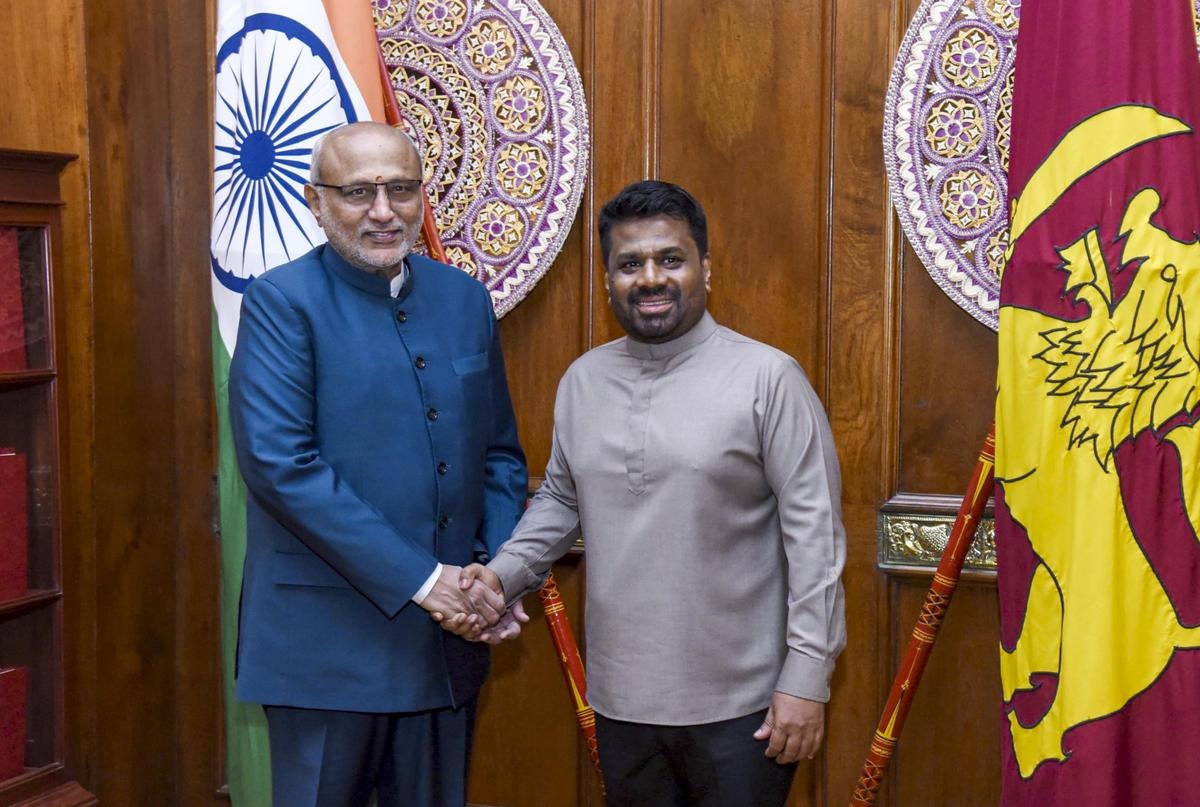
- The visit of Vice President C.P. Radhakrishnan signifies that the India-Sri Lanka relationship has matured into a resilient, multi-dimensional alliance.
- The plan to build a land bridge across the Palk Strait and expand air and sea connections between India and Sri Lanka is a very real objective.
- The memory of the support through ‘Operation Sagar Bandhu’ remains timelessly marked within the Sri Lankan psyche following Cyclone Ditwah, with unconditional and speedy humanitarian support from India.
- In an Indian Ocean that is increasingly under contention, the cooperation between India and Sri Lanka is essential for the continuation of efforts related to counter-terrorism and maritime safety.
The historical and civilizational bond between India and Sri Lanka has long served as the bedrock of stability in the Indian Ocean Region (IOR). In a landmark diplomatic engagement, the visit of Indian Vice President C.P. Radhakrishnan to Sri Lanka on April 19-20, 2026, marks a transformative chapter in this enduring partnership. As the first-ever bilateral visit by an Indian Vice President to the island nation, this mission transcends mere ceremonial protocol. It serves as a powerful reaffirmation of India’s “Neighbourhood First” policy and its vision for “Security and Growth for All in the Region” (SAGAR), positioning Sri Lanka not just as a neighbour, but as a “Southern Anchor” for regional security and prosperity.
Taking place at a critical period, this visit comes as a result of the current stability of the Sri Lankan political environment established under President Anura Kumara Dissanayake and Prime Minister Harini Amarasuriya. New Delhi’s approach to the new leadership in Colombo demonstrates its continued dedication to a long-term, bipartisan strategic partnership that transcends changes in government. The Vice President also meets with senior officials to demonstrate that India is a reliable ally to Sri Lanka, supports its sovereignty and aspires to integrate the economy and security of both countries more closely.
A New Paradigm of Economic Connectivity
The main goal of the Vice President’s trip is to seek ways to help Sri Lanka. This visit also focused on more than just assistance; the idea is to create a level of economic integration with Sri Lanka based on deep economic connections. Discussions about the connection between the two countries included areas such as multi-modal connectivity and connectivity via land, sea, and air corridors. The plan to build a land bridge across the Palk Strait and expand air and sea connections between India and Sri Lanka is a very real objective. These projects will facilitate trade between the two nations at a lower cost and position Sri Lanka within the strong supply chain networks supporting the Indian consumer economy, which is among the fastest-growing economies in the world.
Energy was identified as a foundation for developing the new relationship between India and Sri Lanka. The Vice President’s schedule highlighted efforts to link the energy grids of both nations as well as improvements to the Trincomalee Tank Farm’s ability to store and supply energy to Sri Lankans. The linking of these grids provides India an opportunity to supply reliable and clean energy to Sri Lanka while developing a cooperative framework for renewable energy. The development of this cooperative framework is expected to prevent future electricity shortages in Sri Lanka, similar to the shortages that were experienced during the recent economic crisis, and allow for a clean and reliable source of power to support Sri Lanka’s industrial recovery.
Humanitarian Diplomacy and the “First Responder” Role
The first responder for India in South Asia is appreciated and valued during bilateral discussions. The memory of the support through ‘Operation Sagar Bandhu’ remains timelessly marked within the Sri Lankan psyche following Cyclone Ditwah, with unconditional and speedy humanitarian support from India. The Vice President’s inspection of construction sites throughout Nuwara Eliya further illustrates the dedication to people-centric development as provided by India. The development assistance projects supporting Indian Tamils and rural poor in Sri Lanka demonstrate how India’s strategic objective is built by a sincere commitment to the fundamental well-being of the Tamil people of Sri Lanka.
The same humanitarian sincerity manifests itself via the Digital Public Infrastructure (DPI) of India. The introduction of the Unified Payment Interface (UPI) will allow for rapid and efficient payments between India and Sri Lanka, thus transforming both the tourism and retail sectors throughout both economies. By supporting Sri Lanka’s economic modernisation efforts through the development and sharing of “India Stack” technology, India creates a sense of shared technological destiny with Sri Lanka. In addition to domestic hard-strategic/economic interests, “Soft Power” diplomacy creates a foundation of goodwill upon which both nations can rely in the face of external geopolitical pressures.
Addressing the Maritime Security and Fishermen Challenges
The assertive strategic ramifications of this visit cannot be overlooked. In an Indian Ocean that is increasingly under contention, the cooperation between India and Sri Lanka is essential for the continuation of efforts related to counter-terrorism and maritime safety. There was a special emphasis in the Vice President’s conversations regarding the “Colombo Security Conclave” (CSC) framework that emphasises the fact that neither India nor Sri Lanka can exist without the other due to their shared security.
As Sri Lanka finds its way in a multi-polar world, India’s approach to Sri Lanka is illustrated by the term “equal partner.” An equal partner creates a stable regional environment where maritime trade can thrive; there should not be any concerns about either country being taken advantage of through debt-trap diplomacy or through foreign naval extensions of influence or militarised presence by projecting forward naval assets.
Ultimately, a strong “Southern Anchor” can only be maintained if domestic difficulties are resolved. The Vice President specifically addressed the long-standing fishermen’s issue and emphasised that a humane and sustainable solution was required in order to preserve the economic security of coastal communities in both countries. In keeping with their commitment to resolving these difficult issues in a high-profile manner, India has shown that it is willing to address the complexities in the relationship in such a way that local conflicts do not inhibit the overall strategic momentum.
Conclusion: A Shared Vision for the Future
The visit of Vice President C.P. Radhakrishnan signifies that the India-Sri Lanka relationship has matured into a resilient, multi-dimensional alliance. It is a partnership built on the pillars of mutual trust, economic synergy, and a shared civilizational heritage. As the two nations look toward the future, the “Southern Anchor” is being reinforced not just through signed treaties but through tangible infrastructure, digital bridges, and a commitment to regional stability. By standing shoulder-to-shoulder, India and Sri Lanka are not only securing their own interests but are also setting a benchmark for neighbourhood diplomacy in the 21st century.
References
- Ministry of External Affairs (MEA), India: Official Press Release: Visit of Vice President of India to Sri Lanka (April 19-20, 2026)
- Press Information Bureau (PIB), India: Vice President Shri C. P. Radhakrishnan will undertake a two-day visit to Sri Lanka
- The Hindu: Vice-President CP Radhakrishnan arrives in Sri Lanka on two-day visit
- Official Government News Portal of Sri Lanka (News.lk): Indian Vice President to Visit Sri Lanka for Key Bilateral Talks
- DD News (Official): Vice President Radhakrishnan to undertake a two-day visit to Sri Lanka

Hridbina Chatterjee is a final-year postgraduate student in International Relations at Jadavpur University, Kolkata. She has written for newspapers and think tanks, with interests in South Asian politics, India’s foreign policy, and the Indo-Pacific. Views expressed are the author’s own.
 Anjali Singh
  Archita Gaur