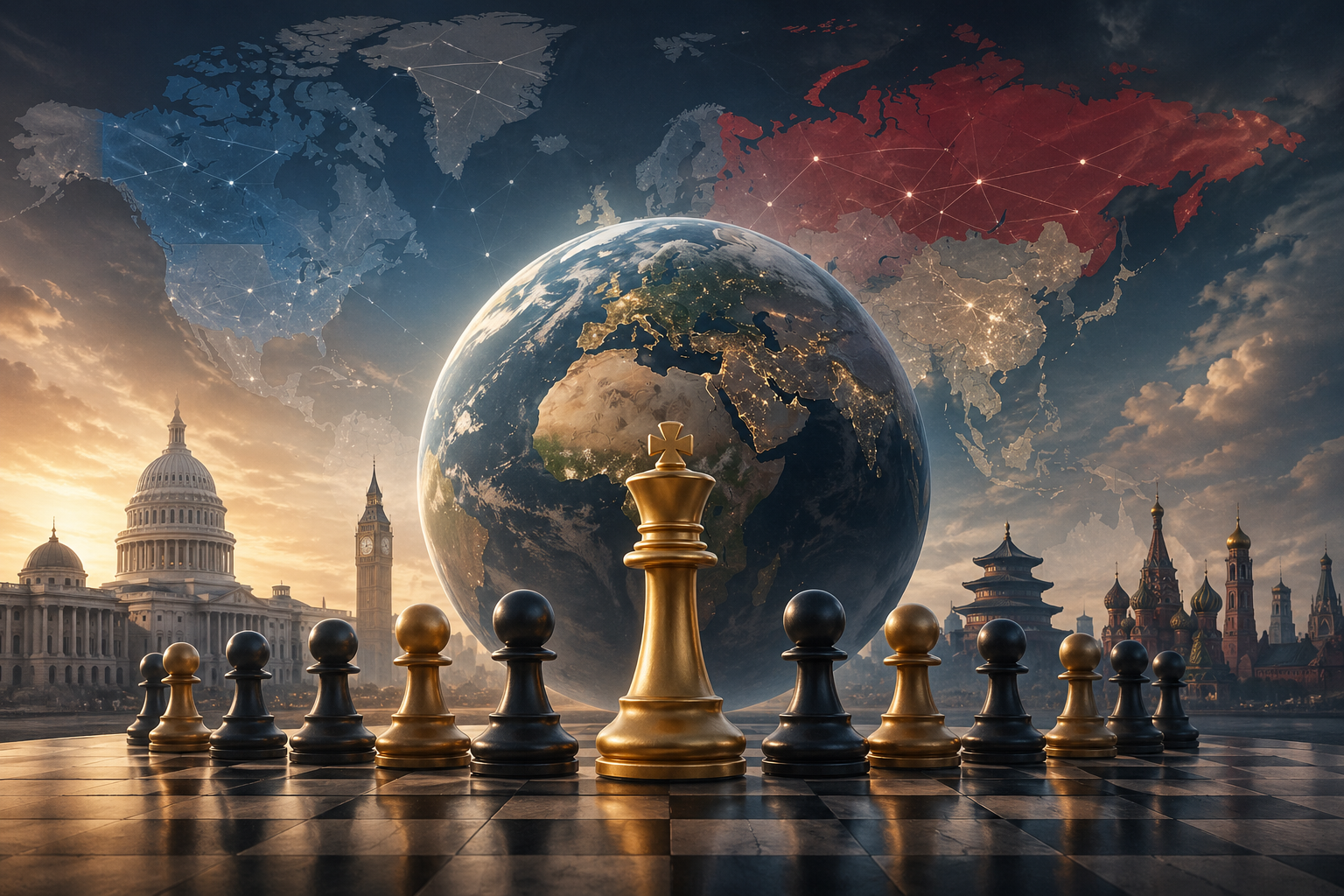
- After World War II, a new geopolitical architecture emerged in the form of the United Nations, a global body of sovereign states designed to prevent international conflicts and provide a structured framework for cooperation.
- Is the existing rule-based international order dead? The answer may not be entirely yes, but it is clear that it requires a new orientation.
- As major powers like the United States demonstrate increasing dominance, global attention is gradually shifting toward these middle powers.
- In this emerging framework, India has effectively become a de facto leader among middle powers. With a population of over 1.4 billion and a GDP growth rate significantly higher than the global average, India is widely seen as a major future power.
The ongoing geopolitical conflicts, particularly the current West Asian crisis, have created a global churn, with an energy crisis affecting the entire world and pushing it toward a new reality. West Asian countries are also awakening to this shift. These developments raise a very fundamental question. The question concerns the state of the international world order established after World War II.
After World War II, a new geopolitical architecture emerged in the form of the United Nations, a global body of sovereign states designed to prevent international conflicts and provide a structured framework for cooperation. However, things went wrong when overdependence, excessive involvement, and perceived bias began to influence this global body. One part of the world came to be overrepresented, while others were often overlooked.
At this stage, the international system appears to be under severe strain. What we are witnessing is not necessarily the complete collapse of the post-war international order, but a visible weakening of it, leading to multiple global disruptions. This raises a key question: is the existing rule-based international order dead?
The answer may not be entirely yes, but it is clear that it requires a new orientation.
The Rise of Middle Powers
This is where the rise of middle powers becomes significant. These are countries that are still emerging, possess considerable potential, and are seeking a stronger presence in global affairs. As major powers like the United States demonstrate increasing dominance, global attention is gradually shifting toward these middle powers.
This concept gained traction when Canada’s Prime Minister Mark Carney addressed the World Economic Forum (WEF) this year and emphasised two key ideas: the rise of middle powers and the emergence of a new world order. This is particularly interesting because Canada is traditionally one of the closest allies of the United States and shares deep economic and strategic dependencies with it. When a leader from such a country speaks of a changing world order, it reflects a broader shift in global dynamics.
European countries are also responding to this evolving reality. Statements from leaders like Emmanuel Macron highlight that at a time when the international order is deteriorating and global isolation is increasing, it is essential for middle powers such as France, European nations, Canada, and India to work together.
This trend is further reinforced by diplomatic activity. Leaders like Spain’s Prime Minister Pedro Sánchez, President Macron, and Germany’s Chancellor Merz have all visited China and India in recent months. This clearly indicates that Europe is adapting to a new geopolitical reality and gradually reducing its traditional dependence on the United States.
The intentions of all these countries are very clear. They want to be aware of the new reality, they need to adhere to it, and they aim to build it together. They have clearly understood that the existing system has failed to turn their aspirations into reality, and now they have to take the onus themselves.
India as the Anchor
In this emerging framework, India has effectively become a de facto leader among middle powers. With a population of over 1.4 billion and a GDP growth rate significantly higher than the global average, India is widely seen as a major future power. More importantly, India’s independent foreign policy approach is gaining acceptance globally.
Countries are increasingly appreciating India’s strategy of multi-alignment. This was evident during the visit of Finland’s President Alexander Stubb, who attended this year’s Raisina Dialogue organised by the Observer Research Foundation. He emphasised that Europe and other regions are beginning to recognise the value of India’s balanced and diversified approach to global partnerships.
The idea is simple. At a time when these countries are trying to diversify their relationships, they need to find a country that is ready to reciprocate the same and is already adhering to this approach while keeping every geopolitical reality in mind. India perfectly fits into this picture.
However, it is not just India; there is also growing discussion around the emergence and consolidation of a new set of middle powers known as the Eurasian middle powers.
Eurasian Middle Powers vs Established Middle Powers
There is also increasing discussion around Eurasian middle powers. This includes countries such as Armenia, Azerbaijan, Hungary, Turkey, Pakistan, Kazakhstan, and Uzbekistan. Many analysts believe that this Eurasian bloc could emerge as a significant geopolitical force.
These countries often act as bridges between major powers, maintaining relationships with the United States, China, and Russia simultaneously. For example, Armenia and Azerbaijan, despite having a territorial conflict in recent years, are now moving toward a new understanding. Armenia is part of the Collective Security Treaty Organisation led by Russia, while also maintaining relations with Western countries.
Similarly, Turkey, under President Recep Tayyip Erdoğan, is a member of NATO but continues to engage actively with Russia and expand its regional influence. However, Turkey’s independent approach has been questioned. Critics argue that a country bound by alliance commitments cannot act fully independently, and that Turkey’s actions are often driven by its own strategic interests.
For instance, in Syria, Turkey has supported incumbent HTS factions of Al Julani while simultaneously advocating for a new regional order. At the same time, it faces criticism over its actions against Kurdish groups, an issue that has drawn strong reactions from leaders like PM Benjamin Netanyahu.
Pakistan: A Case of Strategic Contradiction
Among these Eurasian states, Pakistan presents a particularly complex case. It has attempted to position itself as a mediator in conflicts such as those involving Iran and the United States. However, its credibility as a middle power is questionable. Pakistan lacks strategic independence, as its policies are often influenced by external dependencies.
For example, when Pakistan aligns with Saudi Arabia under its recent defence cooperation agreement, especially at a time when Saudi Arabia has tensions with Iran, its claim of neutrality becomes difficult to sustain. Additionally, Pakistan’s history of supporting terrorism undermines its position as a credible peace mediator.
True middle powers are expected to act with strategic autonomy, pursue long-term goals, and contribute constructively to global stability. In contrast, Pakistan often appears focused on short-term objectives and external leverage, limiting its effectiveness as a middle power.
Conclusion
In conclusion, while the Eurasian middle power bloc holds significant geopolitical potential due to its strategic location and resources, it still lacks the consistency, autonomy, and credibility that define established middle powers like India, Canada, and key European nations.
Reference:
1)https://ecfr.eu/special/what_does_india_think/analysis/conclusion_a_fresh_start_for_europe_and_india
2)https://www.weforum.org/stories/2026/01/davos-2026-special-address-by-mark-carney-prime-minister-of-canada/
3)https://credendo.com/en/knowledge-hub/rising-economic-and-geopolitical-player-india-has-become-attractive-investment
4)https://youtu.be/xXyj7JkOfvo?si=Ml-wD9Zcx4QRFHZ9
5)https://valdaiclub.com/a/highlights/eurasian-security-new-principles-and-new-reality1/
Aayush Pal is a freelance writer on contemporary geopolitical developments. The views expressed in his work are entirely his own.
 Anjali Singh