
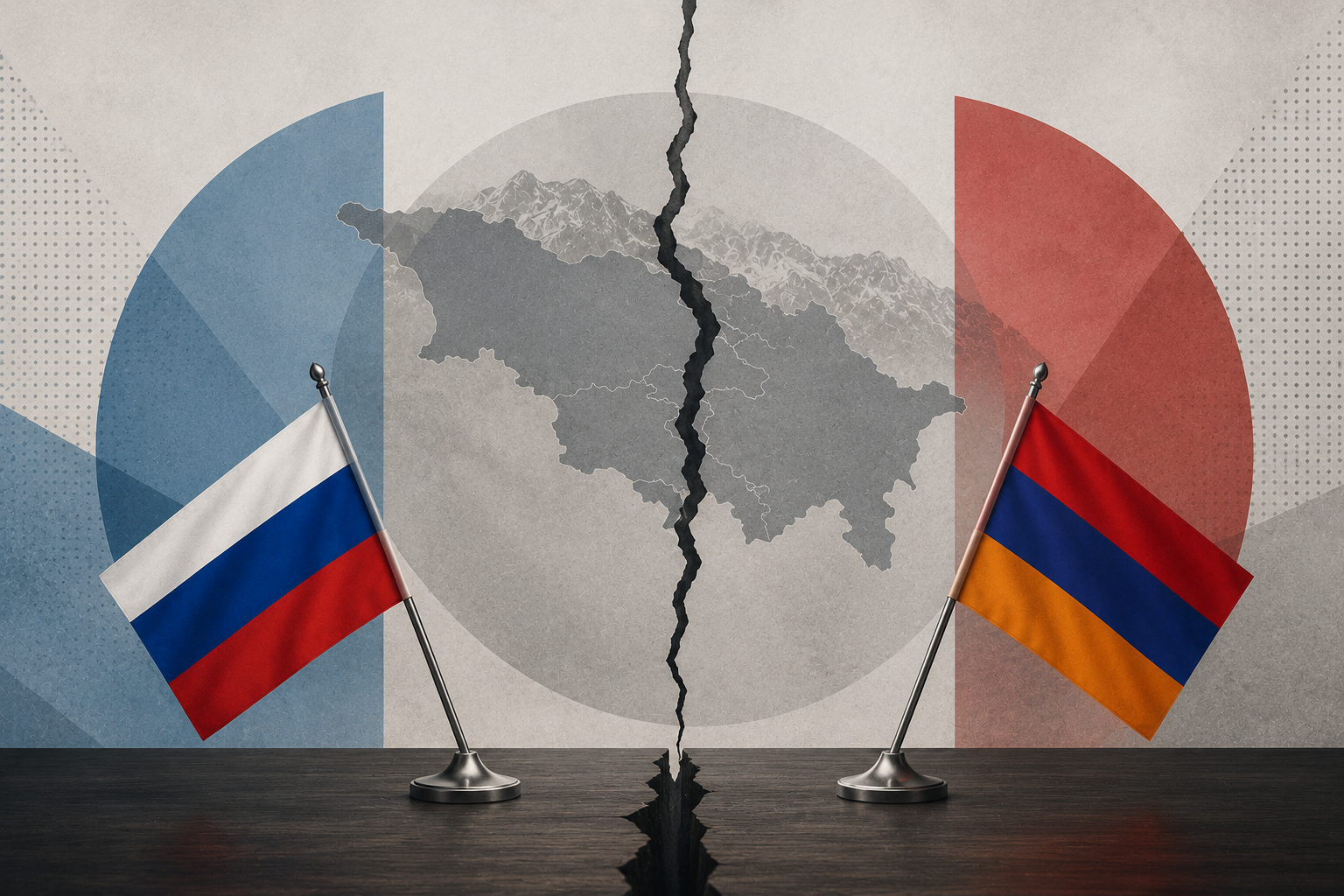
- The old dynamics of Caucasian friendship are witnessing a growing rift.
- This led to a growing perception within Armenia that Russia had failed its ally and that the CSTO was unable to protect Armenian sovereignty.
- As a result, Armenia began looking westwards and started building stronger ties with countries such as France, India, and the United States.
- It represents a significant challenge for Russia as it seeks to preserve its relationship with Armenia while simultaneously managing what it perceives as growing Western influence in the region.
Caucasia, an important geopolitical frontier and a major sphere of influence for Russia, not only reflects the erstwhile Soviet legacy but also serves as a bridge connecting the broader Eurasian world. In recent years, it has emerged as a new geopolitical frontier of modern geopolitics. Facilitating this dynamic have been two major countries, Armenia and Russia, two nations that share a common history, strong people-to-people interactions, and geographical proximity.
For a long time, Armenia has been greatly interdependent on Russia, not only in terms of culture and history but also in areas such as energy, defence, and other modern necessities. Despite this, the relationship between the two countries has only been plummeting over time, gradually turning into a war of words and a broader geopolitical divergence. Armenia is now on the path of creating a new reality by engaging more closely with the European world order and strengthening its relationship with major European countries. It now seeks greater integration with Europe, something that has greatly troubled and baffled Russia.
As a result, the old dynamics of Caucasian friendship are witnessing a growing rift.
Nagorno-Karabakh and the Beginning of Strategic Distrust
However, what is interesting here is to understand and observe how exactly the relationship between the two countries has not only stagnated but reached a point where Armenia is actively trying to dissociate itself from Russia and the Russian-led bloc in favour of a more Western-oriented alignment.
Many may consider this a recent phenomenon, but that is not the case. The history of the current tensions dates back to 2020, when Armenia came into the limelight during the Nagorno-Karabakh War with Azerbaijan. Nagorno-Karabakh is a region that has long been disputed between Armenia and Azerbaijan. Armenia believes that ethnic Armenians have lived there for generations, while Azerbaijan maintains that it is a sovereign Azerbaijani territory that was occupied by Armenia.
During the conflict, Armenia sought Russian assistance as both Armenia and Russia are members of the CSTO. Facing a military confrontation with Baku, Armenia expected collective security commitments under the CSTO to be implemented and hoped that Russia would come to its rescue. However, Russia did not directly intervene, although Russian peacekeepers were present in the disputed Lachin Corridor.
This led to a growing perception within Armenia that Russia had failed its ally and that the CSTO was unable to protect Armenian sovereignty. Armenian Prime Minister Nikol Pashinyan openly blamed Russia for Armenia’s security failures and argued that the CSTO had lost its relevance. According to him, Russia was no longer committed to protecting Armenia’s sovereignty.
The war proved to be a major turning point in Armenia-Russia relations. Although Russia attempted to mediate the conflict and argued that the situation could be resolved through negotiations between Armenia and Azerbaijan, trust had already begun to erode. President Putin himself became involved in diplomatic efforts, and between 2020 and 2024 several rounds of negotiations were held. Unfortunately, none of them produced a lasting solution.
At the same time, Armenia increasingly accused Russia of favouring Azerbaijan and failing to support its traditional ally. As a result, Armenia began looking westwards and started building stronger ties with countries such as France, India, and the United States. This was also a period during which India became increasingly engaged in the region.
Armenia’s Westward Shift and Russia’s Security Concerns
A major question that arises is why Russia chose not to intervene more actively in support of Armenia. One reason is that Russia has always viewed Prime Minister Pashinyan and his Social Contract Party with suspicion. Even before becoming Prime Minister, Pashinyan had been critical of Russia. Moscow has often perceived the current Armenian administration as being too receptive to Western influence and allowing Western countries to gain strategic visibility near Russia’s borders.
From the Russian perspective, such developments undermine its broader security interests. Therefore, while Armenia remains strategically important to Russia, Moscow has had significant differences with the current Armenian leadership.
The second chapter of tensions emerged in 2024 when Azerbaijan moved to establish full control over Nagorno-Karabakh. This was another moment that deeply affected Armenia-Russia relations. Armenia once again argued that the CSTO had failed to provide meaningful support. Although Armenia has not formally withdrawn from the CSTO, the episode became another major turning point in bilateral ties.
Following these developments, Prime Minister Pashinyan made a series of allegations against Russia. He argued that Russian peacekeepers deployed in the region had not effectively assisted Armenia. He also accused Russia of interfering in Armenia’s domestic affairs. At one point, he even suggested that Russian intelligence agencies had contributed to the deterioration of relations between Turkey and Armenia.
The Armenian leadership increasingly signalled its desire to move away from Russia and pursue a future more closely connected with the West, a prospect that carries significant security implications for Moscow.
The European Question and the Future of the South Caucasus
What has further troubled the relationship is a move made by the Armenian Parliament in March this year, when lawmakers approved legislation supporting Armenia’s aspiration for closer integration with the European Union. This development was met with concern in Moscow. President Putin stated that Armenia would eventually have to make a strategic choice regarding whether it wished to remain fully integrated within the Eurasian Economic Union (EAEU) or move towards deeper European integration.
Russia has argued that membership in both structures would be difficult to reconcile in the long run. In response, Armenia indicated that public opinion and national interests would play a major role in determining its future direction.
Economic pressure has also emerged as a tool in the relationship. Restrictions on certain Armenian imports and concerns regarding energy dependence have highlighted Armenia’s vulnerabilities. Given that a substantial share of Armenia’s energy needs is linked to Russia, any deterioration in relations carries significant economic consequences.
With domestic political developments continuing in Armenia and Prime Minister Pashinyan maintaining a strong political position, it remains interesting to observe how Armenia-Russia relations will evolve in the coming years.
Armenia remains strategically important for Russia, and any major geopolitical separation between the two countries would create opportunities for Western powers to increase their influence in the South Caucasus. For Moscow, this would present additional strategic challenges at a time when it is already heavily engaged in the conflict in Ukraine.
Whatever the eventual outcome, the situation in the South Caucasus is becoming increasingly intense and complicated. It represents a significant challenge for Russia as it seeks to preserve its relationship with Armenia while simultaneously managing what it perceives as growing Western influence in the region. The coming years will therefore be crucial in determining the future geopolitical landscape of the South Caucasus and the broader Eurasian space.
Reference:
1)https://amp.dw.com/en/russia-recalls-armenia-ambassador-over-eu-ties/a-77354081
3)https://voxeurop.eu/en/armenia-uncertain-pivot-between-moscow-shadow-europe-promise/

Aayush Pal is a freelance writer on contemporary geopolitical developments. The views expressed in his work are entirely his own.
 Shivendra Shukla
  Anjali Singh