
- Today, fabs in Taiwan and advanced compute supply chains have attained the strategic value once occupied by oil-producing areas.
- If the Strait of Hormuz was the strategic vulnerability of the 20th century, then the semiconductor ecosystem in Taiwan is increasingly that of the 21st.
- The net result is a new breed of geopolitical competition that is not about access to energy resources but rather access to compute power and technology infrastructure.
- Though the struggle for the twentieth century was about access to oil wells and sea routes, the twenty-first century could very well see a struggle for control over fabs, algorithms, and computing capacity.
For much of the twentieth century, the Strait of Hormuz was emblematic of the world’s most acute strategic exposure. Any interruption of surface traffic in the busy narrows that account for almost a fifth of the world’s oil supply had the potential to affect global, not just Middle Eastern, economies. Recent concerns around Iran and maritime security have brought energy chokepoints back into the geopolitical spotlight, both then and now.
But while oil routes still shape world politics, the geography of strategic vulnerability is changing. The pillars of economic and geopolitical power are increasingly shifting away from energy infrastructure and toward technology infrastructure. Today, fabs in Taiwan and advanced compute supply chains have attained the strategic value once occupied by oil-producing areas. As states vie for chips, AI infrastructure, and advanced technologies, the shift from energy security to compute security is redefining the core of geopolitical power in the twenty-first century.
Oil and the Old Geography of Power
Oil has been a key element of global geopolitics throughout the whole twentieth century. The industrial countries in North America, Europe, and Asia had become very dependent on energy, so areas producing oil and their transportation routes have become strategically valuable. Following the oil embargo of 1973, when the oil-exporting nations managed to employ oil to their advantage politically, the significance of energy security as a part of national security came into sharp focus.
One such vulnerable choke point is the Strait of Hormuz. The passage connects the Persian Gulf to the outside world and, thus, allows oil shipments. Because any potential security threat to the strait is automatically perceived as a supply threat, the importance of the area for geopolitics became obvious. The twentieth century proved the crucial role energy plays in geopolitical competition and how the ability to control such a resource became crucial for success.
Taiwan, Semiconductors and Compute Security
If the Strait of Hormuz was the strategic vulnerability of the 20th century, then the semiconductor ecosystem in Taiwan is increasingly that of the 21st. While oil powered the machinery of industrial economies, semiconductors power the digital economy. Modern products and goods, ranging from smartphones and cloud computing to advanced weapons systems and artificial intelligence, all require a stable supply of increasingly sophisticated chips. Hence, semiconductor fabrication is a critical arm of national security and economic competitiveness.
What makes this dependency so crucial is the concentration of production. Taiwan Semiconductor Manufacturing Company (TSMC) dominates the production of the world’s most advanced chips, forming a strategic bottleneck in the global technology ecosystem. This consolidation has turned semiconductors into not just commercial commodities but also geopolitical ones. The rise of artificial intelligence has only intensified such fears, as high-level AI systems require massive computing power driven by state-of-the-art chips.
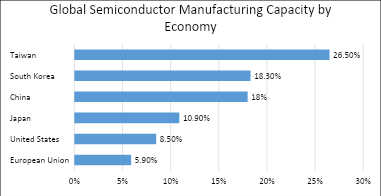
As Figure 1 illustrates, semiconductor manufacturing capacity is concentrated in a handful of economies, with Taiwan, South Korea, and China together accounting for a significant share of global capacity.
Source: Invest Korea, Semiconductor Industry Overview
Recognising the strategic consequences of this dependency, states have become more active in seeking to guarantee access to semiconductor supply chains. U.S.-built advanced chip production equipment and advanced chips themselves have been subject to export controls to China, with the United States simultaneously pouring money into domestic manufacturing through programs such as the CHIPS and Science Act. China has meanwhile, hiked up its pace in order to eliminate its dependence on foreign technology. The net result is a new breed of geopolitical competition that is not about access to energy resources but rather access to compute power and technology infrastructure.
India and the Imperative of Technological Resilience
For India, the day of transitioning from energy security to compute security is coming. With digital technologies playing a greater-than-ever role in driving economic growth, industrial competitiveness, and national security, reliance on foreign semiconductor supply chains has introduced new strategic vulnerabilities. The disruptions experienced during the COVID-19 pandemic demonstrated how shortages of critical chips could affect industries ranging from automobiles to consumer electronics, highlighting the importance of domestic technological capabilities.
Acknowledging these threats, India has initiated projects to enhance its standing within global semiconductor value chains. Through the India Semiconductor Mission, the government has been working to draw investments in semiconductor fabrication, packaging and design. Large-scale initiatives such as Tata Electronics’ semiconductor fabrication plant and Micron Technology’s assembly and testing plant in Gujarat are signs of a growing push to build a domestic semiconductor ecosystem. While it is hard for India to compete with Taiwan or South Korea in cutting-edge chip production anytime soon, these investments are a step toward reducing strategic reliance.
That is not to say that India doesn’t have to navigate a progressively fragmented tech terrain driven by U.S.-China rivalry. Instead of striving for full self-reliance, New Delhi’s aim should be for technological resilience, ensuring access to critical technologies, diversifying supply chains, and developing homegrown capabilities in areas like semiconductor design, artificial intelligence, and high-end computing. In a world in which geopolitical sway is largely derived from ownership of the technological infrastructure, India’s long-term strategic autonomy will depend not just on securing energy sources, but also on carving out a position within the global system of compute power.
Conclusion
Strategic power’s geography is witnessing an important change. In a world where energy sources such as oil and chokepoints like the Strait of Hormuz play important roles in geopolitics, the source of power has evolved to become more dependent on technology. Semiconductors, computer science, and artificial intelligence represent important tools in today’s digitally competitive world. States that want to gain access to these important tools and assets are gradually changing their focus from energy security to compute security. This represents an important step that countries like India must learn to adapt to in order to ensure their competitiveness and strategic freedom.
Though the struggle for the twentieth century was about access to oil wells and sea routes, the twenty-first century could very well see a struggle for control over fabs, algorithms, and computing capacity. The question of international strategy will no longer revolve around access to energy but to technologies of computation.
References:
- Invest Korea. (n.d.). Semiconductor industry overview. Korea Trade-Investment Promotion Agency (KOTRA). Retrieved May 30, 2026, from https://www.investkorea.org/ik-en/cntnts/i-312/web.do
- Miller, C. (2022). Chip war: The fight for the world’s most critical technology. Scribner.
- The White House. (2022, August 9). FACT SHEET: CHIPS and Science Act will lower costs, create jobs, strengthen supply chains, and counter China.
- U.S. Department of Commerce, International Trade Administration. (2023, September 5). South Korea semiconductors.

Archita Gaur is a postgraduate student at the School of International Studies, JNU. She specialises in the World Economy and has a strong interest in public policy, economic research, and governance. The views expressed are the author’s own.
 Aayush Pal
  Kumar Satish