
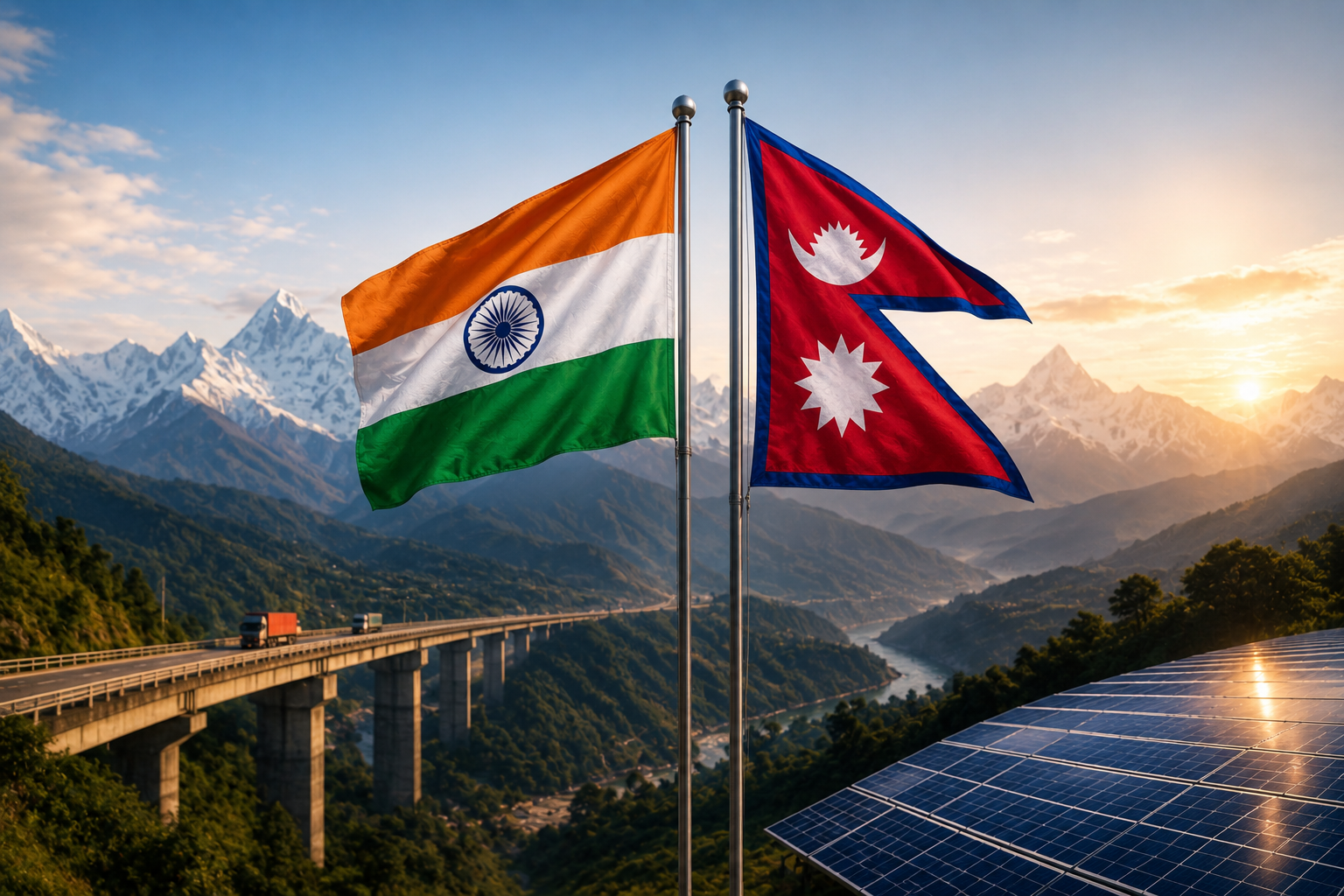
- Nepal holds a key place in India’s strategic and geopolitical calculations, lying between India and China.
- While historical and strategic considerations have influenced the bilateral relations between Nepal and India, economic and development cooperation is now the linchpin of the India–Nepal ties.
- These patterns hint towards a gradual evolution in the relations, from one defined primarily by history to one defined increasingly by common economic interests and development concerns.
India and Nepal have one of South Asia’s most distinctive and stable bilateral relations that have been built on the foundation of centuries of civilisational contacts, cultural commonalities and geographical nearness. The open border between our two countries is simply an enabler of more economic and social interdependence, since it allows people, goods and ideas to flow freely. Setting aside these historical ties, Nepal’s location in the heart of the Himalayas makes it a critical partner for India’s security and regional connectivity ambitions. India-Nepal relations have seen a further surge in recent times through cooperation in hydropower development, cross-border infrastructure, and digital connectivity. Yet still outstanding are border disputes, occasional tensions in political relations, and now an expanding Chinese presence in Nepal. At a time when South Asia is defined by an increasingly competitive geopolitical environment, the India–Nepal relationship has much to say about the possibilities and pitfalls of regional cooperation in the twenty-first century. Amid growing competition in the region, and as connectivity becomes a major tool of influence in South Asia, Nepal has acquired renewed strategic significance in India’s foreign policy.
Historical Foundations of India–Nepal Relations
India and Nepal have a relationship that is based on a strong civilizational, cultural and religious exchange. Common Hindu and Buddhist cultures, migration across borders and close people-to-people connections had traditionally created a special feeling of oneness between the two nations. After India’s independence, the Treaty of Peace and Friendship signed in 1950 between the two countries institutionalised close bilateral cooperation, which, among other things, gave shape to an open border and permitted the free movement of people and commodities. Consequently, India-Nepal relations have been largely a story of close social and economic interlinkages.
Strategic Significance of Nepal for India
Nepal holds a key place in India’s strategic and geopolitical calculations, lying between India and China. As a Himalayan state that shares borders with both countries, Nepal not only acts as a buffer but also adds a unique dimension to the security dynamics of the region. In India’s case, its desire to establish stable, constructive relations with Nepal is not just driven by its own immediate security concerns in terms of protecting its northern border but also by a concern for regional stability and the containment of potential security spill-overs in the Himalayan belt. The permeable border between the two states also adds to Nepal’s strategic importance as events in Nepal have a direct impact on India’s security and issues of migration and border management.
Aside from the security implications, Nepal is central to India’s regional aspirations. Cross-border infrastructure initiatives, energy cooperation and connectivity initiatives are also increasingly being considered as means to boost economic integration and as a means to increase India’s influence across South Asia. Meanwhile, China’s deepening economic and political relations with Nepal have injected a new strategic facet into the ties. Via infrastructure building and development aid, and through more diplomacy, Beijing has become a key player in Nepal’s foreign policy. Due to the deepening economic involvement in China-related projects, Kathmandu was now offered alternative development partners that diminished India’s conventional hegemony in the country. As such, the ‘India-Nepal relations’ of today are not merely a reflection of the historical and cultural bonds but are also a response to the dynamics of strategic competition and regional geopolitics.
Economic and Developmental Cooperation: New Drivers of the Partnership
While historical and strategic considerations have influenced the bilateral relations between Nepal and India, economic and development cooperation is now the linchpin of the India–Nepal ties. India remains the largest trading partner for and investor in Nepal, and Nepal is highly reliant on Indian routes of transit to access world markets. In recent times, the two countries have sought to enhance their economic relations through cross-border infrastructure, energy cooperation and digital connectivity initiatives.
Hydropower has emerged as a key area of cooperation. Having huge hydropower potential and scanty domestic demand, Nepal has gradually begun to eye India as a buyer of electricity. For India, the clean energy from Nepal that it imports furthers its own energy security and sustainable development goals. This increase in cross-border electricity trade in recent years has allowed Nepal to become a regional energy exporter and, at the same time, supported India’s renewable energy goals. This sharing of interests has turned energy cooperation into a strategic pillar of the bilateral relations. At the same time, investment in rail links, integrated check posts, power lines and digital payment systems has improved cross-border connections and added momentum to economic exchange.
Challenges and Future Outlook
Yet, several challenges persist in the India-Nepal relationship. Most recently, the border disputes over Kalapani, Lipulekh, and Limpiyadhura have provoked diplomatic tensions and nationalist fervour on either side. Moreover, some in Nepal’s political class have voiced concerns about economic dependence on India, while in New Delhi, there is concern about China’s growing footprint in Nepal. India is also challenged to maintain its influence amidst Nepal’s quest to broaden its external relationships and adopt a more balanced policy of engagement with the outside world, and not let its past role as a dominant influence be the cause of perennially souring relations. In the future, the durability of the partnership will depend on good faith, concern for each other’s interests, and the successful realisation of current connectivity and energy projects.
Conclusion
The India-Nepal relations rest on what has been termed a special relationship based on an age-old cultural affinity, geographical contiguity and growing economic interdependence. Even though strategic competition and outstanding issues continue to present challenges, there is a solid basis for the future in growing cooperation in energy, connectivity and trade. How each country manages to situate history and geopolitics will ultimately determine the future of this key regional relationship. In an era when power is ever more based on linkages, energy cooperation, and economic interdependence, the future of India-Nepal relations will be decided not only by common past, but by how the two sides can build on historical affinity to fashion a strategic partnership that is beneficial to both. These patterns hint towards a gradual evolution in the relations, from one defined primarily by history to one defined increasingly by common economic interests and development concerns.
References:
- Aryal, S. K. (2022). Post-2015 India–Nepal relations and China factor in South Asia. Politeja, 19(76), 285–303.
- Pant, H. V., & Saha, P. (2024, May 21). Reimagining India–Nepal ties: The decade that was and the road ahead. Observer Research Foundation.
- Karki, B. (2023, November 28). The China factor in Nepal–India relations. National Security Council Secretariat, NatStrat.
- Reuters. (2025, June 16). Nepal begins first power exports to Bangladesh via India’s grid.

Archita Gaur is a postgraduate student at the School of International Studies, JNU. She specialises in the World Economy and has a strong interest in public policy, economic research, and governance. The views expressed are the author’s own.
 Anjali Singh