
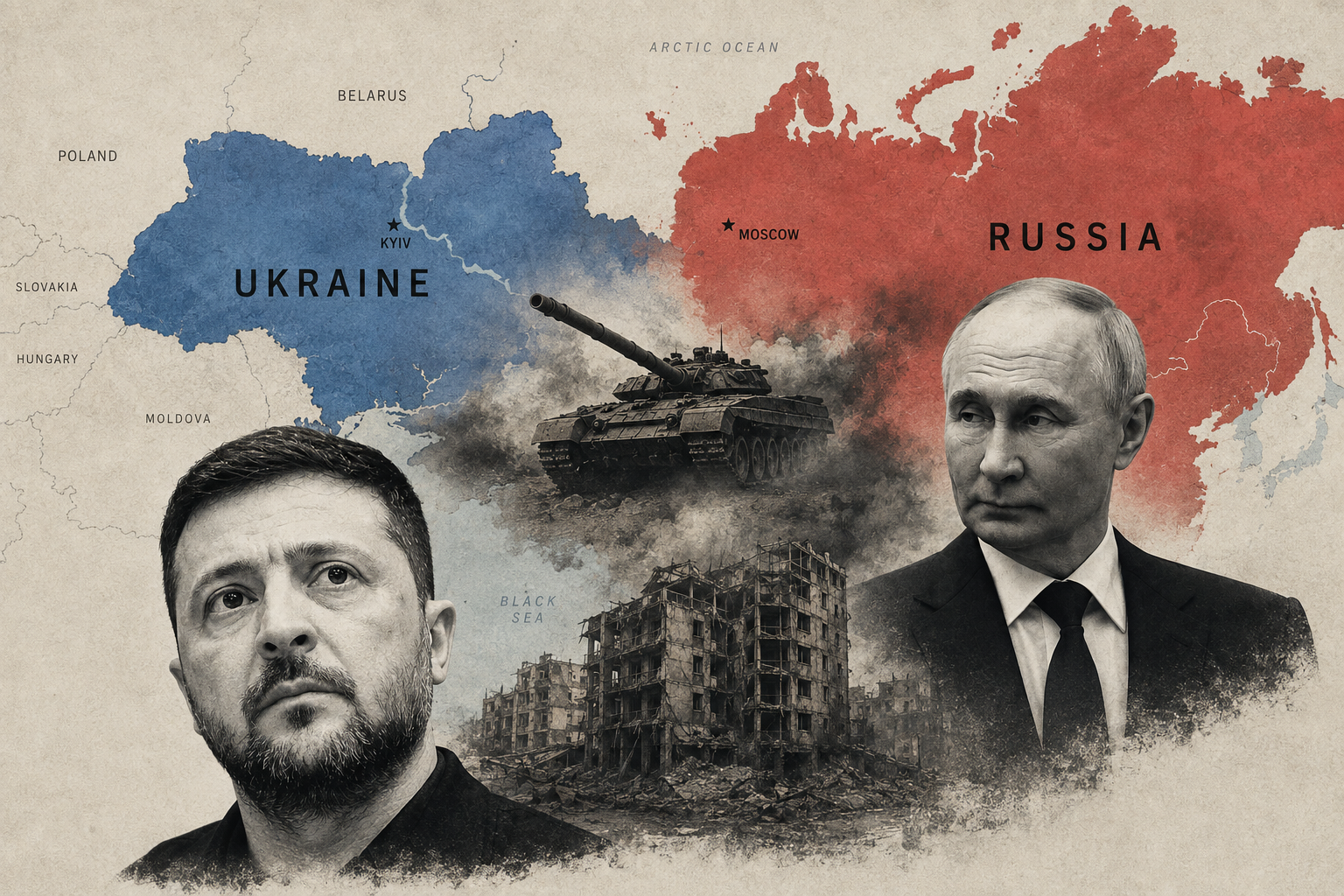
- Russia’s initial expectation of a swift victory in Ukraine has turned into a prolonged and increasingly complex war, with the conflict reaching a stalemate in eastern Ukraine.
- The increasing attacks on Russian energy infrastructure have created both military and economic challenges, with the war increasingly affecting Russia’s wider economic and strategic interests.
- Ukraine has managed to sustain itself for four years and may continue to do so. But the more fundamental question is: at what cost?
- The Russia-Ukraine conflict has now moved far beyond being a purely bilateral confrontation, developing into a much broader international geopolitical confrontation involving the United States, Europe, NATO, and countries across the wider global system.
Four years, thousands of lives lost, and a full-fledged war. What started as a “special military operation” has now turned into a war of attrition. The Russia-Ukraine war has emerged as one of the most interesting and complicated conflicts in modern geopolitical history. What Russia initially described as a “special military operation” on February 24, 2022, has gradually turned into an all-out war. Although President Vladimir Putin has not officially described it as a full-fledged war, the scale of military engagement and the level of forces committed by Russia, particularly in eastern Ukraine, are nothing short of a full-scale conflict.
What Russia initially expected to be a swift victory in Ukraine has turned into a prolonged and increasingly complex war. Russia has become engaged in a stalemate in eastern Ukraine while continuing its efforts to gain ground in the resource-rich regions of the country.
The war initially began on the pretext of the denazification and demilitarisation of Ukraine and what Russia described as a fight to protect its own security interests. However, what was initially presented as a limited military operation has now developed into a prolonged conflict between Russia and Ukraine.
One of the most interesting aspects has been the resilience demonstrated by Ukraine. Although Ukraine had been preparing for such a scenario since 2014, it had also witnessed significant Euro-Atlantic military engagement during this period. The Ukrainian military received training and assistance based on NATO standards. Despite this preparation, however, the conflict has continued to be decided largely on the battlefield. Both countries are now facing their own respective challenges, and the costs of the war have extended far beyond the battlefield.
Russia’s Military and Economic Costs
Starting with Russia, the limited military gains in eastern Ukraine and the prolonged nature of the conflict have created significant problems. The increase in military expenditure has come at the cost of other areas of economic spending, particularly technology, innovation and other sectors of development.
Russia has increasingly shifted its economic and industrial capacity towards military production. The country has almost moved into a war-mode production system, with significant resources being directed towards sustaining the military effort.
This has raised questions among sections of the Russian population about whether the money being spent on the war could instead be directed towards other sectors of the economy.
Alongside the military cost, there is also a high economic cost. Ukraine has adopted an interesting counter-offensive and offensive-defensive approach, under which it has increasingly targeted critical and strategic Russian oil facilities.
Ukraine has developed considerable expertise in the use of drones over the last four years and has used them to target strategically important Russian energy infrastructure. This has become an important element of Ukraine’s military strategy, with other countries also becoming interested in understanding the lessons emerging from Ukraine’s experience.
The repeated Ukrainian drone attacks have also placed pressure on Russia’s military-industrial complex and air defence systems. A significant portion of Russia’s air defence capabilities has had to be deployed to protect critical sites within the country. Ukraine has also demonstrated an ability to penetrate deeper into Russian territory and target strategically important infrastructure.
This has created a difficult situation for Russia. Despite being one of the world’s major oil and gas producers, Russia has faced disruptions to its energy infrastructure, while its dependence on energy exports remains an important part of its economy.
The increasing attacks on Russian energy infrastructure have therefore created both military and economic challenges. The war is no longer simply about gaining territory in Ukraine; it is also increasingly affecting Russia’s wider economic and strategic interests.
There are also differences within Russian society regarding the future direction of the war. One section has demanded a stronger offensive under President Putin, while another favours a diplomatic solution. This has created a difficult situation for the Russian leadership as the war continues without a decisive outcome.
Ukraine’s Manpower and Economic Crisis
For Ukraine, the situation is even more challenging. Ukraine has suffered significant military losses since the beginning of the Russia-Ukraine war. It has limited resources and has become heavily dependent on external support. Its economic situation has also been severely affected, with European countries and the United States playing a major role in sustaining the Ukrainian economy.
In terms of economic independence, Ukraine has become heavily dependent on European powers and, particularly, the United States for financial and military support.
The war has also created a major demographic challenge. It has resulted in large-scale migration and has depleted a significant portion of Ukraine’s young adult population, which is crucial for the country’s future economic growth.
Before the war, Ukraine had a population of around 40 million. Since the beginning of the conflict, a large number of Ukrainians have left the country, while others have been enrolled in the military or have suffered permanent physical and psychological damage because of the war.
The exact size of Ukraine’s current population and the number of Ukrainians remaining in the country have therefore become difficult to determine precisely. This demographic transformation presents a major challenge for President Zelenskyy and the future of Ukraine.
Another major challenge is manpower. Ukraine has been able to sustain the war through modern weapons and military assistance from European countries and the United States, but weapons alone cannot compensate for the shortage of personnel.
Ukraine has managed to sustain itself for four years and may continue to do so. But the more fundamental question is: at what cost?
The cost is being paid through the mobilisation of the young population, the continued migration of young people out of the country, and increasing dependence on external powers. In the long term, this raises serious questions about Ukraine’s economic sovereignty.
The Question of Democracy in Wartime Ukraine
Another fundamental question concerns the erosion of democratic institutions in Ukraine. President Zelenskyy’s constitutional term came to an end in 2024, but he has continued to remain in office under martial law. This has generated questions about the functioning of democratic institutions during wartime.
Questions have also been raised regarding media freedom, religious freedom and the ability to openly challenge the government. More importantly, concerns have emerged over the growing influence of oligarchic networks, with allegations of corruption involving individuals close to the economic and political circles surrounding President Zelenskyy.
These issues represent another dimension of the war. While Russia faces military and economic pressures, Ukraine is dealing with its own challenges surrounding manpower, economic dependence, demographics and democratic institutions. The cost of the war, therefore, has been enormous for both countries, although it has taken different forms.
Europe’s Dilemma and the Role of the United States
The war has also created significant challenges for the countries supporting Ukraine, particularly the United States and European countries. President Donald Trump has made it clear that his approach towards supporting Ukraine may not be the same as the approach adopted by the United States over the previous years. This has placed greater responsibility on European countries to continue supporting Ukraine.
However, this responsibility comes at a significant cost.
Many European economies are already facing economic stagnation. Germany, which was once considered the economic powerhouse and engine of European growth, has increasingly been described as the “sick man of Europe.”
European countries therefore face a difficult situation. On one hand, they have their own economic challenges; on the other, they are expected to continue providing financial and military support to Ukraine.
Another major problem is the capacity of the European military-industrial complex. European countries do not possess the same level of military-industrial capacity as the United States, creating further difficulties in maintaining long-term military assistance to Ukraine.
This raises a fundamental question: even if European countries want to reduce or discontinue military support to Ukraine, can they afford to do so?
The concern among European countries is what Russia might do next. If Russia has been willing to wage such a prolonged war against Ukraine, what could happen if European support for Ukraine is significantly reduced? Could Russia potentially pose a greater challenge to other European countries? This creates a fundamental dilemma for Europe.
Can Russia and Europe Reset Their Relations?
The larger question now is what the eventual outcome of this war will be and whether European countries will eventually begin negotiating directly with Russia. There have been some indications of a growing debate within Europe over negotiations. French President Emmanuel Macron and Italian Prime Minister Giorgia Meloni have spoken about the importance of diplomacy and the need to consider negotiations with Russia.
The European Union has also sought to maintain channels for diplomatic engagement.
Russia, meanwhile, has historically viewed itself as an important European power and has expressed an interest in maintaining relations with Europe. However, Moscow believes that Europe would need to abandon what Russia considers its bias towards the West and adopt a more independent approach before relations can be reset.
Whatever the eventual outcome, the Russia-Ukraine conflict has now moved far beyond being a purely bilateral confrontation. What began as a conflict between two neighbouring countries has developed into a much broader international geopolitical confrontation, involving the United States, Europe, NATO, and countries across the wider global system.
Reference:
- https://cirsd.org/horizon-article/the-causes-and-consequences-of-the-ukraine-war
- https://www.csis.org/analysis/russian-blood-and-treasure-ballooning-costs-putins-war

Aayush Pal is a freelance writer on contemporary geopolitical developments. The views expressed in his work are entirely his own.
 Kumar Satish
  Anjali Singh