
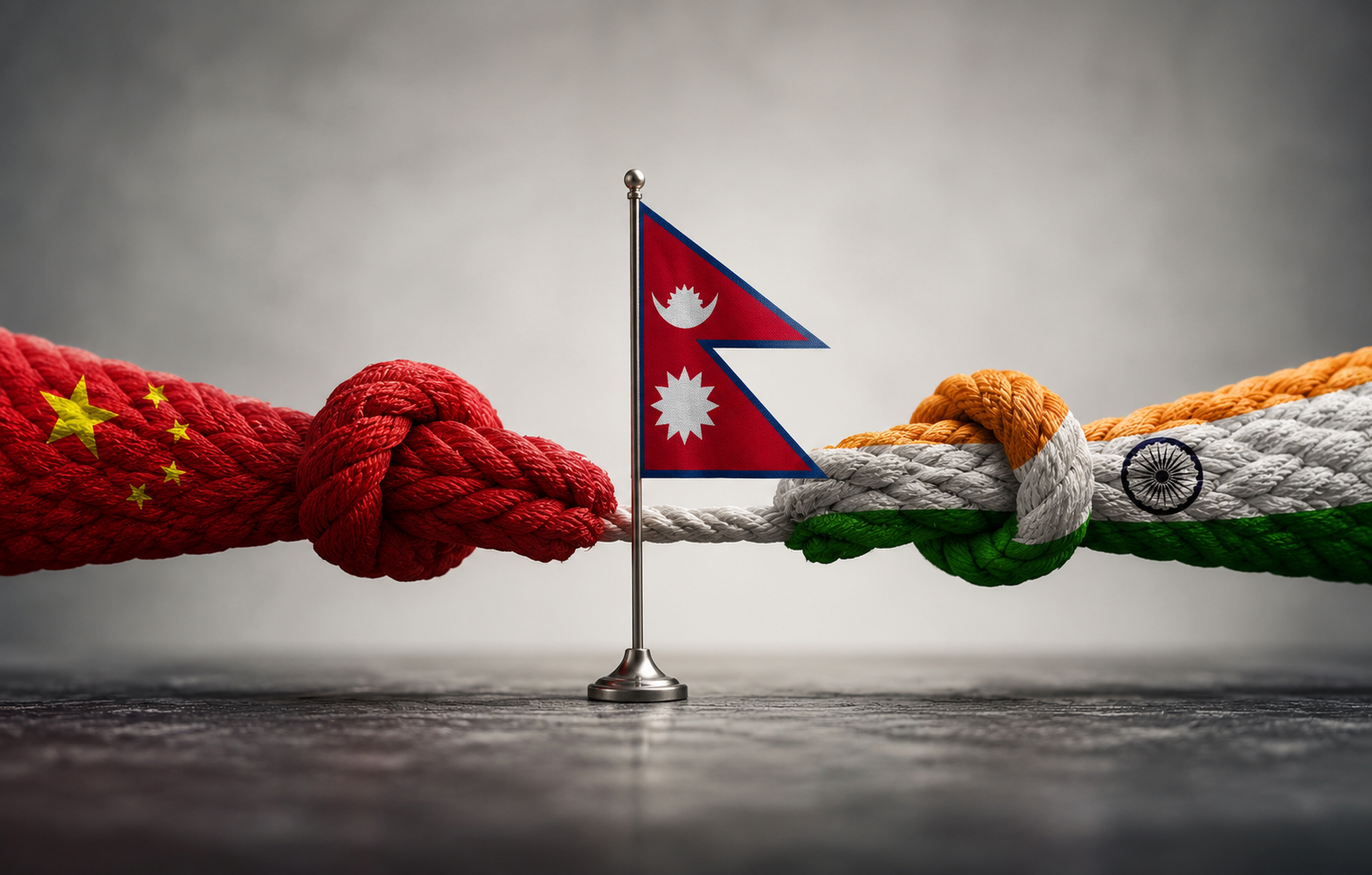
- For Nepal, the classical image of a “yam between two boulders” has undergone a profound 21st-century transformation.
- By framing infrastructure as a path for Nepalese economic emancipation from India, China has effectively leveraged the desire for economic development of Nepal to shift the balance of power regionally, thereby transforming connectivity to create a strategic influence tool for China.
- The institutionally defined relationship fosters a state of dependence that provides security and security related guarantee, however, it serves as a source of resentment at the domestic level.
- To protect its sovereignty, Nepal must move beyond the perception of infrastructure being a tactic available in the zero-sum game of neighbours.
For Nepal, the classical image of a “yam between two boulders” has undergone a profound 21st-century transformation. In the contemporary era, sovereignty is no longer defined solely by territorial integrity or diplomatic non-alignment; it is increasingly negotiated through the material reality of infrastructure. As Nepal navigates the competing gravitational pulls of China’s investment-driven development model and India’s entrenched institutional dependency, its domestic policy-making has become a site of intense geopolitical contestation, where connectivity projects serve as both instruments of national progress and vectors of external influence.
The Chinese Investment-Driven Approach
China’s engagement in Nepal is an investment strategy, which is exemplified through its infrastructure development which is developing through its Belt and Road Initiative (BRI). China’s infrastructure development framework perceives it as a physical and economic integration mechanism, using it as the connection between the Himalayas through connecting railways, energy grids, and enhanced cross-border connectivity, thus facilitating a way for Nepal to connect physically to China without using the traditional southbound transit routes.
This development model has affected Nepal’s sovereignty in a more complicated manner than usually acknowledged. For example, with the significant amount of capital being injected into Nepal from China, the procurement processes for this capital are often characterised by a lack of transparency; in other words, the lack of transparency creates increased Chinese state-sponsored enterprise influence on the local political environment in Nepal. Furthermore, this political influence has both an economic as well as a social nexus vertically connecting local political elite with foreign contractors, creating a nexus for compromising local governance through inefficiencies in project management. By framing infrastructure as a path for Nepalese economic emancipation from India, China has effectively leveraged the desire for economic development of Nepal to shift the balance of power regionally, thereby transforming connectivity to create a strategic influence tool for China.
India’s Institutional Dependency Model
The nature of Nepal’s relationship with India can be traced back to the “institutional dependency model” that has governed Nepal and India for years, starting with the Treaty of Peace and Friendship in 1950 and the decades of shared economic, military, and social history known as the “Roti and Beti” relationship. Hence, the systemic leverage of India over Nepal is a function of India controlling the key transit routes and ports for Nepal’s trade with third countries, while also historically providing the majority of training and armaments to the Nepalese security sector.
The institutionally defined relationship fosters a state of dependence that provides security and security related guarantee, however, it serves as a source of resentment at the domestic level. For example, attempts at Nepal asserting its autonomy through a tilt toward China have continually caused Nepal to be subjected to “unofficial” avenues of economic pressure from India, as evidenced by the three border blockades of 1969, 1989, and 2015. The domestic policy-making process in Nepal is often paralysed by the degree to which it must balance the requirements of Indian integration with the populist appeal of anti-Indian sentiment. Many in Kathmandu, therefore, see India’s institutional presence as a constraint on sovereignty, which has been a major motivator for the state to seek out alternative development partners to help dilute India’s influence.
Domestic Politics and the Infrastructure Paradox
In Nepal, the confluence of these two models has drastically changed the way people view domestic politics in that country. Infrastructure has become such a prominent issue that it creates division within society. An example of this was the issue around the signing of the U.S. backed Millennium Challenge Corporation (MCC) grant as to what constituted sovereignty over the nation of Nepal and what is ultimately a divisive issue within governing coalitions in Nepal.
Political players in Nepal have figured out how to navigate this type of environment by “playing the cards of politics” by using their rivals to gain political advantage or using foreign infrastructure investments as a way to mobilise nationalist support by scapegoating those investments. Although such acts of nationalism are often viewed as attempts to preserve nationalism, they often reflect a state with very little control over its actions. The inability of internal actors (e.g., bureaucrats, political parties) in Nepal to agree upon a unified national development strategy is a trend which is also impacting their domestically driven decision-making and will continue to do so.
Navigating Sovereignty
The concept of Nepal’s sovereignty is fragmented under globalisation and so no longer relates purely to the exclusion of neighbours, but rather to how best to manage the conditions under which they may be invited to participate. The Chinese model delivers a physical means of escape from a constraining geography but risks entangling Nepal in greater financial and political networks and relations of an opaque nature. The Indian model provides reassurance based on a long history of integration but often creates a ceiling effect on the autonomy of Nepal’s policy.
To protect its sovereignty, Nepal must move beyond the perception of infrastructure being a tactic available in the zero-sum game of neighbours. The greatest challenge facing the state of Nepal is developing the domestic capacity to govern effectively by determining, regulating and enforcing the frameworks necessary to protect national interests against other geopolitical spheres of influence through infrastructure development. In this modern world, sovereignty will be determined by the capacity of a country to govern its domestic policies independently of the competing regional powers that connect with it, primarily through systems of infrastructure.

Hridbina Chatterjee is a final-year postgraduate student in International Relations at Jadavpur University, Kolkata. She has written for newspapers and think tanks, with interests in South Asian politics, India’s foreign policy, and the Indo-Pacific. Views expressed are the author’s own.
 Rajeev KS
  Diksha Bharti