

- The emerging world is no longer just consuming public goods; it is increasingly producing and sharing them.
- Cooperation among developing countries has become an important mechanism driving this transformation. Notwithstanding the traditional donor-recipient relationships, it is more and more concerned with the exchange of policy innovations, technological solutions, institutional expertise and capacity-building initiatives.
- The Global South is no longer a passive recipient of global development; it demonstrates that the Global South is an active producer, diffusing, and governing these public goods.
- As global public goods such as digital infrastructure, affordable healthcare, climate solutions, and development expertise increasingly originate in developing rather than developed countries, these countries are evolving from recipients of such goods to their architects.
For most of the post-war era, the architecture of global public goods was designed, funded, and managed by the developed world. Through multilateral development institutions, humanitarian aid, health programs, or technology innovation, developing nations were mainly seen as the recipients rather than providers. The rest of the world was supposed to conform to international standards, adopt external models of development, and rely on foreign knowledge for solving common challenges.
This binary is slowly being overturned. In fields as disparate as digital governance, basic healthcare, clean energy, disaster resilience, and development finance, the emerging world is no longer just consuming public goods; it is increasingly producing and sharing them. India’s Digital Public Infrastructure, the agricultural cooperation of Brazil across Africa, Indonesia’s leadership in biofuel development, as well as the growth of developing countries in vaccine production and climate adaptation, all reveal a larger shift in the international political economy.
This rebalancing is about more than the rising economic power of the Global South. It indicates a change in the way development cooperation as such is perceived. Instead of depending just on traditional aid relations, a growing number of developing countries are also trading in policy innovations, technological solutions, institutional expertise and scalable public goods adapted to the conditions of poor and middle-income countries. And in the process, they are starting to shape not merely the allocation of development resources but the rules and ideas that structure global governance.
As the international system shifts toward greater multipolarity, an important question arises: is the Global South simply asking for a larger say in global governance, or is it transforming global governance by becoming a provider of global public goods? Studying this transition provides valuable lessons for the understanding of evolving models for development cooperation, South-South cooperation, as well as new regional centres for both norm and techno-leadership in the twenty-first century.
From Aid Recipients to Knowledge Providers
The change in the Global South from a recipient to a provider of cross-border public goods has been enabled by significant economic, institutional, and technological shifts in the past decades. Against the backdrop of rapid economic growth, enhanced state capacity, burgeoning digital infrastructure, and investments in science and innovation, a number of developing countries have been able to produce solutions that extend beyond their national borders. Rather than relying solely on external expertise, many have taken to crafting policies and technologies that address the specific conditions of low- and middle-income countries.
Meanwhile, the constraints of so-called traditional development cooperation have become ever more evident. Models from the advanced economies have not necessarily been affordable, scalable, or compatible with the institutional realities in the developing countries. Instead, this has opened the door for alternative approaches that emphasise accessibility, cost-effectiveness, and local relevance. With many Global South nations facing similar development challenges, they, too, are increasingly discovering value in one another’s experiences.
Cooperation among developing countries has become an important mechanism driving this transformation. Notwithstanding the traditional donor-recipient relationships, it is more and more concerned with the exchange of policy innovations, technological solutions, institutional expertise and capacity-building initiatives. Whether through digital public infrastructure, public health collaborations, agricultural research or climate resilience programmes, developing countries are working together as partners, not as donors and recipients of aid. It is a significant change in development co-operation from the transfer of financial assistance to sharing information and public goods.
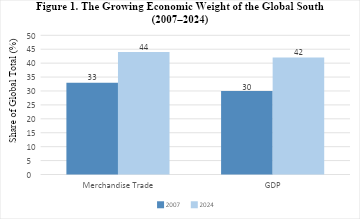
Source: UNCTAD. (2025). Trade and Development Report 2025, Figure IV.1.
As can be seen in Figure 1, the share of the Global South in world merchandise trade increased from 33% to 44%, and its share in world GDP grew from 30% to 42% between 2007 and 2024. This increasing economic significance has enhanced the ability of the Global South to contribute more actively in the provision of public goods.
The Global South as a Producer of Global Public Goods
The Global South’s growing contribution to global public goods is evident across a range of sectors. Many developing countries are not just adopting externally developed models, but creating solutions that are increasingly being adapted by others. These contributions are especially consequential as they are frequently created in resource-constrained settings and are therefore affordable, scalable, and applicable to the requirements of other low- and middle-income countries.
India’s DPI is a case in point. Platforms such as Aadhaar, the Unified Payments Interface (UPI), and recently CoWIN have shown how digital public infrastructure can promote financial inclusion, public service delivery and governance at scale. India is now providing these digital public goods to countries across Asia, Africa and Latin America through MOSIP and the Global Digital Public Infrastructure Repository, among others, marking a transition from technology adopter to technology provider.
A parallel pattern can also be seen in agriculture and clean energy. Through institutions such as EMBRAPA, Brazil has become a hub of tropical agriculture knowledge, and this expertise is making a difference in African agricultural productivity and food security. Indonesia has also been instrumental in the promotion of biofuel development and sustainable energy transitions in other developing countries. These and other such contributions highlight how innovations developed within the Global South are increasingly shaping the development agenda transnationally.
The same trend can be found in healthcare and climate resilience. Countries like India, Brazil and South Africa have scaled up their vaccine production capacities and bolstered South-South cooperation in public health, and a number of developing countries are making significant contributions to climate adaptation, disaster resilience, and sustainable development. While these examples demonstrate that the Global South is no longer a passive recipient of global development; it demonstrates that the Global South is an active producer, diffusing, and governing these public goods.
Why This Matters for Global Governance
The consequences of the Global South’s rise as a provider of public goods extend well beyond development cooperation. It signals a broader rebalancing of influence in the international system, and the emerging powers within it aren’t simply making claims for increased representation but instead are shaping development through the institutions, technologies, and policy innovations of their own.
This shift is significant also because it challenges the very architecture of global governance, which has traditionally been shaped by northern institutions and aid frameworks. South-led initiatives typically highlight demand-driven partnerships and the principle of mutual benefit and respect for national priorities, thus providing an alternative modality for development cooperation. These models are certainly not immune to criticism, especially on issues of transparency, financing practices, and ability to implement, but they expand the range of development pathways available for developing countries.
Also, the supply of global public goods strengthens the normative influence of the rising powers. Countries exporting digital infrastructure, low-cost health care solutions, climate technologies or institutional expertise that is applicable in the real world are not just sending material goods, but ideas that help shape international development agendas. In this regard, influence in the 21st century seems to be more about having the potential to offer scalable solutions to common global problems and less about wielding financial or military muscle.
With global concerns such as climate change, pandemics, food insecurity, and digital transformation requiring collective effort, the effectiveness of global governance will be influenced by a broader range of actors. The expanding role of the Global South is thus not only a change in participation, but a reconfiguration of leadership in the provision of cross-border public goods.
Conclusion
What is at stake in this transition is not only the growing economic clout of the Global South, but also its ability to shape the ideas, institutions, and solutions that define the international cooperation architecture. As global public goods such as digital infrastructure, affordable healthcare, climate solutions, and development expertise increasingly originate in developing rather than developed countries, these countries are evolving from recipients of such goods to their architects. This transformation is unlikely to represent a simple transfer of power from North to South. Rather, it points towards a more pluralistic model of global governance. If this nascent approach is to evolve into a more balanced and effective framework for international cooperation, then it must remain rooted in the principles that have long underpinned South-South cooperation: inclusivity, transparency, mutual benefit, and responsiveness to the diverse priorities of the developing world.

Archita Gaur is a postgraduate student at the School of International Studies, JNU. She specialises in the World Economy and has a strong interest in public policy, economic research, and governance. The views expressed are the author’s own.
 Dr Mohmmad Rizwan
  Kumar Satish