
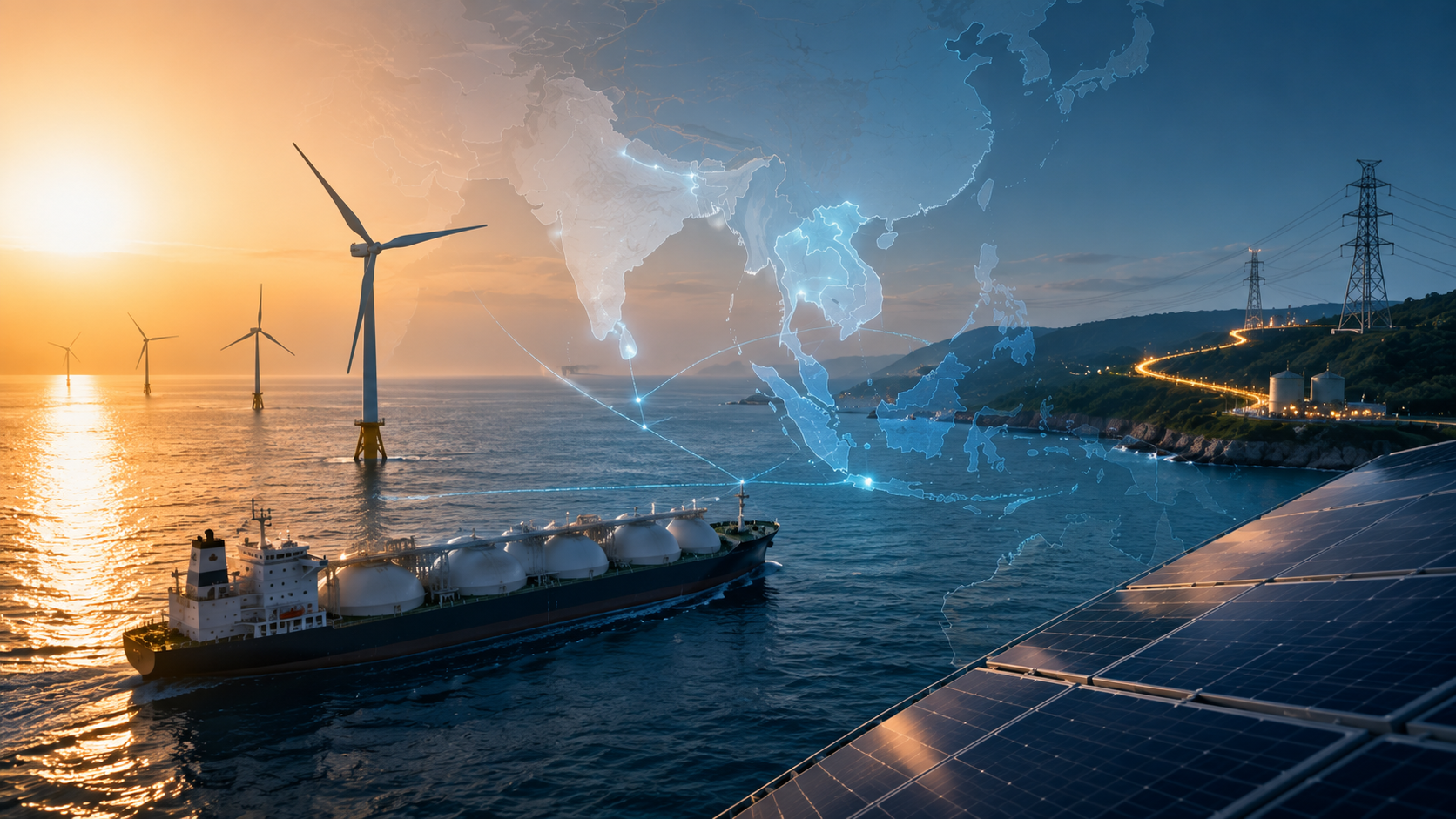
- The Bay of Bengal is emerging as more than just a strategic waterway. It is becoming an important space where energy security, maritime connectivity and geopolitical rivalry intersect.
- The Bay of Bengal is fast becoming the next big energy frontier in the Indo-Pacific.
- The Bay of Bengal is fast emerging as an important theatre of strategic competition in the Indo-Pacific. But this contest is unlike previous rivalries that have been motivated by military alliances or territorial disputes. It refers to energy corridors, subsea cables, electricity markets, renewable technologies and robust supply networks.
- The Bay of Bengal is no longer just a junction between two oceans. It is evolving into an energy frontier, where power, clean tech, maritime links and strategic competition intersect. If oil shaped the geopolitics of the twentieth century, energy connectivity may shape the Indo-Pacific order of the twenty-first.
With the global energy transition gaining momentum, the Bay of Bengal is emerging as more than just a strategic waterway. It is becoming an important space where energy security, maritime connectivity and geopolitical rivalry intersect. The Bay of Bengal has been a central focus of maritime security discourse for decades. It has mainly been viewed as a significant transit linking the Indian Ocean to the Pacific via the Strait of Malacca, facilitating approximately one-third of the world’s marine commerce and a substantial share of the world’s energy requirements. But under the surface of this classic sea story, another change is in the offing. The Bay of Bengal is fast becoming the next big energy frontier in the Indo-Pacific.
The increasing strife in the Bay is more than simply controlling hydrocarbon reserves or securing shipping lanes, as oil geopolitics did in the twentieth century. This affects more and more electrical grids, offshore renewable energy, liquefied natural gas (LNG) infrastructure, essential minerals, green hydrogen and the maritime connectivity needed to support them. As governments look to diversify energy sources and reduce dependence on fossil fuels, the Bay of Bengal is emerging as a battleground where economic progress, strategic competitiveness and the global energy transition collide.
The Geography of Energy Is Shifting
Until now, world energy geopolitics was centred around West Asia. Strategic thinking was dominated by the oil-rich Gulf states, the Strait of Hormuz and marine routes through the Indian Ocean. But with the rise of renewable energy and regional power markets, the focus is rapidly moving east. The Bay of Bengal is the meeting point between South Asia and Southeast Asia, connecting India, Bangladesh, Myanmar, Sri Lanka, Thailand and the wider ASEAN region. This place is a unique opportunity for energy cooperation. It has large offshore natural gas reserves, huge potential for renewable energy, a growing port infrastructure and increasing demand for electricity.
India’s eastern coastline is becoming more important as new LNG terminals, industrial corridors, petroleum infrastructure and renewable energy projects are being developed along the Paradip, Dhamra, Haldia, Visakhapatnam and Ennore ports. Bangladesh has increased imports of LNG as it explores for gas offshore. Myanmar has huge offshore gas reserves, despite political turmoil. These activities together are turning the Bay into a regional energy production and delivery powerhouse.
India’s East Energy Strategy
Now the Bay of Bengal has become the epicentre of India’s Act East Policy and Indo-Pacific strategy. While naval deployments and maritime security have been the focus, New Delhi has quietly increased its energy diplomacy along the eastern seaboard. The last decade saw a gradual increase in cross-border electrical trade with Nepal, Bhutan and Bangladesh. India’s renewable energy aspirations are being increasingly supplemented by hydropower sourced from the Himalayas, while Bangladesh has become a major consumer of Indian electricity.
However, these changes are not just commercial transactions. They promote long-term strategic interdependency. Highways or ports may not be used, but electrical systems need to cooperate continuously. Transmission operators match supply in real time, regulatory bodies standardise rules, and governments have a shared interest in keeping flows uninterrupted. In this sense, energy connectivity is a kind of diplomacy that is not built on political declarations, but on shared economic interests. India’s ambitions are larger. The National Green Hydrogen Mission seeks to position the country as a major producer and exporter of clean fuels. One day, eastern ports could be gateways for green hydrogen exports to East Asia, and support for the offshore wind industry and renewable-energy supply chains.
China’s energy footprint is growing.
China’s growing strategic footprint must be mentioned in any discussion of the Bay of Bengal. Through the Belt and Road Initiative (BRI), Beijing has invested heavily in regional ports, industrial zones, transportation corridors, and energy infrastructure. The Kyaukphyu deep-sea port in Myanmar and the China-Myanmar oil and gas pipelines address a longstanding strategic vulnerability for Beijing by allowing Chinese energy imports to bypass the Strait of Malacca. Chinese firms have also funded power generation projects, renewable energy infrastructure and transmission systems in Bangladesh and Myanmar. While these investments are publicly billed as economic cooperation, they actually enhance China’s long-term regional power by embedding it in key infrastructure networks.
India’s challenge is not just to match China’s financial muscle but to provide an alternative model of transparent financing, regional ownership and long-term energy partnerships.
Renewable Energy and the Changing Face of Maritime Geopolitics.
The Bay of Bengal’s strategic value now extends beyond hydrocarbons. It has a huge potential for offshore wind along its coastline and neighbouring countries are adding solar and hydro power capacity. The future of the region could be based not on oil tankers but on electricity carried by interconnected grids and subsea cables.
There are many benefits to integrating regional power. Hydropower from Bhutan and Nepal can offset India’s erratic solar power generation. Offshore wind projects off the east coast of India can meet seasonal power needs. Instead of new fossil-fuel capacity, Bangladesh could build cleaner electricity in regional markets. So we use energy cooperation to make both decarbonisation and regional stability happen. This is a more significant change in world geopolitics. In the twentieth century, energy security meant securing access to scarce fossil fuel reserves. In the twenty-first century it increasingly depends on the management of infrastructure which allows for the integration of renewable energy.
Ports Are Turning Into Energy Hubs
Ports in the Bay of Bengal are assuming completely new strategic roles. They’re more than just cargo gateways now. They are being converted more and more into LNG import terminals, renewable-energy logistics centres, hydrogen export facilities, battery manufacturing clusters and industrial hubs connected to global clean-energy supply chains.
India’s Sagarmala project is aimed at integrating port development, industrial growth and logistics. Matarbari and Payra ports of Bangladesh are going to boost the position of the country in regional energy trading. Kyaukphyu in Myanmar is strategically important due to its marine access and the pipelines which connect it to southwest China. Infrastructure is increasingly becoming the currency of geopolitical influence.
The Untapped Potential of BIMSTEC
BIMSTEC, the Bay of Bengal Initiative for Multi-Sectoral Technical and Economic Cooperation, is viewed as a smaller regional grouping than ASEAN or the European Union. But there is scope for BIMSTEC to be of most strategic value in the energy field. The member states possess complementary energy resources. Nepal and Bhutan generate hydropower. India is one of the fastest-growing renewable energy markets in the world. Bangladesh is a fast-growing electrical market. Myanmar has reserves of natural gas. Sri Lanka is investing in offshore wind and renewable energy.
Using economic interdependence, a regional power market to interconnect these economies could lower prices, improve energy security and strengthen political cooperation. Unlike SAARC, which has often been mired in political differences, BIMSTEC’s energy agenda offers a pragmatic basis for development-based cooperation rather than ideological divisions.
The New “Great Game”
The Bay of Bengal is fast emerging as an important theatre of strategic competition in the Indo-Pacific. But this contest is unlike previous rivalries that have been motivated by military alliances or territorial disputes. It refers to energy corridors, subsea cables, electricity markets, renewable technologies and robust supply networks. Who pays for the ports? Who builds the transmission infrastructure? Who provides LNG? Who’s got the battery manufacturing process under control? Who builds offshore wind? These questions are as strategically important as the deployment of navies.
Clearly, the countries that shape the region’s energy architecture will influence the region’s economic future.
India’s Moment of Strategy
India has a special role to play in this evolving scenario. With its strategic location, emerging economy, growing potential in renewable energy and as a leader in BIMSTEC, it is set to emerge as the principal energy bridge of the Indo-Pacific. But to make this a reality will require ongoing investment in transmission infrastructure, offshore renewable energy, domestic manufacturing, regional electricity markets, and robust maritime logistics. Military power will not be the sole determinant of influence in the Bay of Bengal. Strategic leadership will increasingly be decided by whoever builds the infrastructure that powers the Indo-Pacific region. The Bay of Bengal is no longer just a junction between two oceans. It is evolving into an energy frontier, where power, clean tech, maritime links and strategic competition intersect. If oil shaped the geopolitics of the twentieth century, energy connectivity may shape the Indo-Pacific order of the twenty-first.
India’s chance is obvious. Leadership in the Bay of Bengal will not be assured by naval power or diplomatic rhetoric, but by the ability to construct an integrated regional energy ecosystem that creates wealth, resilience and long-term strategic leverage.

Anusreeta Dutta is a columnist and climate researcher with experience in political analysis, ESG research, and energy policy. Views expressed are the author’s own.
 Anjali Singh
  Aayush Pal